
- News
- City News
- delhi News
- New NGT chief to tackle over 3,000 pending cases
Trending
This story is from July 14, 2018
New NGT chief to tackle over 3,000 pending cases

Representative image.
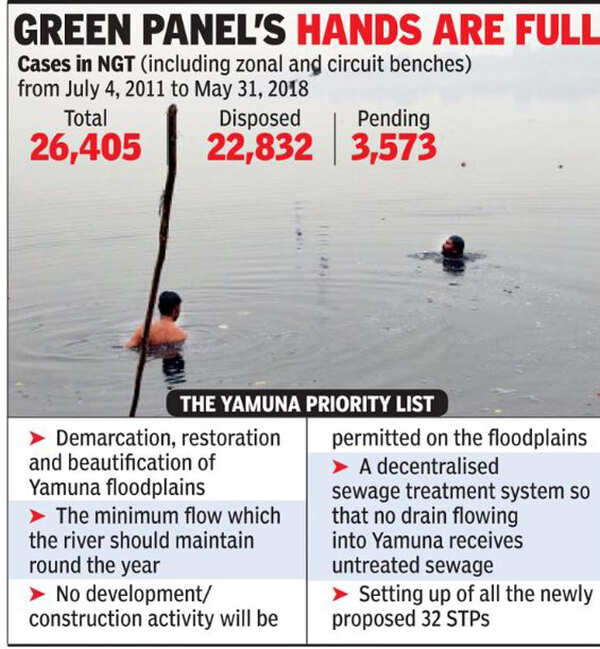
Goel, who took charge on July 8, will take up first a landmark petition on Delhi’s air pollution filed by advocate Vardhaman Kaushik in 2014. He is likely to take a call on one of the most contentious interim orders in the case this Tuesday—whether new diesel vehicles can be registered in the capital.
By the month-end, the Yamuna cleaning-up petition will be before him.

A bench headed by former NGT chairperson Justice Swatanter Kumar, who retired in December 2017, had on December 11, 2015 directed that no new diesel vehicle would be registered in Delhi till January 6, 2016.
The tribunal had ordered the Delhi government not to register any diesel vehicle because of their high particulate matter (PM) emissions. It also asked the Centre and the Delhi government to stop procuring diesel vehicles for their departments. The bench stated that there would be no renewal of registration of over 10-year-old vehicles in Delhi.
Since then, several miscellaneous applications have been filed by individuals, corporations and government departments seeking permission to procure and register diesel vehicles. However, the ban stayed.
Goel has recently asked for a case brief and a synopsis of earlier directions. “We have already submitted a compilation of earlier orders. The chairperson will be briefed on the diesel vehicle registration issue and the aspect may be resolved on Tuesday so that there is clarity on whether diesel vehicles are to be registered in Delhi,” said Sanjay Upadhyay, advocate for Kaushik.
The compilation of orders on air pollution suggested that NGT has passed over 100 directions—burning of agricultural residue prohibited, plying of over 10-year-old diesel vehicles banned in NCR, construction activities to be undertaken under stringent precautions to cut dust pollution, strict penalty on burning waste, and setting up an emergency response system based on PM 10 and PM2.5 levels in the national capital region (NCR).
While banning the registration of diesel vehicles, NGT had cited a report by Central Pollution Control Board (CPCB), which observed that each diesel vehicle causes pollution as much as 24 petrol cars and 40 CNG cars. But the Centre, particularly the Union transport ministry, had maintained that these vehicles contribute to less than 1% of PM2.5 emissions in the city. But the case is yet to be closed as it has branched out into several aspects of air pollution.
The other landmark case that Goel will hear has been filed by Yamuna activist Manoj Mishra on restoring and cleaning the river. Mishra filed the petition in 2012, but the issue, too, soon branched out into several difficult aspects of the Yamuna clean-up, including inter-state agreements on Delhi’s share in the river water. On January 13, 2015, an NGT bench gave a 100-page judgment on dealing with the pollution, ecological flow and restoration of the Yamuna floodplains.
The judgment stated that a decentralised sewage treatment network consisting 55 sewage treatment plants (STPs) would be set up to ensure each drain discharging into the Yamuna carries treated waste water. It also said an environmental flow had to be maintained in the river in consultation with the Haryana government. None of these has been implemented yet, only a few tenders for STPs in Burari have been floated by Delhi Jal Board.
Goel may dispose of some long-pending cases soon, said lawyers at NGT. Many such cases are also being heard by the Supreme Court and the high court.
End of Article
FOLLOW US ON SOCIAL MEDIA









Hot Picks
TOP TRENDING
Trending Stories
In City
Entire Website
- The Secret Behind NFL Marriages: How These Couples Make It Work
- UPI transaction limit to change from September 16! Here are the new limits for various UPI payments
- When Laura Loomer said she's single because she's too focused on Donald Trump
- South Delhi shooting: Sleuths see killing as a message to big businessmen
- Top 10 sports stars turned power couples: From Agassi-Graf to Conner-Comaneci
- 3 Zodiac Signs Most Likely to Become Multimillionaires
- Narayana Murthy faces backlash for parenting remarks on social media; users say, "after working 72 hours a week, there’s barely time left to have babies…”
- 'Would not fit in ... ': Princess Diana's brother warned Prince Harry about marrying Meghan Markle
- The 3 Strongest Zodiac Signs: Powerhouses of the Zodiac Wheel
- Dark Side Of Each Zodiac Sign
- CM Kejriwal says he will resign in 48 hours: Does this mean early elections in Delhi?
- Trump's 'mass deportation' threat evokes images of WW2 internment camps
- Will Germany’s suspension of Schengen entry end the Europe dream?
- Donald Trump 'safe' after gunshots heard nearby, campaign says
- Union minister calls Rahul Gandhi 'terrorist'; 'seek psychiatric help', says Cong
- Who could be the next Delhi CM if Kejriwal resigns?
- She called 9/11 an ‘inside job’. Why is she part of Trump campaign?
- Wipro to employees: Attend office at least 3 days-a-week or risk losing…
- ‘I Hate Taylor Swift!’: Donald Trump rages after singer endorses Harris
- 'Gambhir wasn't a friend, we were ...': Former Indian opener's bold revelation

Popular Categories
Hot on the Web
Top Trends
Trending Topics
World Largest HorseEID WishesOnam WishesPriyanka Chopra TattooKottukkaali OTT ReleaseEngineers Day WishesGoat CollectionHair LossSudha MurtyMalayalam ProducersIndia's Best Dancer 4Simi GarewalDilli BabuIndian National ParksLaung BenefitsVikas SethiApple iPhone 16Donald TrumpAadhar Card UpdateWordle Answer
Living and entertainment
Latest News
Four Zodiac Signs That Are Hard to Control'Message for Modi': Opposition takes jab at BJP over Nitin Gadkari's 'PM post' claimNetflix denies filmmaker Soham Shah’s plagiarism allegations over Squid Games, says claim holds 'no merit''Virat bhaiya's passion and dedication for the game is...': Sarfaraz KhanFather rapes and murders 8-year-old daughter in Madhya Pradesh, throws body in wellBakuchiol: Nature’s answer to youthful skin radianceSaudi Arabia footballer Fahad Al-Muwallad hospitalized after fall from balconyNeeraj Chopra misses second Diamond League title by an agonising 1 cm; finishes second behind AndersonZodiac Signs That Crave a Luxurious LifestyleRain washes out England-Australia T20I series finale"Miami Dolphins Owner Stephen Ross Eyes Multi-Billion Dollar Deal: The $7 Billion Power Play"Rajkummar Rao hails Kareena Kapoor Khan's The Buckingham Murders as a 'gripping thriller'MoS Finance likely to be convenor of GoM on GST compensation cessRole Rewind: Did you know Ranveer Singh and Deepika Padukone's love story has a strong Kareena Kapoor Khan connection?How to set up partner sharing in Google PhotosIndia, Pakistan players involved in heated exchange during Asian Champions Trophy. WatchNoida authority fraud: 2 arrested in Rs 3.9 crore scam linked to fake bank accountsGovinda’s wife Sunita Ahuja talks about losing their premature daughter at three months: ‘That’s why I brought up Yash in a cocoon’
Copyright © 2024 Bennett, Coleman & Co. Ltd. All rights reserved. For reprint rights: Times Syndication Service