
- News
- City News
- delhi News
- 'Link protected areas with major patches to enhance green fight'
Trending
This story is from June 18, 2023
'Link protected areas with major patches to enhance green fight'
A plan prepared by Indian National Trust for Art and Cultural Heritage (Intach) for enhancing climate resilience and urban biodiversity suggests that habitat value and biodiversity richness of existing greens in Delhi can be increased by creating new patches in the urban matrix and linking major patches through corridors.
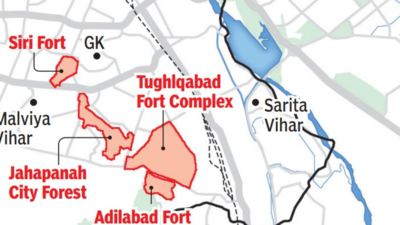
Biodiversity corridor
According to the plan, protected areas like wildlife sanctuaries and biodiversity parks can be linked with unprotected patches like large campuses, heritage sites, gram sabha lands and green belts.

The plan says isolated patches of urban biodiversity prevent gene flows through lack of corridor connectivity, resulting in vulnerable disease-prone populations of flora and fauna. However, biodiversity corridors are corridors of land planted with appropriate vegetation, enabling fauna to move across a wider territory.
Manu Bhatnagar, principal director, natural heritage division, Intach, said, "The urban biodiversity plan has been prepared to enhance ecological services from underutilised areas and by augmenting the green area network."
Giving an example of a possible corridor connectivity, Bhatnagar said, "The Hauz Khas district park can be linked on the east to Siri fort-Jahapanah city forest, which can be further connected to Tughlakabad Fort. This can be connected to Adilabad Fort-Nai ka Qila and Dr Karni Singh Shooting Range Area. On the other hand, the western side of Hauz Khas can be connected with patches like IIT campus, Sanjay Van, NCERT campus, JNU, Aravali Biodiversity Park, Shankar Vihar and Delhi Cantonment; and, then, northwards to Central Ridge and IARI campus."
The potential corridors, which can enable movement between green patches, are river banks and floodplains, bank strips of major stormwater drainage channels, large side strips along railway tracks, roadside greens, areas below major transmission lines, long and wide densely planted verges and hedgerows.
"In Delhi, there are around 50km of irrigation channels in north-west and west districts. Another example for corridor development is railway tracks like the eastward-bound line passing through Anand Vihar which has plenty of vegetated strips," says the plan.
It also emphasises on a softer greener environment utilising components of small land use, like vertical landscaping, rooftop greens and hedges, as it contributes to the ecosystem. Many campuses could serve as local nature reserves.
Intach recommends that land-owning agencies and entities can be incentivised to execute ecological plans within their precincts. Government agencies dealing with infrastructure can factor in ecological considerations, especially when dealing with the suggested corridors, it adds. "Once the proposals are accepted in Delhi, they can be extended to NCR," said Bhatnagar.
End of Article
FOLLOW US ON SOCIAL MEDIA







Photostories

Hot Picks
TOP TRENDING
Popular Categories
Hot on the Web
Top Trends
Baba Siddique Death News LiveRussell WilsonsBaba Siddique DeathMickey ArthurWho was Baba SiddiqueVirat KohliUGC NET ResultMahadev Betting AppAmazon LayoffsRatan Tata DiesCBSE Class 10 12 Practical ExamPopular Schools in Navi MumbaiManagement Colleges of IndiaTop Medical Colleges of IndiaTop Engineering Colleges of IndiaTop Pharmacy Colleges of IndiaLive Cricket Score
Trending Topics
Diwali WishesDussehra 2024 QuotesDussehra WishesVettaiyan OTT ReleaseVettaiyan CollectionVettaiyan ReviewNatasa StankovicDevara CollectionBigg Boss 18Deepika PadukoneShraddha KapoorRatan Tata Passed AwayJigra Movie ReviewVettaiyan Movie ReviewSwatantrya Veer SavarkarDussehra 2024Elon MuskDussehra Whatsapp StatusUltimate Football Codes October 2024Wordle Answer
Living and entertainment
Latest News
New Zealand pile pressure on India after routing Sri LankaSena vs Sena: Dusshera rallies in Mumbai turn political as Shinde, Uddhav take aim at each otherCan a dash of cinnamon in your coffee speed up belly fat loss?Manasi Parekh celebrates National Award win with husband Parthiv Gohil: “What a year it’s been!”Roblox dismisses claims made by Hindenburg report: "...don't support their agenda"'Procrastination greatest thief of time': HC junks 'belated case'RSS chief Mohan Bhagwat: Hindus must take lessons from Bangladesh violenceTapSwap Daily Codes for October 13, 2024: Earn coins and cryptocurrency by completing tasks2 flee Uttarakhand jail. Did they escape as Ramlila ‘vanars’ looking for Sita?Did you know NTR is the only actor to play both Lord Rama and Ravana?Leo, Daily Horoscope Today, October 13, 2024: Keep your plans and strategies to yourselfHurricane Milton triggers EF-3 Tornado in Florida's Palm Beach County, leaving seven injuredNIA charges Babbar Khalsa chief with VHP neta's murder'Ab ki baar 300 paar': Fans go crazy as India pile up 297 against Bangladesh'Really sympathetic...We want him bowling': Pat Cummins shows solidarity with Cameron Green during injury recoveryThe Great Indian Kapil Show 2: Kareena Kapoor Reveals hubby Saif Ali Khan is jealous of her bond with sister Karisma; says, “He thinks I talk to her more than him”Ranji Trophy: Bhatt, Akash Singh give Baroda 76-run lead over MumbaiEx-Delhi University professor GN Saibaba passes away
Copyright © 2024 Bennett, Coleman & Co. Ltd. All rights reserved. For reprint rights: Times Syndication Service