
- News
- City News
- delhi News
- Delhi's Gangaram hospital suffered ransomware attack last year
Trending
This story is from May 17, 2017
Delhi's Gangaram hospital suffered ransomware attack last year
While the world reels under a global ransomware attack, the capital’s Sir Gangaram Hospital too had suffered a similar breach in March last year. Three of their systems were infected with a malware called Cryptowall that encrypted all data on them, and asked for two bitcoins (which was worth around $825 at the time) to decrypt it and unlock the systems.
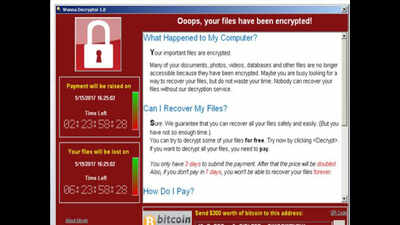
WannaCry ransomware has taken the world by storm.

The hospital’s chief information officer Niranjan K Ramakrishnan told TOI that the situation was quickly controlled as the infected systems were isolated from the networks hosting the hospital and lab information systems.
“An employee had downloaded a zipped file with the malware through personal email. That is how the system got infected. Two other machines connected with this system also got the same malware. These affected systems had a message in a text file leading that contained a link. It led to a page that asked for 2 bitcoins by a deadline,” recalls Ramakrishnan. The affected systems were on Windows XP operating system at the time. Strangely enough, says Kumar, the ransom came down to 1 bitcoin when they checked the link again after a couple of weeks.
Ramakrishnan says the hospital chose not to report the attack as the scale of the breach was small and no sensitive data were affected. Paying ransom too was out of the question. “These systems were not connected to our hospital or lab information systems. 90% of the data we had on the infected systems were backed up. We brought in a new policy where we prohibited use of external USB drives. We also isolated the enterprise network of the hospital from the external network and got an audit done. Our business was not affected,” says Ramakrishnan, adding that the hospital has now upgraded to Windows 10 -- something that had everyone heaving a sigh of relief as the WannaCry cyber offensive unfolded across the world.
“We definitely would have been in a soup had we not upgraded,” says Ramakrishnan, who has disabled internet access on hospital systems since the WannaCry attacks started. “In the last four days, people have begun to understand the importance of such measures,” he says.
Ransomware is a kind of malware that, literally, holds one’s data to ransom. The malware, once inside the system, encrypts or locks all data and asks for a “fee” to be sent to the malware creators to release the data back to the rightful owner. WannaCry is a strain of ransomware that infected systems in Europe and Asia and started spreading the world over last weekend. In India, 102 computers of the Andhra Pradesh police were compromised with WannaCry.
The current spate of WannaCry ransomware attack exploits certain vulnerabilities in Windows XP, for which Microsoft released a security update in March this year. However, the ransomware that affected Sir Gangaram Hospital last year was a different strain. It was called “Cryptowall”.
An advisory from cyber security firm Symantec says, “In Cryptowall spam campaigns, the emails usually contain a malicious attachment and include a message attempting to convince the user to download the file. The email could claim that the attachment is an invoice, an undelivered package notice, or an incoming fax report. If the user opens the attachment, then their computer will be infected with Ransom.Cryptowall.”
End of Article
FOLLOW US ON SOCIAL MEDIA











Hot Picks
TOP TRENDING
Popular Categories
Hot on the Web
Top Trends
Tirupati Laddu Case HearingIND vs BAN Live ScoreRohit SharmaIftikhar AhmedMayank YadavUGC NET Result 2024Taylor SwiftCanada Study Permit Pilot ProjectSean CombsIsraeli AirstrikeNaomi Net WorthWho is Dominik Mysterios WifeWho is Hassan NasrallahIsrael Hezbollah WarDiddyShah Rukh KhanLive Cricket Score
Trending Topics
Devara CollectionBigg Boss Kannada 11 Launch Live UpdateKangana RanautJungle SafariStree 2 OTT ReleaseRose GardenDevara CollectionOTT Release MovieMasala OmeletteEmergencyDevaraTaaza Khabar 2 Twitter ReviewDevara Movie ReviewHealthy RaitasSwatantrya Veer SavarkarColdplay India tour 2025Smartphone DealsApple Macbook Air M1Amazon SaleWordle Answer
Living and entertainment
Latest News
UP man kidnaps boy to arrange UPSC funds, heldAishwarya Rai Bachchan touches Nandamuri Balakrishna's feet as a sign of respect, the Telugu star blesses herCovid lockdown on earth led to dip in Moon's temperature: StudyFrom A.R. Rahman to Satyajit Ray: Indian Oscar winners who made historyHost Kiccha Sudeep to Bigg Boss Kannada 11 contestant Aishwarya Shindogi: Come back as a stronger personManipur CM Biren accuses Kuki militants of abducting 2 Manipuri youthsKhatron Ke Khiladi 14 winner: Karan Veer Mehra lifts the trophy and Krishna Shroff becomes the first runner-upWhat to expect after a facelift procedureFPIs buy Rs 57k crore stocks in September, flows hit 9-month highDelhi PWD to restore roads by Diwali; CM Atishi inspects Okhla as part of govt's repair drive"It sounds like they really had to squeeze responses out of Vince": WWE Hall of Famer discusses Vince McMahon's reluctance in speaking during Netflix seriesColleagues remember braveheart Delhi Police constable Sandeep: 'Would rush to crime scene alone'‘Nadikar’ OTT release: Reason why the Tovino Thomas starrer is on hold10 desk exercises for 40-plus men for a healthy lifeA killing & a tipping pointFun-filled inside pictures from Inaaya Naumi’s 7th birthday party with Kareena Kapoor, Saif Ali Khan, Taimur, Jeh, Soha, Kunal Kemmu and more family membersIndia to maintain LAC troop deployment as trust deficit with China remainsWith $3.16 Million Lost in Game Checks, Can Haason Reddick Afford to Keep Holding Out?
Copyright © 2024 Bennett, Coleman & Co. Ltd. All rights reserved. For reprint rights: Times Syndication Service