
- News
- City News
- delhi News
- Delhi government scales up food relief as crisis grows
Trending
This story is from March 29, 2020
Delhi government scales up food relief as crisis grows
Thirty-year-old Chandni collected her food packet from a government school in Neb Sarai, south Delhi, on Saturday afternoon and burst into tears. The food was hardly enough for her and her three teenage children. Her husband left her six months back and she doesn’t have cooking gas or any provisions at home. Many migrant labourers like her said they could die of hunger before the novel coronavirus got them.
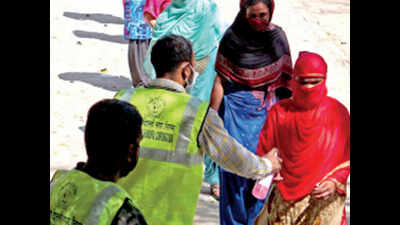
Delhi government has mounted a herculean effort to ensure that poor people don’t go hungry
A Delhi government facility working from the Radha Soami Satsang at Bhati mines has been preparing food packets for 30,000 people and distributing at 500 locations in the city.

When Chandni, who belongs to Samastipur in Bihar, opened her packet, she found three puris and aloo sabzi. “We have been waiting since the morning for this. How can four people survive on three puris?” she asked. She used to work as a labourer but now there is no work.
“They should see the number of people residing in each house and distribute the food accordingly. We do not have provisions and only people who have ration cards are able to get some. All of us are daily wage labourers or do menial jobs,” said Kiran Chauhan of the same village.
“Most of us are daily wage labourers who can neither go to work, nor return to our villages,” said Renu Gupta, collecting her share. “We live in a joint family and not everyone can come to collect but I am glad we have got something to eat.”
Though civil defence volunteers and officials made sure they sanitised the hands of people and asked them to stand apart on marked lines, as soon as the people walked out, they began huddling together for comfort.
Indu Prakash Singh, a member of the advisory panel on the food relief work, said the government has decided to attach one or two members of civil society or NGOs with each DM to attend to complaints. “A big problem is of the poor being unable to reach the centres because of the police coming in the way. We have written to the police commissioner,” he added.
Kamlesh Agarwal and his wife had come to the capital in the first week of March from Panna district in Madhya Pradesh and couldn’t even settle down before the crisis hit them. “Back home, our daughter is down with fever for the last couple of days and I just wish to return. My parents are too old to take care of her.” said Kamlesh as he sobbed, clutching a food packet at Neb Sarai.
In other areas like north and southwest Delhi, the tie-up with agencies that provide midday meals has turned out to be a boon. In north Delhi, food packets were distributed from 34 schools catering to about 17,000 people. However, with the demand increasing, 10 more schools have been added to the list. Mobile vans are, meanwhile, distributing food to people who are squatting at Singhu Border, hoping to return home.
Village pradhans and local political functionaries have been roped in in south-west Delhi to gauge demand and needs of people. Soumya Sharma, SDM, Najafgarh, said: “We provided food to around 11,000 people and are also in touch with others to ensure no one is hungry. We are also changing the menu every day.”
With 350 Delhi government schools being designated as meal distribution centres, teachers have been roped in for supervising the meals. This is under the overall supervision of the district magistrate.
End of Article
FOLLOW US ON SOCIAL MEDIA










Photostories

Hot Picks
TOP TRENDING
Popular Categories
Hot on the Web
Top Trends
Trending Topics
Kaun Banega Crorepati 16Dhanteras 2024RajinikanthThe Great Indian Kapil Show 2Salim KhanVicky Vidya Ka Woh Wala Video CollectionSomy AliNick JonasAvinash MishraBigg Boss 18PapayaKiccha Sudeep's Mother Death NewsVettaiyan CollectionBougainvillea Movie CollectionJuhi ChawlaLiam PayneTop Load Washing MachinesBest Premium LaptopsIntel LayoffsWordle Answer
Living and entertainment
Latest News
Protests in Bhagalpur over desecration of religious siteGive protection to interfaith couple, Uttarakhand HC tells policeInspiration for creativity and art through eye of the tigerSalman Khans's sister Arpita Sharma and Aayush Sharma sell their Bandra house for Rs 22 crores: ReportWho is Naim Qassem? Hezbollah leader who allegedly fled to Tehran amid fear of assassinationDelhi pollution: Air quality reaches 'very poor' levelsWhen Janhvi Kapoor recalled about the ‘hectic itineraries’ made by her dad that gave her mother late Sridevi ‘anxiety’Perplexity AI seeks $8 billion valuation in new round, WSJ saysOptical illusion personality test: Are you diplomatic or brutally honest?Centre unable to maintain law and order in Delhi: AAP on school blastRani Mukerji, Sonam Kapoor, Padmini Kolhapure and others make heads turn at Anil Kapoor-Sunita Kapoor's Karwa Chauth celebration - See photos'Vicky Vidya Ka Woh Wala Video' box office collection day 10: The Rajkummar Rao starrer sees a slight jump over the second weekend, crosses Rs 30 croreEarthquake or cylinder? Delhi's Rohini blast leaves residents rattled after loud explosionGarena Free Fire MAX redeem codes for October 21: Win in-game goodies and rewards todayLess Dons, More PuppetsNFL's Choice to Play US National Anthem in London Sparks Outrage Over Historical Hypocrisy and American ArroganceKartik Aaryan treats fans with his surprise appearance at Alan Walker's show in Mumbai; grooves to 'Bhool Bhulaiyaa 3' title track - WATCH video1st ODI: Sri Lanka beat West Indies in rain-affected match
Copyright © 2024 Bennett, Coleman & Co. Ltd. All rights reserved. For reprint rights: Times Syndication Service