
- News
- City News
- delhi News
- Crush hours in Delhi Metro: Overcrowding sparks stampede fears at key stations
Trending
Crush hours in Delhi Metro: Overcrowding sparks stampede fears at key stations
Delhi Metro passengers are increasingly concerned about overcrowding during peak hours, fearing potential stampede-like situations at congested stations like Hauz Khas. Despite high ridership, inadequate public transport options contribute to the problem, necessitating measures like increased train frequency and advanced crowd management technologies.
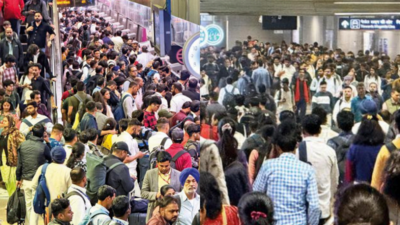
Delhi Metro is facing severe overcrowding at stations, especially during peak hours, leading to concerns about stampede risks. Passengers are urging for increased train frequency and better management of crowding.
The Hauz Khas metro station, for one, becomes extremely congested during the busy hours. There is always a fear of a chaotic situation developing due to the crowding. It is the same at many other stations.
In the aftermath of the disaster at New Delhi Railway Station on Feb 15 that took a toll of 18 lives, TOI visited various metro stations, observing significant crowding during peak hours.
In particular, the escalators were packed with passengers shoving each other while the staircases remained largely unused.
People opt for the urban train system because of the inadequacies in other public transport.
The passageway to access both the Yellow and Magenta lines at Hauz Khas metro station is one of the longest among the stations. On Friday evening, TOI found that the passageway chock-a-block with commuters in both the directions.
It was worse at the platform where a swarming mass waited to board the Magenta Line train. Among them were many who had disembarked from trains on Yellow lines, whose frequency is better than those on the Magenta Line.
Shefali Arora, who travels daily to Gurgaon, said, "The platform at Hauz Khas metro station is always very congested and any untoward incident, even a stampede, can happen. Delhi Metro should take measures to decongest the metro station."
Arnav Rastogi, a student, said he too faced inconvenience every day entering and exiting trains at peak hours at halts such as Hauz Khas, Laxmi Nagar and Rajiv Chowk. "The frequency of trains should be increased to prevent overcrowding and other measures should also be taken to manage the gathered passengers," he said.
Things were no better at other metro stations during peak hours. Most passengers complained about escalators where, at times, three people are forced to stand on each step. Satyajeet Khurana said, "Last Sunday, I almost couldn't use the escalator at Chandni Chowk station because of the huge number of people using it."
It's not only the platforms or the concourses that are crammed. Even the trains leave no space to wiggle for passengers. Aashi Singh, who travels daily from Rajiv Chowk to Shahdara, said, "I skip crowded trains and prefer the women's coach, which is more manageable space-wise."
There is no alternative for travellers trying to use public transport. In 2018, Delhi govt informed the Supreme Court that the city required 11,000 buses to meet the citizens' transportation needs. However, there are only 7,600 public buses in the fleets run by Delhi Transport Corporation and Cluster Scheme. Of these, 3,000 CNG buses are more than 10 years old. Traffic police revealed that an average of 70 buses break down every day. Besides, people have no way of checking whether or when a bus will arrive on a route.
Amit Bhatt, India managing director, International Council on Clean Transportation, said, "In central Delhi, at the Udyog Bhawan, Central Secretariat and Rajiv Chowk metro stations, queues stretch even outside the stations in the evening when all the offices get over around the same time and the security screening cannot speedily clear the flow. Similarly, there are serpentine queues at Millennium City Centre and Sikandarpur metro stations in the mornings."
There was a need to relook the system, he said. "We need to introduce technological interventions. For instance, the security checks at Dubai airport are fast and passengers do not have to take out their laptops for checking," said Bhatt. "Secondly, we should create redundant infrastructure like Hong Kong and Singapore. It means if there is a demand for two staircases, build three staircases for the smoother flow of passengers. Thirdly, we need to adopt new technologies like AI for crowd management. With the help of AI, it can be easily determined if there is a requirement to hold passengers in one area."
Bhatt admitted that bus transport wasn't delivering the way it was expected to. Gurgaon has just 150 buses when more than 650 are needed, a situation similar to Delhi in terms of demand and supply. "Apart from improving bus infrastructure, we should integrate the bus and metro train systems with pedestrian-friendly options," he said.
Stay updated with breaking news, weather updates, bank holidays and upcoming public holidays in march.
End of Article
FOLLOW US ON SOCIAL MEDIA








Hot Picks
TOP TRENDING
Explore Every Corner
Across The Globe
Oscars 2025 WinnersOscars 2025Tulsi GabbardHimani Narwal MurderUttarakhand AvalancheFlorida Resort AirspaceKilambakkam TerminalAmerican AirlinesAC Patel GujaratJohn CenaShama MohamedVolodymyr ZelenskyyDonald TrumpJD VanceEffective Strategies for Perfect TimetableTSBIE Inter 2025George P Abraham DeathWWE Elimination Chamber ResultRhea RipleyKevin OwensRoman ReignsLiv MorganThe RockErin AndrewsMicrosoft Outlook OutageBank HolidaysBank Holidays in MarchChampions Trophy ScheduleChampions Trophy Points TableICC Champions Trophy Live Streaming
Hot on the Web
Oscars 2025 LIVE UpdatesOscars 2025 Full Winners ListChia Seeds BenefitsHeart HealthIbuprofen GuideNaga ChaitanyaMagnesium Oil BenefitsViral KohliAloe VeraJackie ShroffOptical illusionSpiky Green FruitVineet Kumar SinghBhagyashreeRegrow HairAnjali AnandShalini PandeyGenelia D'SouzaChhaava Box Office CollectionAnujaSadhguru Diet HabitsAshwagandha for Hair GrowthMorning Brain ExercisesUS National ParksUnique AnimalsBig Cat Safari DestinationFatty Liver Reducing FoodsBig Cats IndiaBaby Girl NamesDates Benefits
Trending Topics
Rob GronkowskiBrady TkachukTaylor SwiftJoe BurrowBrett FavreNBA Offseason RumorsGisele BundchenLebron JamesTaylor Swift RelationshipTravis KelceLuka DonicBlake LivelyCarlos CorreaAnthony EdwardTom BradyAuston MatthewSimone BilesMHT CET LLBUS National Anthem BooedVivian RichardNyt ConnectionsKing Legacy CodesDa Hood CodesWordle HintsNyt StrandsXiaomi 15 UltraIndia vs New Zealand ScorecardChampions Trophy Points TableChampions Trophy ScheduleICC Champions Trophy 2025 Live Streaming
Popular Categories
HeadlinesSports NewsBusiness NewsIndia NewsWorld NewsBollywood NewsHealth+ TipsIndian TV ShowsTechnologyICC Champions TrophyIPLTravelEtimesHealth & FitnessHollywood NewsWeb SeriesWWEUS NewsNFLHow to watch IPL 2025How to watch IPL in CanadaHow to watch IPL in USACBSETechnology NewsInternational SportsAstrologyPublic HolidaysBank HolidaysIndia vs New ZealandWeather Today
Latest News
Renowned urologist George P Abraham found dead at farmhouse in KeralaAfrican rock python: The snake species that hunts in packs – physical traits, diet, habitat, and moreSunita Williams return to Earth: Know the health challenges astronauts face on long space missionsSSC GD Constable 2025 provisional answer key to be out soon at ssc.gov.in: Check important details herePrague Masters Chess: Praggnanandhaa and Aravindh Chithambaram maintain lead after draw in fifth roundViral: German Shepherd sacrifices his life to save owner from tiger attackWatch: On World Wildlife Day, PM Modi takes a Lion safari at Gir National ParkUS commerce secretary proposes separating government spending from GDP reportsClash erupts between TMCP and AIDSO during students' strike in West BengalList of all WWE Superstars and their reaction to John Cena's Heel TurnWhat happens when you drink 1 cup Anjeer Water on an empty stomach dailyTiming in the market: Why rupee cost averaging is a winning strategy for long-term investors'Asked to delete posts': Congress pulls up party leader for 'fat' remark on Rohit SharmaCalisthenics to powerlifting: Women embrace strength, endurance, agilityAxar Patel finds 'self-belief' in his journey as an all-rounder6 benefits of drinking Okra water with lemon every morning‘Medical Miracle’ first look out! ‘Premalu’s Sangeeth Prathap to make his debut as leadChampions Trophy: 'Varun Chakravarthy could be India's trump card in semi-final against Australia'
Copyright © 2025 Bennett, Coleman & Co. Ltd. All rights reserved. For reprint rights: Times Syndication Service