
- News
- City News
- delhi News
- Child rights panel to grade 5,800 schools
Trending
This story is from September 5, 2018
Child rights panel to grade 5,800 schools

Representative image
According to commission officials, the grading will be done on the basis of four umbrella parameters — security, teaching, community involvement and social inclusion.

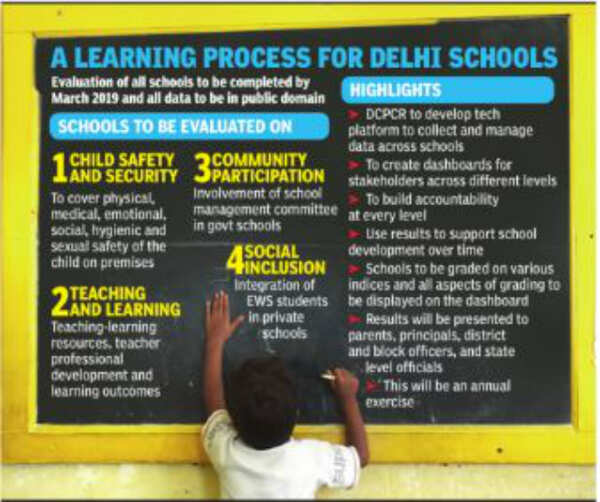
Under security, a large part of the framework will be based on guidelines set by the directorate of education. Further, aspects of sanitation and health will be included in the framework. Through the teaching and learning index, the commission wants to monitor learning outcomes and evaluate how academically sound the infrastructure of a school is to provide the student appropriate standard of education. The assessment will be done through a sample size collected from each school, until Class VIII. Beyond that, the commission will take help of an NGO to assess the students through a designed assessment tool. For higher board classes, the CBSE results will be taken as indicators.
Simultaneously, student-teacher ratio, student-classroom ratio teach-vacancy status and section-teacher ratio will be used to evaluate under this index, among other parameters. The community participation index will be based on the frequency of PTA meetings, attendance in these meetings, SMC involvement and EWS student integration.
Security aspects like fire safety will also be scrutinised. According to commission sources, at least 200 schools in the capital are yet to get fire safety certificates.
Once the survey is done, the commission, with the help of some NGOs, will visit schools and carry out a ground survey. This exercise is expected to start in December and continue for three months. The final report and grading will be released in March 2019. This coincides with the time several parents start looking at schools for admissions.
If found defaulting, local bodies and agencies will also be held accountable. “For example, if a school has garbage strewn over the campus, the principal alone won’t be held responsible. What if the actual problem is that the school has no safai karamcharis?” said Anurag Kundu, a DCPCR member and chairman of the working group committee for the grading exercise.
End of Article
FOLLOW US ON SOCIAL MEDIA











Hot Picks
TOP TRENDING
Popular Categories
Hot on the Web
Top Trends
Caleb WilliamsBilkis Bano CaseAnne AllanVince McMahon Netflix DocuseriesIPL Player RetentionHigh Paying Freelance JobsSean CombsIsrael Hezbollah WarNEET UG Paper Leak CaseKerala Lottery ResultsTamil Nadu NEET UG CounsellingTirupati LadduWest Bengal Teacher RecruitmentSoudi Al Nadak IslandParam Rudra SupercomputersKerala Bans Study NotesLive Cricket Score
Trending Topics
Living and entertainment
Latest News
Police add forgery, corruption charges against 17-year-old in Pune Porsche crash case“Goodbye Meta AI”: How over 600,000 people, including celebrities, fell for a fake message on Facebook, Instagram'It's been done 5 times already': Supriya Sule's jibe at PM Modi on Pune Metro inaugurationHC raps CCP for evicting 2 from fish mkt buildingTravis Kelce Shares His Excitement for His Acting Debut in Ryan Murphy’s Mystery Thriller GrotesquerieRhea Ripley’s husband comments on how much time she has left in the ringNayanthara and Vignesh Shivan share emotional notes on their twins Ulag and Uyir's second birthdayIsraeli strikes kill 600, displace 90,000 as Lebanese civilians flee in DesperationNavya Naveli Nanda reacts to Kolkata rape-murder case, calls for accountability and safer spaces for womenArijit Singh apologizes to his female fan as the security guard held her neck during his UK concert: 'I could not protect you'World tourism day 2024: Recreate your favourite filmi moments at these locales'Hezbollah doesn’t want you to watch this video': IDF exposes hidden weapons in Lebanese homes in a post‘Laughter Chefs Unlimited Entertainment’:Team Ankita Lokhande and Team Jannat Zubair clash in culinary combatSearching for synthetic opioid rescue agents: Identification of atoxifent as a potent opioid agonist with reduced respiratory depressionKrithi Shetty shares a sneak peek of her birthday celebration - SEE PICSChennai court acquits customs officer in diamond misappropriation caseSaif Ali Khan admits that the ‘Adipurush’ controversy was 'unsettling'; says “you need to stay away from religion...'Valpoi torrential rainfall sets record, crosses 200 inches
Copyright © 2024 Bennett, Coleman & Co. Ltd. All rights reserved. For reprint rights: Times Syndication Service