
- News
- City News
- dehradun News
- Village resident ends abusive marriage, is now Swiggy’s 1st woman delivery exec in Uttarakhand
Trending
This story is from July 27, 2023
Village resident ends abusive marriage, is now Swiggy’s 1st woman delivery exec in Uttarakhand
Nayak Gotha is a remote village nestled in Tanakpur region of Uttarakhand’s Champawat district, a good 25 km away from the sub-district headquarter Poornagiri. Here, Manisha Bohra Singh, 31, mother of two daughters aged seven and four, sets out early in the morning, daily, on a bike, and delivers items for online food delivery platform Swiggy. Singh, the first female delivery executive of Swiggy in Uttarakhand, is an inspiration to her two young daughters, the 3000 odd residents of her small village and the rest of Uttarakhand. She walked out of an abusive marriage in Ghaziabad a couple of months ago and returned to her hometown. In order to support herself and her young children, she enrolled with Swiggy as a deliverywoman. She now earns around Rs 15,000 per month.
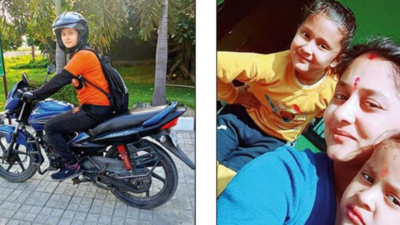
Singh had learnt how to ride a bike from her father and decided to take the job of a deliverywoman. Her daughters, five and seven, understand the demands of her work

Singh had married Mahendra Singh, a resident of Ghaziabad, Uttar Pradesh, and employee of a private company in Noida, in 2015. Her husband frequently beat her. After her second daughter’s birth in 2019, the beatings resulted in a miscarriage. That is when she decided to leave. In January this year, she moved back to Uttarakhand, to Udham Singh Nagar district headquarters Rudrapur, banking on some friends working in the Pantnagar industrial area. She tried to get work there, but being unable to care for her children at the same time, was unsuccessful. She then returned to her native village.
Singh eventually got to know that Swiggy was hiring delivery persons. She had learnt how to ride a bike from her father and decided to take up the job. Singh, who has now spent around half a year on the job, recalls that it was difficult at first. “I was very nervous on the first day. I kept calling my colleagues for guidance. However, it got easier within a week,” she says.
“I start working at 7am every day and work till late at night, riding over 150 kilometres daily on my bike. My daughters and young and would rather have me by their side at home. But surprisingly, they understand the demands of my work and are very supportive,” Singh said.
She added that her husband had threatened to file a false case against her and she is now thinking of going to police and complaining against him.
Swiggy’s team leader of UP (West) and Uttarakhand, Shivam Aggarwal, said, “Manisha was the first woman delivery person hired by Swiggy in Uttarakhand. Now, there are five others. To ensure a safe working space for them, we provide gender-sensitive training and support, addressing harassment complaints promptly and offering flexible schedules. We want a more inclusive and diverse workplace and want to give equal opportunities to women.”
Another woman who works for Swiggy in Dehradun said anonymously that the job, regarded as unconventional for a woman, does come with its challenges. “We face safety concerns, long working hours and even harassment and gender discrimination. We often deal with late-night deliveries, unsupportive customers and limited access to restrooms. That said, the company does work to ensure our well-being.”
Zomato, which also has a considerable presence in Uttarakhand, is also considering recruiting more female delivery agents. The company had employed five women delivery agents, who left due to personal reasons.
The company’s assistant manager, Samarjeet Singh, said, “We are organising walk-in interviews and hope women apply for delivery roles. Zomato aims to break traditional gender stereotypes associated with this line of work.”
Rajnish Batra, a women and children’s rights activist from the city, said that “traditionally, the women in Uttarakhand have never shied away from taking up difficult or unconventional work to support their families”.
“The women of this hill state are known for their indomitable spirit and strong desire to support their families by whatever means available, even if it means stepping out of conventional boundaries. You will find many women tour guides, handicraft business owners, hotel or eatery owners here. The government must provide vocational training to women, especially those that are married, so they can enhance their skills and be self-reliant.”

About the Author
Aakash AhujaEnd of Article
FOLLOW US ON SOCIAL MEDIA










Photostories
Hot Picks
TOP TRENDING
Popular Categories
Hot on the Web
Top Trends
Israel Hezbollah WarMost Runs in International CricketVirat KohliIND vs BAN Live ScoreRohit SharmaIndian Team Fastest Test FiftyMohammed SirajUGC NET Result 2024TS DSC Results 2024Women T20 World Cup Points TableWomen T20 World Cup ScheduleShane McMahon Net WorthHezbollah ChiefTourists Not AllowedDiddyTop Management Colleges of IndiaLive Cricket Score
Trending Topics
Devara CollectionMithun ChakrabortyKangana RanautNavratri WishesGandhi Jayanti WishesAnant AmbaniDevara CollectionGandhi Jayanti 2024Masala OmeletteEmergencyDevaraTaaza Khabar 2 Twitter ReviewDevara Movie ReviewHealthy RaitasSwatantrya Veer SavarkarColdplay India tour 2025Smartphone DealsApple Macbook Air M1Amazon SaleWordle Answer
Living and entertainment
Latest News
iVoomi S1 Lite e-scooter launched at Rs 84,999: 180 km range, three-year warranty!Tata Nexon turbo CNG: Variant-wise features with price explainedPMI in India intensifies efforts against Illicit Tobacco Trade to Safeguard Economic Interests and Consumer ProtectionMumbai vs Rest Of India: Irani Cup tie offers chance for hopefuls and rejects to impress selectorsOlivia Culpo and Christian McCaffrey buy George Clooney's mansion for $14.5 millionKaun Banega Crorepati 16: Amitabh Bachchan believes he is 'Half-Sikh' recalling his maternal roots; reveals his aunts called him 'Amitabh Singh'RG Kar case: Kolkata court extends judicial custody of ex-principal, suspended cop till October 4When Dikembe's shoe size astonished the Mumbai Temple guardHow can Ben Stokes and other overseas players avoid a two-year IPL ban?"Nothing he was doing was believable", Darby Allin picks names wrestler who benefited most from AEW All In 2023 backstage incidentColleagues remember braveheart Delhi Police constable Sandeep: 'Would rush to crime scene alone'5 ways insecurity can ruin a relationshipBengaluru resident exposes fake Flipkart agent attempting to deliver bogus iPhone 15; read online reactionsBihar and Jharkhand among top two states enrolling for contributory pension scheme for farmers"Tyler Huntley’s 'Snoop' Nickname: The Rapper Connection Explained”BTS star V crowned 'Most Handsome Man in the World 2024'Decoding a bowl of Idli Sambhar: From calories to nutrients4 members of notorious robbery gang held in crackdown by Ghaziabad police
Copyright © 2024 Bennett, Coleman & Co. Ltd. All rights reserved. For reprint rights: Times Syndication Service