
- News
- City News
- chennai News
- Hema's bun or Sadhana cut our ancients had them all
Trending
This story is from April 3, 2016
Hema's bun or Sadhana cut our ancients had them all
To create awareness about ancient hair-styles, the Archaeological Survey of India (ASI) has been conducting a travelling exhibition, now at Fort Museum, of more than 100 photographs of hair-styles of men and women in Indian art from the Indus Valley Civilisation.
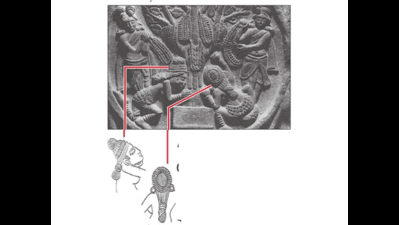
To create awareness about ancient hair-styles, the Archaeological Survey of India (ASI) has been conducting a travelling exhibition, now at Fort Museum, of more than 100 photographs of hair-styles of men and women in Indian art from the Indus Valley Civilisation.

Now, to create awareness about ancient hair-styles, the Archaeological Survey of India (ASI) has been conducting a travelling exhibition, now at Fort Museum, of more than 100 photographs of hair-styles of men and women in Indian art from the Indus Valley Civilisation.
"Hair has been associated with charm, rank, power and aristocracy. In Indian art, arranging hair in an attractive manner and decorating it with flowers, beads, ribbons remains an interesting subject to study . Ancient literature narrates fine descriptions of various methods of coiffures. The idea of this exhibition is to trace the root of a great tradition thorough photographs and sketches taken from the archives of the ASI," said Neeti Anilkumar, curator of the exhibition.
"Kesa-vinyas": Hair-styles in Indian Art" puts on display a kaleidoscope of coiffures in Indian art beginning from the Harappan to the medieval period. "Apparently, no civilization in the world barring the Indus Valley Civilisation maintains a continuous tradition when it comes to maintenance of hair. Also, no other civilization has probably invested so much imagination, thought and artistic genius in the art of hair-dressing. Not only the lay person, the cosmic or divine figures have also been identified with their peculiar type of hair-do. Siva and Parvati wore matted hair or 'jata' while Karthikeya had a tri-sikha kind of coiffure. Buddha himself is signified by curly hair," said Neeti.
Rare photographs and sketches of sculptures and paintings from sites such as Ajanta, Amaravati, Bhubaneswar, Halebidu, Khajuraho, Mathura, Patan and Vellore have been exhibited in chronological order. It's the second venue of the travelling exhibition after the first stop at New Delhi's Red Fort a couple of months ago.
Braided glory:
Hair tied in long pleats was a fashion during the Vijayanagara era. It's still popular among women in south
Divine style:
"Worship of Bodhi tree", a panel created during the Satavahana era in Bharhut, Madhya Pradesh (top). The panel shows hair that is looped and loosely knotted and further embellished with flowers and turbans.
End of Article
FOLLOW US ON SOCIAL MEDIA










Photostories

Hot Picks
TOP TRENDING
Popular Categories
Hot on the Web
Top Trends
World First Top 10 TrillionairesVinesh Phogat Election ResultTravis KelceElection Results 2024Haryana Election ResultJason KelceJammu Kashmir Election Result 2024Israel Hezbollah WarHardik SinghAakash ChopraAssembly ElectionJammu Kashmir Election Winners ListGurgaon Election ResultHaryana Election Winners ListLive Election ResultFaridabad Election ResultLive Cricket Score
Trending Topics
Tulsi KumarBigg Boss Tamil 8 Contestants ListAjay DevgnNavratri Colours 2024Sanjay Leela BhansaliDurga Puja 2024Bigg Boss 18 House PhotoDevara CollectionBigg Boss 18Deepika PadukoneShailesh LodhaDevaraGovinda NewsNational Film Awards 2024Swatantrya Veer SavarkarColdplay India tour 2025Watch NFL Live StreamDress To ImpressCall Of Duty Black Ops 6Wordle Answer
Living and entertainment
Latest News
Ambala Cantt Assembly Election Result 2024: BJP's big gun Anil Vij defeats Chitra Sarwara by over 7000 votes5 must follow rules of Ayurveda to lose 5kg in 30 daysUniversity of East Anglia Introduces £4,000 Scholarship for Indian Students: Explore Courses, Eligibility, and BenefitsTodd Phillips explains SHOCKING CLIMAX of 'Joker: Folie à Deux', reveals Arthur Fleck acceptance of his true identityThe Power of Navratri: Honoring Goddess Durga and Manifesting DesiresAlia Bhatt just cannot keep calm on watching 'Singham Again' trailer, says 'all the dynamite in one frame' for the big multi-starrer led by Ajay Devgn3 reasons why Jimmy Uso can betray Roman Reigns and join forces with Solo SikoaThis is the stock trading app linked to Rs 500 crore investment fraud; YouTubers Elvish Yadav, Bharti Singh among 5 summonedMonetary policy committee meet: RBI moving closer to rate cutIndian branded pharma sector to see a decline in growth: ReportFrom spending habits to hiding reality: What each zodiac sign is likely to lie about2024 Haryana assembly election result: 5 reasons why BJP's victory is significantKathua (SC) Assembly Election Result 2024: BJP's Dr Bharat Bhushan wins by 12,177 votesTaylor Swift surpasses Rihanna in Music Rich list: A look at her impressive net worthAlexander Zverev scrapes through, set to face David Goffin at Shanghai Masters pre-quartersRoh Yoon Seo shines as a supportive sister in 'Hear Me: Our Summer'Best TVs Of 2024 In India: Top Picks For Every BudgetSuhana Khan pens a fun caption directed to Shah Rukh Khan and Karan Johar along with picture of ‘birthday girl’ Gauri Khan
Copyright © 2024 Bennett, Coleman & Co. Ltd. All rights reserved. For reprint rights: Times Syndication Service