
- News
- City News
- chennai News
- 40 years, and a lot to ‘croc’ about!
Trending
This story is from July 29, 2016
40 years, and a lot to ‘croc’ about!
As The Madras Crocodile Bank Trust and Centre for Herpetology celebrates their eventful journey of 40 years, we join them on a trip down memory lane, and also get a low-down on their current activities.
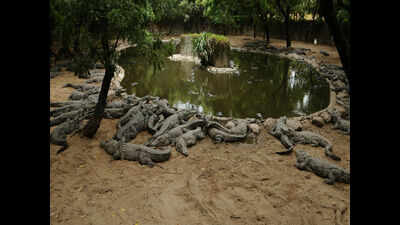
As The Madras Crocodile Bank Trust and Centre for Herpetology celebrates their eventful journey of 40 years, we join them on a trip down memory lane, and also get a low-down on their current activities.
Looking back...

The founder of the crocodile bank, Romulus Whitaker says that it all started with the increase in popularity of the Chennai Snake Park Trust after it was moved to Guindy from Rajakilpakkam near Tambaram. “The tremendous success of the snake park made a couple of us think about other reptiles and their conservation, as well. And that’s when I chanced upon a crocodile at an aquarium in Chennai. It was kept in a case which was only the size of the crocodile. So, we asked them if they would want us to take care of it at the snake park. They readily agreed, and that's how we got the first ever crocodile. That was a male crocodile and soon, we got a female one, too. Both were muggers (Indian marsh crocodiles) and we put them together. Soon they mated and within months the female laid a clutch of eggs,” he shares.
The first successful breeding of crocodiles at the snake park was a big boost for Romulus to get totally involved with their conservation. “Back then, we hadn’t really heard about crocodiles being bred in captivity in India. So, when we managed to do that, it made us more enthusiastic about conservation. Incidentally, wildlife and conservation was also just beginning to become a big thing in India then. So, couple of us decided to go around India and find the numbers of crocodiles in different habitats. We found that the numbers of three Indian species — gharials, muggers and salt-water crocodiles were quite bad because of several reasons. So, we thought we should do something to stop them from getting extinct. And that's how we set up The Madras Crocodile Gene Bank at Vadanemmeli, near Mamallapuram. Now, we have done away with the word 'gene' in the name. In the later years, we started getting more crocodiles from different parts of the country, and abroad. Now, out of the 23 different species of crocodiles in the world, we’ve 17 of them here,” informs Romulus.
The main attractions at the croc bank
As years passed by, the crocodile bank further expanded its conservation activities to other reptile species, too. And that saw new species like turtles, tortoises and iguanas making their way into enclosures at the crocodile bank. Among the crocodiles, the main attraction is a 45-year-old salt-water crocodile called Jaws III. “This 17ft long and 700kg crocodile is the largest crocodile in captivity in India,” says Yamini Bhaskar, the assistant director of the crocodile bank. She adds, “Jaws is definitely one of the main attractions here. Every Sunday he is fed 5kg of meat. We do public feeding for him when visitors are here. Then he comes out of the water and keepers toss meat to him.” Aldabra giant tortoise, which is the second largest tortoise species in the world, is another eye-catcher at the bank. “They grow up to 5ft in length and 3ft in height. We’ve four of them. They are still very young and yet to grow to their full sizes. The biggest among the four weighs around 85kg,” reveals Yamini. The countless number of marsh crocodiles in one of the enclosures is a sight to behold. “Actually there are two such enclosures with 400 marsh crocodiles in each of them,” says Yamini. Talking about a few other species, she shares, “We also have three iguanas, though only two of them are on display at the moment. Also, everyone come asking about the anacondas that we have. Sadly, anacondas are misrepresented in the movies. Firstly, they don’t grow that big as they are shown in the movies. They can actually grow only up to six meters, but they put on a lot of weight. They are the world’s heaviest snakes. Now, we’ve anaconda babies, too. The newest addition is the komodo dragons. We’ve got four of them and now we are awaiting an appropriate enclosure to put them on display.”
Researches, projects and future plans
Apart from conservation and exhibition of reptiles, the croc bank is also involved in other projects and researches. The crocodile bank co-founder and director, Zai Whitaker, says, “Right now we’ve three field stations where different projects are being underway. One is on the banks of the Chambal River for the study on gharials, another one is in the Western Ghats, for king cobras. The third one is in the Andaman Islands for projects related to marine biology. Also, we have volunteer programmes for which we get a wide range of people as volunteers, including students from Indian colleges, as well as from those abroad. Apart from this, both Nikhil Whitaker and Ajay Karthik from the curatorial department are researchers. They study the behaviour of the reptiles.”
Meanwhile, the croc bank is also ready with a master plan for the future. “There are some requirements laid out by the Central Zoo Authority. Apart from that, we are also planning a few things like making the exhibits at the crocodile bank much more exciting. For that we’ve plans to have non-reflective glasses for some enclosures, better lighting techniques to cut down reflection to enhance visibility. We are also hoping to bring about a change in the signage,” informs Zai.
End of Article
FOLLOW US ON SOCIAL MEDIA





Photostories

Hot Picks
TOP TRENDING
Popular Categories
Hot on the Web
Top Trends
IND vs BAN Live ScoreIsrael Hezbollah WarMost Runs in International CricketVirat KohliRohit SharmaIndian Team Fastest Test FiftyMohammed SirajUGC NET Result 2024TS DSC Results 2024Women T20 World Cup Points TableWomen T20 World Cup ScheduleShane McMahon Net WorthHezbollah ChiefTourists Not AllowedDiddyTop Management Colleges of IndiaLive Cricket Score
Trending Topics
Devara CollectionMithun ChakrabortyKangana RanautNavratri WishesGandhi Jayanti WishesAnant AmbaniDevara CollectionGandhi Jayanti 2024Masala OmeletteEmergencyDevaraTaaza Khabar 2 Twitter ReviewDevara Movie ReviewHealthy RaitasSwatantrya Veer SavarkarColdplay India tour 2025Smartphone DealsApple Macbook Air M1Amazon SaleWordle Answer
Living and entertainment
Latest News
Sagittarius, Daily Horoscope Today, October 1, 2024: A day of inner peace and happinessAquarius, Daily Horoscope Today, October 1, 2024: Optimism in the airBasic Home Loan raises Rs 87.5 crore in a Series B funding roundMallikarjun Kharge's remarks on PM Modi distasteful, disgraceful: Amit ShahPriyanka Chopra shares charming throwback pictures of her transformation from 9 to 17 years old: 'Not a girl, not yet a woman'HC stays probe against Sitharaman, others based on FIR linked to poll bondsTapCoin daily bounty cards for October 1, 2024: Earn tokens, exclusive rewards and moreLaughter Chefs: Rahul Vaidya shares a fan's heartfelt message for them; Chef Harpal Singh Sokhi breaks down in tears, 'My sister was in ICU...'Gemini, Daily Horoscope Today, October 1, 2024: Day of hard work and focus'Terrorism has no place in our world': PM Modi tells Israel's NetanyahuBhuvan Bam: Digital creators can thrive in mainstream cinemaSplitsvilla X5’s Siwet Tomar and Anicka Sharma call it quits? The two unfollow each other on social mediaLamborghini convoy stuns Mussoorie: 71 cars on hill steal the spotlightKolkata hospital rape-murder: West Bengal junior doctors resume 'total cease work'Mumbai vs Rest Of India: Irani Cup tie offers chance for hopefuls and rejects to impress selectorsHow to use charcoal powder to whiten teethKaun Banega Crorepati 16: Amitabh Bachchan believes he is 'Half-Sikh' recalling his maternal roots; reveals his aunts called him 'Amitabh Singh'WWE Superstar CM Punk responds to the passing of legendary singer Kris Kristofferson
Copyright © 2024 Bennett, Coleman & Co. Ltd. All rights reserved. For reprint rights: Times Syndication Service