
- News
- City News
- chandigarh News
- Stubble burning continues unabated in Haryana
Trending
This story is from November 9, 2017
Stubble burning continues unabated in Haryana
The Haryana government’s claims of making efforts to stop stubble burning have been belied by the fact that farmers continue to indulge in it without caring about its consequences. Farmers continue to burn stubble without any fear of being punished. In other words, they are in the practice fearlessly.
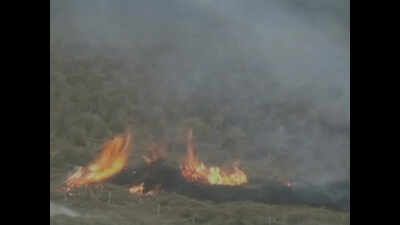
Stubble burning in Haryana continues even as pollution levels rise in the region and neighboring states. (Photo: ANI)
A TOI team in Ambala district found farmers burning stubble without any fear of punitive action from the authorities.

Ambala’s CMO Vinod Gupta said smog led to respiratory diseases during this time every year. “The people suffering from asthma need to take extra precautions during these days. An asthma patient may even die due to the smog,” Gupta said.
Farmers on the other hand, claimed helplessness and regretted lack of alternatives other than stubble burning. Said Mahindra Singh, a farmer, “If we do not burn the stubble, seeds of the next crop do not get mixed in the soil, following which we suffer losses. The government should provide farmers with an alternative,” Singh alleged.
He added that marginal farmers could not afford machines to manage the stubble. “Moreover, why does the government only keep a watch on stubble burning and not the pollution emitted out by the industries,” he alleged.
Meanwhile, ADGP Haryana R C Mishra said that they had received directions from the government to lodge a complaint against the violators. However, he was not specific about the number of challans issued to farmers.
Agricultural research scholar, Jaspreet Singh Randhawa, said, “There are two methods to manage crop residues. One is ‘In-situ’ and the other is ‘Ex-situ.’The machine costs about Rs 10 lakh.”
End of Article
FOLLOW US ON SOCIAL MEDIA








Photostories

Hot Picks
TOP TRENDING
Popular Categories
Hot on the Web
Top Trends
Hurricane MiltonRatan Tata NewsNew UPI Transaction LimitRatan Tata DiesPM ModiShantanu NaiduTom BradyStock Market TodayNarayana MurthyNitish Kumar ReddyIsrael Hezbollah WarRahat Tata Inspiring QuotesManagement Colleges of IndiaTop Medical Colleges of IndiaTop Engineering Colleges of IndiaTop Pharmacy Colleges of IndiaLive Cricket Score
Trending Topics
Diwali WishesBigg Boss Tamil 8 Contestants ListBhool Bhulaiyaa 3 TrailerVettaiyan Twitter ReviewSanjay Leela BhansaliVettaiyan ReviewSalman KhanDevara CollectionBigg Boss 18Deepika PadukoneShraddha KapoorRatan Tata Passed AwayColdplayVettaiyan Movie ReviewSwatantrya Veer SavarkarDussehra 2024Watch NFL Live StreamDress To ImpressRatan Tata DeathWordle Answer
Living and entertainment
Latest News
How Chennai Night Race swerved past challenges to zoom toward a brighter motorsports futureAll-Star Tower Defense (ASTD) Codes October 2024Who is Noel Tata? Meet Ratan Tata’s half-brother, who could be successor at Tata TrustsHow to make Ginger Turmeric Shots for seasonal changeWhen Amitabh Bachchan slept on Marine Drive with rats as neighbours: I didn’t have a place to stayHanging Lights For Living Room: Transform and Illuminate Your SpaceICC Women's T20 World Cup: Harmanpreet Kaur, Smriti Mandhana, bowlers demolish Sri Lanka as India get NRR boostOnly a true creative genius can spot the odd unicorn in 12 seconds!Ratan Tata no more: When his throwback pic had netizens saying he looked like a Hollywood star'Vettaiyan' Twitter review: Rajinikanth shines in this investigative thriller'Vettaiyan' early and first review: Rajinikanth starrer has a good twist!CATS YouTube codes for October 10, 2024: Enhance your gameplay and know how to redeem the codesKarnataka BJP chief hints at CM Siddaramaiah’s possible exit amid 'fast-paced political changes'DaRon Bland’s Return: Could He Be the Key to Reviving the Cowboys’ Defense?Exploring the link between spirituality and mental health on World Mental Health DayAAP alliance could've helped Congress in Haryana, but just to boost its tally by 3Unsolved for centuries: 5 ancient mysteries that defy explanationShehnaaz Gill reacts to Ratan Tata's demise during her interaction with the paps: 'Joh hua accha nahi hua'
Copyright © 2024 Bennett, Coleman & Co. Ltd. All rights reserved. For reprint rights: Times Syndication Service