
- News
- City News
- bengaluru News
- Will the person with the saddest story speak up?
Trending
This story is from October 13, 2019
Will the person with the saddest story speak up?
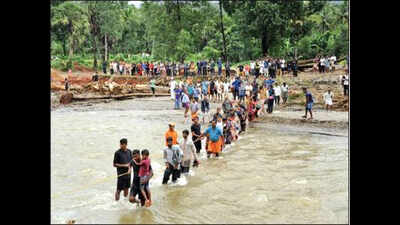
DISASTER REPORT: How often do reporters make people who have suffered pose like mannequins so that they can exploit their losses?
The question in the title of the book was yelled out by a British correspondent in the early 1960s to a crowd of refugees fleeing the war-ravaged Congo.

Today too, when tragedy strikes and TV crews shove a microphone in the victims’ faces, and ask them, “How do you feel?” or “What do you make of it?” there is a strong hint of the nihilism about news reporting. Should they really be asking those questions?
A Hindi film made in 2010, Peepli Live, parodied this tendency. At its centre is a poverty-stricken farmer who plans to commit suicide hoping his family will get government compensation. But as word spreads, hordes of national television reporters and technicians pitch tent outside the house. Politicians too rush there, hoping to reap votes. And the village is soon suffused with a carnival-like buzz. The director takes a dig at the media’s herd behaviour driven by cut-throat competition. And of course, its inbuilt scepticism.
Demands of the rat race apart, not all newspersons can deal with trauma victims. Many years ago, a teenage rape survivor discovered she was pregnant and insisted that she won’t go in for an abortion, ignoring repeated requests from her family. A young reporter in Bengaluru made it to the one-room house in which the girl lived with her parents and siblings. She had, though, been advised by a social worker to talk only if the teen showed signs of interest in the conversation. Inside, the reporter was met with the girl’s cold, transfixed stare. For a whole five minutes, the girl sat in stony silence.
“Would you like to talk to me?” the reporter asked.
“……”
The girl cleared her throat, but didn’t say anything. The reporter thought it wise to let her be. She came back two or three days later, but the situation hadn’t changed a bit. The girl wouldn’t speak to anyone else, other than the social worker. Ethical practice indeed calls for restraint and demands that victims of tragedy be treated with compassion. There are even questions whether you should talk to a teenaged victim at all.
But aren’t news strategies inspired by audience expectations? Also, isn’t the new tribe of citizen reporters spurred by the need for social media transmission? With news forming a big component of popularity ratings index, shouldn’t every emotional angle be explored? Wouldn’t a victim’s version help in getting relief from authorities?
Old-timers often spoke of “showcasing poverty” in documentaries. Films Division newsreels captured famine with the visuals of weeping women and children while violins wailed on the soundtrack. It wasn’t so much an era of soundbites. Nobody asked upsetting questions such as, “Is this the worst that you have seen?” or leading ones like, “Would you call this gross negligence on the part of the government?”
There are stereotypes too: of TV crew asking farmers squatting on cracked lands to stare blankly at the sky; of holding a framed photograph of a departed member of the family; or of pointing at empty pots by the oven. In drought-stricken places, the insensitivity can appear more pronounced. An apocryphal story goes that a couple of reporters sporting sunglasses and carrying water bottles, got off an SUV to talk to a couple of village elders. At first, the men mistook them for officials from the district headquarters, but later brushed them off, saying: “Get us some water to drink.”
At the core of every interaction with a victim/survivor is the question: why should she talk to you? Is it right to badger a person who’s experiencing post-traumatic stress disorder with more questions? Are we overstepping our boundaries when we talk to families and friends at funerals or hospitals? What constitutes aggressive or intrusive reporting? Are we using appropriate language in mentioning the tragic incident? How long does it take to build trust with the victims or their dear ones? In our eagerness to get a story, can we overlook basic decency?
Reporting conflict, crime or disaster doesn’t always allow one enough time to think of moral guidelines. Edward Behr writes that he faced other contingencies too. As he put it: “In my world notebooks are lost, tape recorders jam, taxis break down in remote places, and on my way to the revolution, noisy children throw up in crowded planes.”
By the way, the title of his memoirs for the US edition in 1978 wasn’t “Anyone Here Who’s Been Raped…” It was a more staid – “Bearings: A Foreign Correspondent’s Life Behind the Lines”.
End of Article
FOLLOW US ON SOCIAL MEDIA










Hot Picks
TOP TRENDING
Trending Stories
In City
Entire Website
- What is the Cost of Studying Medicine at a Private College in India?
- Missiles in living room: Israel releases photos of Hezbollah’s arms in civilian homes
- It's YEET time! - Rikishi shares Rhea Ripley's dance moves over Jey Uso's WWE Intercontinental title victory
- 'Jahil log': Pakistan's Basit Ali slams home curators after India's win over Bangladesh
- 'Diddy List': Names of celebrities connected to Sean Combs viral
- When Kamala Harris denied Kimberly Guilfoyle a job: 'She called and pretended to be...'
- Why Earth will have two moons from September 29 to November 25
- 'Grave insult': Atishi's 'Bharat'-like gesture with CM chair for Kejriwal angers Congress, BJP
- PM Modi meets Ukraine President Zelenskyy for second time in a month, reaffirms India's support for peaceful conflict resolution
- Apple MacBook Air M1 to be available on Amazon for Rs 49,990; know how to grab the deal
- Badlapur locals happy with ‘encounter’ of sexual assault accused Akshay Shinde, distribute sweets
- Muda case: Will not hesitate from facing probe, says CM Siddaramaiah on HC order
- Tired, judged and always catching up: Modern parenting’s only getting harder
- 'NRI business is fraud': SC junks Punjab govt's plea against HC verdict
- When Mohinder Amarnath called BCCI selectors 'a bunch of jokers'
- Lebanese journalist hit by Israeli missile while live on air; watch video
- Why renaming Port Blair as Sri Vijaya Puram is a mockery of history
- Apple cuts price of iPhone 15 & iPhone 14 models, here's new price list
- Exclusive: Rishabh Pant is biggest match-winner for India, says Kaif
- Gangster Raja gunned down: A look at his modus operandi involving juveniles

Popular Categories
Hot on the Web
Top Trends
Trending Topics
Living and entertainment
Latest News
CG Vyapam admit cards released for HELT24 and FF124 exams at vyapam.cgstate.gov.in: Direct link to download hereSupreme Court: Must stick to timeline for UAPA sanctionSEBI fines Anil Ambani’s son Rs1cr for loan approvals without 'due diligence'Swara Bhasker-Fahad Ahmad's daughter Raabiyaa turns one; see how the doting parents celebrated the special day with cake, balloons and moreFamily kills rape survivor, frames 'rapist' out on bailAPPG pushes for Ayurveda integration in UK’s healthcare systemBorder Gavaskar Trophy: When Steve Smith had a 'brain fade' moment against IndiaBest Time To Upgrade To 4G & 5G Tablets: Lightning-Fast Performance At Unbeatable PricesEssential tips for building and maintaining a happy marriageWhen and where to watch England vs Australia 3rd ODI: Date, time, venue, squad, broadcast detailsThe Luckiest Zodiac Signs: Who's Got the Midas Touch?BJP plans protests over reopening of ‘old cases’When Remo D'Souza opened up about his heart attack and revealed how Salman Khan stayed in constant touch with his wife over the phoneWB ANM, GNM result 2024 out: Direct link to download rank card hereYour daily career horoscope: 24th September 2024Tirupati Laddoo Controversy: What is Beef Tallow and why was it addedVince McMahon Breaks Silence on Netflix's 'Mr. McMahon'"Tom Brady's problem, and ours, is his voice": Tom Brady Faces Criticism From ESPN Analyst For His Broadcast Skills
Copyright © 2024 Bennett, Coleman & Co. Ltd. All rights reserved. For reprint rights: Times Syndication Service