
- News
- City News
- bengaluru News
- Song of the morning
Trending
This story is from January 24, 2021
Song of the morning
Composed around 1430 AD, the Suprabhatam has retained its hold on the minds of devotees all over India, not least because of MS Subbulakshmi’s iconic rendition. After all, how many hymns are sung to wake a sleeping God?
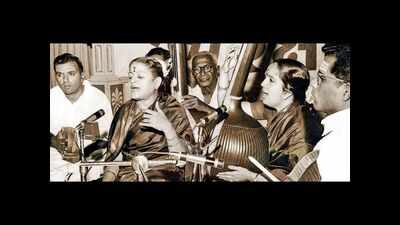
All over South India, and in many parts of the north, the recital of the Suprabhatam marks the dawn of a new day.
If you take a walk through the streets of some of Bengaluru’s residential areas, a little before dawn, when birdsong is just beginning, you will see the occasional house with the lights on in the kitchen.

All over South India, and in many parts of the north, the recital of the Suprabhatam marks the dawn of a new day, and nowhere more so than at the temple of Lord Venkateswara at Tirumala.
Suprabhatam
Every night, the Bhoga Srinivasa Murthy – the silver replica of the main deity at the temple – is laid to bed. And in the early hours of the next day, the idol is brought back to the Garba Griha, to listen to the prayers of the devotees who come to Tirumala for a glimpse of the deity.
The Suprabhata seva is the first seva of the day at the temple. According to the temple website, “This ritual is performed at Sayana Mandapam inside sanctum sanctorum to wake up the Lord from His celestial sleep, amidst the rhythmic chanting of vedic hymns.” The first of the hymns begins with the words “Kausalya Supraja Rama…”
The famous opening verse of the Suprabhatam comes from Valmiki’s Ramayana, chapter 23 of the first section, the Balakaanda. Rama and Lakshmana are with their guru, the sage Viswamitra, and are asleep in his ashram. Viswamitra uses these words to wake them up, asking the princes to get ready to face the Sometime last year, Parthasarathy Venkatesh was having coffee with a close friend in a restaurant in Jayanagar. Venkatesh, who had just given up a corporate career to pursue other interests, had been learning Sanskrit. The two friends’ conversation turned to the Suprabhatam. Venkatesh’s friend, who had never heard of the prayer before, took issue with the contention that it was probably the most widely known prayer in South India. To prove this point, he went around the café, asking customers if they had heard of it.
Every single person there knew the prayer.
“I have heard the Suprabhatam in the unlikeliest of places,” says Venkatesh, who would go on to write a book on the hymn. “I once heard it being played on a truck, somewhere in the middle of the Rajasthan desert, early in the morning,” he says.
Stotram
When he was in class IV, in 1960, KS Ramamurthy’s father bought home a radio. “It was a huge luxury in those days,” says Ramamurthy. “Every Saturday, at around 7:00 am, my father would switch on the radio, in time for the Suprabhata recital by MS Subbulakshmi, and he would ask me to listen as well,” says the former All India Radio newsreader. Now, at 68, he has been working on a booklet about the Suprabhata, and the contribution of Karnataka to the temple at Tirumala. “The Suprabhatam was composed by Prativadhi Bhayankaram Annan - born Hasthigirinathar, in 1361. He was one of the disciples of Manavala Mamu-Suprabhata, most prayers at the Venkateshwara temple were conducted in Tamil. Mamunigal asked his disciple to compose a prayer in Sanskrit, and the is how the Suprabhata became a part of prayers there,” he says.
Hindu religious texts can be classified as stotras - which are sung, and shastras - which are recited. The Suprabhatam is a stotra, and while MS’s rendition of it is the best-known version today, the hymn has been sung for centuries.
Prapatti
One of the main reasons for the popularity of the Suprabhatam was its regular broadcast on All India Radio. “My grandmother and mother practiced every day in advance of the recording,” says Viswanathan Shrinivasan, son of Radha Viswanathan and grandson of MS Subbulakshmi. “One thing that helped them was that they already knew Sanskrit - they had been taught Sanskrit by Professor Veezhinathan, the head of the Sanskrit department at Madras University,” he says.
“In December 1958, AIR announced that for the Vaikunta Ekadasi festival...the Sri Venkatesa Suprabhatam would be broadcast,” writes Venkatesh in his book - named after the hymn- and he believes that it may have been the first time the performance of the Suprabhatam on radio.
Most of the people involved in the recital and recording are long gone, but Shrinivasan notes that he was there. His mother was pregnant with him, and since she had been practicing the Suprabhatam during her pregnancy, she would name the child Shrinimavathi if it was a girl.
“The gramophone recording of the Suprabhatam was first released for sale by President S Radhakrishnan in 1963,” says Venkatesh. “Radhakrishnan’s speech talked about the difficult times facing the country - this was, after all - just after the Chinese aggression. And he hoped that works like the Suprabhatam would remind people about the core values and help them find solace during times of trouble.”
Mangalasasanam
The hymn is divided into four parts: the Suprabhatam ,a Sanskrit term that means “auspicious morning”; stotram: songs of praise;prapatti: songs of surrender to the lord; and mangalasasanam, songs of glory. And maybe the nature of the song - and its definitive recital - itself holds key to its longevity.
“If you listen to the Suprabhatam, you will find that it has no particular metre - no particular tala,” says Shrinivasan. “But it sounds like it has a tala,” says Shrinivasan. “It’s testimony to the amount of hard work that went into the recital,” he says. “If you listen to MS’s version of the Suprabhatam - its a perfect melding of rhythm and simplicity,” says Ramamurthy. “Even a layman can appreciate its beauty.”
“Before MS Subbulakshmi’s performance, the Suprabhatam used to be recited at Tirumala by PV Ananthasayanam. However, AIR decided that a prayer in praise of the most popular deity in India could be only be sung by the most popular classical artist of the time,” says Venkatesh.
For Quiz, go to Times of India
End of Article
FOLLOW US ON SOCIAL MEDIA








Hot Picks
TOP TRENDING
Trending Stories
In City
Entire Website
- Travis Kelce Net Worth 2024, Current Salary and More
- Jordan Love Luxurious Lifestyle: Expensive Properties, Net Worth, Car Collections and more
- Watching, downloading child pornography are offences under POCSO Act: SC
- Tirupati laddu controversy: Former TTD chairman moves SC, seeks probe into lab report
- EXCLUSIVE | Rohit Sharma to Akash Deep after no-ball drama: 'Aage badh, hota rehta hai'
- Coldplay India tour 2025: Band announces new show in Mumbai; check dates, how to book tickets and more
- Kerala lottery results: Win Win W-788 winners for 23 September 2024; first prize Rs. 75 lakhs, second prize Rs 5 lakhs and third prize Rs. 1 lakh
- Withdrawal symptoms: IMD issues orange alert for Tue
- Without these two players, India can't form a Test playing XI: Kamran Akmal
- Tamil Nadu to develop city's own 'Central Park' on 118 of 160 acres of MRC land
- Amit Shah's remarks on Bangladesh migrants deplorable: Dhaka
- Rate of unemployment unchanged at 3.2% in year ending June 2024
- Why do Indians glorify overwork even if it kills them?
- Family kills rape survivor, frames 'rapist' out on bail
- 3 railmen held for cooking up sabotage plot to earn rewards
- 356 killed as Israeli air strikes hammer Lebanon
- As Sri Lankans swing left, will India get another hostile neighbour?
- Uncademy CEO: 'Didn’t clear JEE. But got the Coldplay tickets…'
- Male VC’s unannounced girls hostel visit triggers protests
- Jharkhand excise staff fitness test claims one more; toll 16

Popular Categories
Hot on the Web
Top Trends
Tirupati Laddu ControversyPM Modi US Visit LiveAkash DeepEY Employee DeathRishabh PantIsrael Hezbollah WarVirat KohliAnura Kumara DissanayakeJetblue Flight Emergency LandingRyan RouthAwadhesh PrasadUGC NET ResultBengaluru Mahalakshmi MurderRohit SharmaBadlapur School Sexual Assault CaseShoaib AkhtarLive Cricket Score
Trending Topics
Laapataa LadiesZodiac SignsBigg Boss 18The Great Indian Kapil ShowChia SeedS ShankarOptical IllusionSharp Eye TestChiranjeevis FarmhouseSana KhanDevaraStree 2 CollectionAnupam MittalHealthy RaitasUrvashi RautelaColdplay India tour 2025Best Laptops For CodingPM Narendra ModiAnupam MittalWordle Answer
Living and entertainment
Latest News
SCERT Assam DElEd PET result 2024 declared at scertpet.co.in: Direct link, steps to downloadCathay Pacific bans two passengers as seat-reclining dispute turns 'xenophobic'Why tea and biscuit combination is bad for healthWhen Nitanshi Goel revealed she missed class 11 exams for 'Laapataa Ladies' promotionsOlivia Munn and John Mulaney welcome second daughter via surrogateBigg Boss Tamil 8: VJ Jacquline to participate in the upcoming season?TOI Dialogues: How Kanpur plays pivotal role in UP growth story? Experts weigh inToyota is building a car for NASA's Artemis III mission, and this is how it will look likeSupreme Court: Must stick to timeline for UAPA sanctionYour Birth Chart Explained: Unlocking the Secrets of Your Cosmic BlueprintGoogle CEO Sundar Pichai after meeting PM Narendra Modi in US: “He pushed us to continue..”Family kills rape survivor, frames 'rapist' out on bailAlia Bhatt reveals Ranbir Kapoor sings Malayalam lullaby 'Unni Vavavo' to daughter Raha Kapoor: 'She cues, ‘Mumma vavo, papa vavo’'Sean 'Diddy' Combs music streams jump after arrest and indictmentHow Sachin Tendulkar became 'The Little Master'Amid Odisha custody abuse row, Puja held at police station; CCTVs installedEncounter underway in Chhattisgarh-Maharashtra border area: PoliceBest Time To Upgrade To 4G & 5G Tablets: Lightning-Fast Performance At Unbeatable Prices
Copyright © 2024 Bennett, Coleman & Co. Ltd. All rights reserved. For reprint rights: Times Syndication Service