
- News
- City News
- bengaluru News
- Congress, BJP spin guarantees’ FORTUNE WHEEL
Trending
This story is from March 26, 2024
Congress, BJP spin guarantees’ FORTUNE WHEEL
Karnataka's election battleground features guarantees as Congress and BJP clash over promises. Siddaramaiah leads Congress against economic injustice, while BJP focuses on PM Modi's achievements. The state forms Guarantee Schemes Implementation Authority to oversee promises.
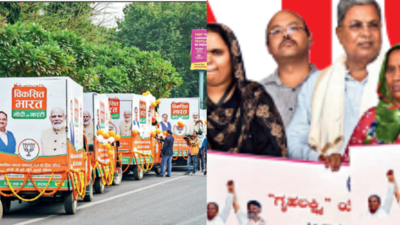
Image used for representative purpose only
Congress, confident after implementing its five guarantees, has been banking largely on these promises, besides others such as persistent accusations of economic injustice being meted out by the Centre to Karnataka.

Chief minister Siddaramaiah, pushing the northsouth divide rhetoric, had led a delegation to Delhi to protest the issue of unfair devolution of taxes and the state assembly subsequently passed a resolution castigating the Centre.
Many factors may have weighed in on the decision to make guarantees the main poll issue in Karnataka, primary among them being Congress’ prospects in other states. For instance, the rhetoric that Uttar Pradesh is eating into Karnataka’s development may work well in local elections but could cost the party dearly in the northern state.
Recently, deputy CM and KPCC president DK Shivakumar recited his own Kannada poem that translates to: “Five fingers make a fist. Five guarantees make the Hand (Cong) strong. With five guarantees, the petals of the Lotus (BJP) withered. And the Lady Farmer (JDS) dropped the bundle of paddy.”
The govt even formed a ‘Guarantee Schemes Implementation Authority’ complete with a president and four vice-presidents at the state-level and committees at the district and taluk-level to oversee roll out of its schemes. Congress women wing president Pushpa Amarnath, also a vice-president of the authority, told TOI that the principal objective is to ensure no beneficiary is left out. “On average, the schemes have reached more than 85% of beneficiaries,” she said.
Shivakumar, leveraging this, said: “All office bearers of the authority will be given election responsibilities too.” Siddaramaiah, whose Feb 16 budget earmarked Rs 54,000 crore for guarantees, has used many guarantee conventions for stump speeches.
On the other hand, BJP is banking on the charisma and rhetoric of PM Narendra Modi, positioning itself as the party of ‘Modi ki Guarantee’ – a guarantee of “development, progress, and decisive leadership”. It plans to particularly showcase promises that the PM has already fulfilled.
V Sunil Kumar, BJP state general secretary and cam paign committee convener, told TOI: “In this guarantees vs guarantees battle, we’ll show voters how Congress is robbing the same families it’s claiming to be assisting. While they give meagre benefits, they’re hurting families by increasing stamp duty, liquor prices and milk prices just to name a few. Compared to that, PM Modi has delivered by providing gas cylinders and tap water and building homes.”
BJP did not go the guarantees way during last year’s assembly elections, but it did leverage schemes during subsequent elections in five states — Chhattisgarh, Madhya Pradesh, Rajasthan, and Mizoram — lending some importance to Congress’ “guarantees” mantra by countering it with ‘Modi ki Guarantee’. In those battles, Congress’ benefit-push campaign worked only in Telangana. Now, to counter ‘Modi ki Guarantee’, Congress has announced 25 new guarantees — five each under the five ‘Nyay Pillars’ — at the national level, in line with Rahul Gandhi’s Bharat Jodo Nyay Yatra.
One could draw parallels of this electoral dynamic of guarantees gaining pan-India status with the unexpected success of Kannada movie ‘Kantara’. Just as ‘Kantara’ transcended its regional origins and captured the imagination of a broader audience, the Karnataka model of guarantees has shown the potential to shape national political discourse.
But just as with movies, electoral strategies lend themselves better to post-result analysis that affords the luxury of hindsight. To predict voter behaviour is best avoided.
End of Article
FOLLOW US ON SOCIAL MEDIA






Hot Picks
TOP TRENDING
Trending Stories
In City
Entire Website
- UPS vs NPS Calculator: Is A Switch From National Pension Scheme to Unified Pension Scheme Really A No-Brainer? Check Calculations, Benefits - Top Points
- Top 10 sports stars turned power couples: From Agassi-Graf to Conner-Comaneci
- UPI transaction limit to change from September 16! Here are the new limits for various UPI payments
- Protests by Hindu groups in Shimla continue despite mosque demolition
- Schools to be closed tomorrow in these states: Here’s why
- 9 Inspirational Quotes Every Student Should Embrace for Academic Success
- 'We can be political rivals but ... ': BJP's reaction on minister's Rahul 'No. 1 terrorist' remark
- Donald Trump Jr dumps fiancee Kimberly Guilfoyle for Bettina Anderson?
- Trump vs Kamala polls latest: Harris gains from post-debate bounce
- NEET PG counselling schedule 2024 delayed: Why candidates moved to Supreme Court, hearing dates and other latest updates
- 'Kejriwal will be back', says Atishi; BJP questions CM-designate's 'background'
- 'Congress, its ecosystem angry': PM Modi over Ganesh Puja with CJI
- How ‘Oxford returnee’ Atishi became chief minister of Delhi
- Kolkata top cop, 2 health officials replaced by Mamata govt
- 'No glorification of bulldozer justice': SC bans demolition till Oct 1
- Jugraj Singh's late strike hands India record 5th Asian Champions Trophy title
- Did doctors humiliate Mamata, or did she make it an ego issue?
- Reliance Jio confirms outage, here’s what the company said
- Kejriwal resigns as Delhi CM, Atishi stakes claim to form govt
- Sukanya Samriddhi Yojana: What are the latest guidelines for SSY accounts? Check here

Popular Categories
Hot on the Web
Top Trends
Dominique PelicotUS Fed Rate CutIndia vs China Champions TrophyUPI Transaction LimitWhere to Watch India vs China Final Hockey MatchUPS vs NPS CalculatorKolkata Commissioner Manoj VermaNEET UG Admission CriteriaAtishiKolkata Doctor Rape CaseArvind Kejriwal Resignation LiveAli Khamenei TweetSuryakumar YadavVince McMahonTech LayoffsDonald TrumpLive Cricket Score
Trending Topics
Living and entertainment
Latest News
Pankaj Kapur is proud of son Shahid Kapoor’s film choices, calls him ‘the finest actor in the country’Mukhtar Ansari died of heart attack, not poisoning: UP's Banda district magistrate's report4 types of tea to improve gut health and ease digestive issuesMemeFi daily codes for 17 September 2024: Boost your earnings with daily codes and know how to maximizeKhatron Ke Khiladi 14: Shalin Bhanot hosts a fun party for his co-contestants Krishna Shroff, Abhishek Kumar, KaranVeer Mehra and othersDecoding how log analytics systems are enabling brands to derive maximum value from dataSebi U-turn: Pulls note blaming 'external elements' for staff stirAnother Mpox suspected case in India: Man showing symptoms admitted to hospitalTaurus, Daily Horoscope Today, September 17, 2024: Anxiety and stress diminishLiza Colon becomes 1st Latina to win Best Supporting Emmy AwardSelena Gomez recreates practiced applause she learnt from TV show Friends after losing at Emmys 2024Former WWE superstar is no longer listed on their internal rostersBeyond Paychecks: Job satisfaction, work-life balance more important than salary for Gen Z workforceThrowback: When Sunita Ahuja showered love on husband Govinda, 'A superb son, brother, and a very good father...'‘You is sleep or you can sleep’: Students prank Benglauru’s ‘pookie professor’ in viral videoHow ‘Oxford returnee’ Atishi became chief minister of DelhiWhy more couples aged 50 or older are getting divorcedThese are the most toxic fresh produce of 2024
Copyright © 2024 Bennett, Coleman & Co. Ltd. All rights reserved. For reprint rights: Times Syndication Service