
- News
- City News
- allahabad News
- Allahabad: A temple at Sangam city has Geeta embossed on its walls
Trending
This story is from January 23, 2020
Allahabad: A temple at Sangam city has Geeta embossed on its walls
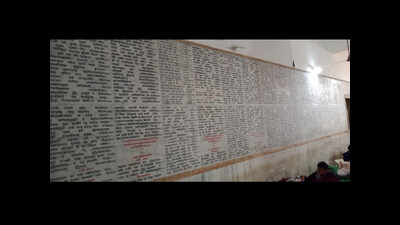
On the limestone slab, nine chapters of Geeta have been written while the other nine chapters on the opposite side of the corridor wall.
The highlight of this temple, located within the Falahari Baba ashram, is the walls of the main corridor. The two walls of the corridor have in writing the entire 18 chapters of Bhagwat Geeta.

This ancient temple, which is over 100-year-old, was earlier in shape of a cave in which Brijwasi Baba used to practice Tap (austerity) to please his deity Lord Krishna. It is said that during the same period Tapasvi Swami Ram Charan Das Ji Maharaj arrived in the cave shaped temple in search of his deity and with the permission of Brijwasi Baba, he installed the Shivlinga and henceforth the temple is known to be one with having two deities Krishna and Shiva.
With the passage of time, idols of several God and Goddesses were installed in the temple but Swami Ram Charan Das always wanted to temple to be associate with Shrimad Bhagwat Geeta.
He even laid the foundation stone of a temple of his dream, having Geeta as its central theme but since he left his human body in 1991, the agenda took to backstage.
Now, his dearest disciple Swami Ram Ratan Das, who looks after the temple administration, decided to fulfil the dream of his Guru.
“My guru always wanted to associate the temple with Lord Krishna and Bhagwat Geeta and hence the same now stands as a main theme of the temple for which the main wall of the temple’s corridor has 18 chapters of Bhagavad Geeta is carved on the limestone slab,” said Swami Ram Ratan Das.
He further informed that a team of over 150 artists, mainly from Rajasthan and adjoining areas were roped in and they wrote the slokas in Sanskrit, chiselling the curves of the Sanskrit alphabets so that it remains for ages.
“Had we used the black ink on the sandstone, it could have faded in couple of years but now that the slokas are embossed on the limestone, it will remain intact till the time this temple remains,” added Swami Das.
On the limestone slab, measuring over 50-feet of the each side of the corridor, nine chapters of Geeta have been written while the other nine chapters on the opposite side of the corridor wall.
“I have been a regular visitor to the temple and now the corridor with Geeta on its wall will quench my thirst of knowledge, when I will pray to my deity and recite his preaching at the same time,” said Uma Shankar Pandey a local resident of Naini area.

About the Author
Rajiv ManiEnd of Article
FOLLOW US ON SOCIAL MEDIA










Hot Picks
TOP TRENDING
Trending Stories
In City
Entire Website
- Why has the iconic Tupperware Brands filed for Chapter 11 bankruptcy?
- Meerut Metro: India’s ‘Fastest’ Metro Service Unveiled! Check Top 10 Features, Stations, Route & More
- Several people feared trapped after house collapses in Delhi's Karol Bagh
- 'Putting an end to all the masala': Virat Kohli and Gautam Gambhir leave fans stumped
- Massive tech layoffs at Apple, Dell, IBM are a wake-up call for IT professionals: Why upskilling is the key to survival
- 'Biggest security breach': 1000s of pagers explode across Lebanon, many Hezbollah fighters hurt; 9 dead
- Maharashtra schools closed on Sep 18: Here’s why
- Schools to be closed tomorrow in these states: Here’s why
- 'Prophet Muhammad who taught us to...': Pakistan batter Babar Azam turns to faith amid poor form
- Sukanya Samriddhi Yojana: What are the latest guidelines for SSY accounts? Check here
- 3-5 grams explosives, 5,000 pagers: How Israel carried out covert strike on Hezbollah
- 'One nation, one election' cleared by Union Cabinet
- What IPO-bound startups learnt from Paytm’s costly mistakes
- Indus Water Treaty: India serves formal notice to Pak, seeks modification
- 'Subah bheege badam khate ho?': Virat to Gambhir
- Govt approves Chandrayaan-4 expansion with Rs 2,104cr allocation
- Why Isro needs a new approach to realise its lunar ambitions
- Fired techie shares his 'survival story' on LinkedIn, post viral
- J&K phase 1 polling: 50.65% voter turnout recorded till 3 pm, says EC
- Security threat! When NZ called off Pakistan tour

Popular Categories
Hot on the Web
Top Trends
India Fastest Metro ServiceVince McMahonNPS Vatsalya LaunchDonald TrumpKolkata Doctor Rape CaseShreyas IyerTaiwan PagersGautam Gambhir Press ConferenceUGC Net ResultVirat KohliSukanya Samriddhi YojanaIsrael Hezbollah WarNEET UG Admission CriteriaDelhi CM's ListPager Attack in LebanonDMK StalinLive Cricket Score
Trending Topics
Diljit DosanjhsLuxury BrandAbdu RozikKhatron Ke Khiladi 14Chinas EggBigg Boss 18Sunita AhujaGoat CollectionSalman Khan FarmhousePitra Paksha 2024CheetahsKangana RanautAditi Rao HydariDalljiet KaurHoliday DestinationVikas SethiBest Selling Earbuds Under 1000Apple iPhone 16 ProVirat KohliWordle Answer
Living and entertainment
Latest News
Throwback: When Aishwarya Rai said that dignity is 'extremely precious' to her; 'The way I have been brought up.....'Shilpa Shetty just rolled out the latest sari trend 'a rainbow sari''Could restore sight': FDA grants 'breakthrough status' to Musk’s Neuralink 'Blindsight' implant. What it meansCM Punk to Step In as Guest Referee for NXT Title Match at WWE NXT Chicago EventWaterborne disease cases spiked after flood in VadodaraThe man who wants to 'cancel' Adani from Sri LankaSuriya to play the antagonist in 'Dhoom 4', here's what we know11 get new lease of life with organs from two in SuratMrBeast aka Jimmy Donaldson, Amazon sued by ‘Beast Games’ contestants over sexual harassment and chronic mistreatment allegations - reportsAmazon India appoints new country headBigg Boss Tamil 8: Actress Sachana Namidass to participate in the upcoming season?India 'very big abuser' of trade ties with US, says Donald TrumpJr NTR's 'Devara: Part 1' to have early morning showsGrieving mom's heart-wrenching letter blames toxic culture for daughter’s deathRicky Ponting is new Punjab Kings head coachA lot at stake as Mohun Bagan get ready for Asian footballWhy am I feeling irritable? Common causes of mood swings and how to manage themPoonam Kaur calls out MAA over inaction on Trivikram complaint amid Jani Master allegations
Copyright © 2024 Bennett, Coleman & Co. Ltd. All rights reserved. For reprint rights: Times Syndication Service