
- News
- City News
- ahmedabad News
- Women cyclists connect India’s East to West
Trending
This story is from February 22, 2022
Women cyclists connect India’s East to West
They began from Kibithoo, the last town on the Indo-China border in eastern India on a cycling expedition on January 27.
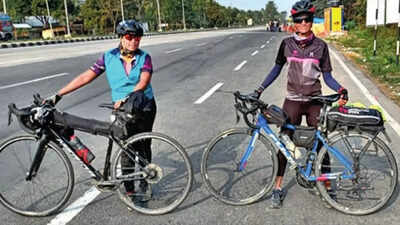
Never before has a pair of women cyclists travelled from India’s eastern-most town to the last town on the western borders of the country. The cyclists reached Bhuj late on Monday evening
Covering between 150 to 175 kilometres every day, depending on the kind of terrain they were passing through, the Bengaluru-based cycling duo will achieve a unique feat on Tuesday.

Meera Velankar, 45, who has been cycling for the past 10 years and is among India’s top long-distance cyclists, said that cycling from India’s eastern-most town to the last town on the western coast with another woman cycling has been extremely satisfying “I have done long distance trips with male cyclists earlier, but this expedition has truly been challenging and satisfying,” said Velankar. In 2020, Velankar and Dikar Patil, an ex-serviceman, completed the 6,263km golden quadrilateral route on a tandem bicycle.
Earlier, she also completed a Kanyakumari to Kashmir expedition on a bicycle.
“It has been an enormous and unimaginable experience. From the Himalayas to the Aravali mountain ranges, we traversed the most versatile landscape one could think of,” said Tasneem Mohsin, who has been an endurance rider and mother of two. Mohsin, 42, who is passionate about travelling by bicycle, has earned the ‘Super Randonneur’ two times by completing 200km, 300km, 400km and 600km in a single year.
When asked about how tough the expedition was, Meera said, “Managing temperature variations in a short span is tough. Cycling in mountains in freezing cold to high temperatures in Gujarat and Rajasthan was a challenge. We threw away heavy winter clothing as we cycled into the plains.” Tasneem added, “It was scary at times when for miles together we did not see anything on the roads in Arunachal. We are so used to seeing people, vehicles and roadside stalls, but the hilly regions of Arunachal Pradesh are completely deserted.”
End of Article
FOLLOW US ON SOCIAL MEDIA
Photostories

Hot Picks
TOP TRENDING
Popular Categories
Hot on the Web
Top Trends
PAK W vs SL W Live ScoreLiv Morgan Car CollectionSSC CGL Answer KeyTrichy School Bomb ThreatIsrael Hezbollah WarKerala Lottery ResultsRohit SharmaBrittany MahomesUP Police Constable ResultSeth Rollin Car CollectionTirupati Laddu CaseICC Women t20 World CupWomen's T20 World CupTop Management Colleges of IndiaT20 WC ScheduleWomen T20 World Cup Points TableLive Cricket Score
Trending Topics
Samantha Ruth PrabhuNavratri Colours 2024Navratri WishesHappy Navratri 2024 WishesNaga ChaitanyaDevara CollectionGOAT OTT ReleaseRajinikanthRajinikanth Health UpdateNavratri HistoryDevaraGovinda NewsDevara Movie ReviewHealthy RaitasSwatantrya Veer SavarkarColdplay India tour 2025Upcoming Smartphones In OctoberNavratri JewellerySony Bravia 55 inch 4k Ultra HD TVWordle Answer
Living and entertainment
Latest News
ICC Women’s T20 World Cup ninth-edition: Will India capture their first title? Key players, schedule, and where to watchMohammad Azharuddin skips ED summons in money laundering caseTirupati Laddu row: Pawan Kalyan backs Naidu's statement on ghee adulteration, says CM spoke about issue at internal party meetingBeard Trimmer with Titanium Blades: Style Your Beard to Perfection with Unmatched SharpnessEver wondered how business and corporate laws provide organisations with a competitive edge? Learn their nuances with IIM Calcutta5 must follow rules of Ayurveda to lose 5kg in 30 daysMicrosoft launches developer feedback program to address Xbox platform pain pointsKiara Advani shakes up the internet with her backless crochet and ruffle-dressNavarathri is all about inspiration and motivation: Shivani NarayananBank of America faces outage leading to zero balance glitches, hilarious memes flood social mediaThere’s a huge angle of woman empowerment also in our story of Ram and Vaishnavi: Shiv SagarSSC CGL Answer Key 2024 released for Tier 1 exam, raise objections by Oct 6: Direct link hereGlobal Chess League 2024: Indians in action, teams, format, scoring system, timeSomen Mishra sets record straight on Alia Bhatt and Vasan Bala 'Jigra' controversy: We were DYING to get Alia on boardThis Is Why Tarot Cards Are Classified As Potential, Consciousness, Subconscious And SuperconsciousKiran Rao arrives at Aamir Khan's first wife Reena Dutta's house to attend her father's last rites - WATCH videoRachel Zegler discusses 'Snow White', defends herself over backlash on commentsFormer WWE Champion makes shocking revelation about wanting to quit wrestling post AEW exit
Copyright © 2024 Bennett, Coleman & Co. Ltd. All rights reserved. For reprint rights: Times Syndication Service