
- News
- City News
- ahmedabad News
- Graphic tales: Lobo Aunty’s kitchen and other stories
Trending
This story is from July 30, 2018
Graphic tales: Lobo Aunty’s kitchen and other stories
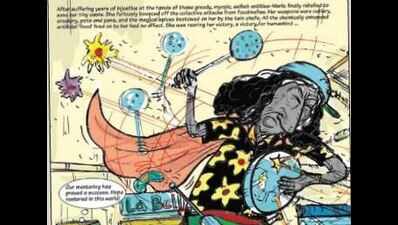
“As a foodie, it was an oasis in the city with the dishes on offer and the affordability of the fare.

fix. Memory of that aroma, taste and above all Lobo aunty is etched in the minds of many regulars like me,” recounts Mukherjee, now a senior faculty member of communication design at NID.
Thus, when he had to choose one of his works for ‘Longform Volume 1,’ an anthology of graphic narratives, he chose to fictionalize the account of Lobo aunty and tell the story of how food culture forms the heritage of a city like Ahmedabad.
“I am also a character in the story, as my younger self enamoured by her dishes and caramel custard. The graphic panels talk about the challenges she faced from different quarters and how she stood up to them. Thus, the penultimate panel shows her as larger than life, like Ma Durga, taking the opposition head-on,” says Mukherjee.
It’s the idea of the anthology, edited by Mukherjee, Sarbajit Sen, Debkumar Mitra and Pinaki De, to give voices to such personal narratives. Mitra, having a day job as a mathematician and researcher, was at NID for a talk on the anthology. He said that the four of them – all from Kolkata and comics aficionados – came together to create a platform that explores the space between Amar Chitra Katha on one end of the spectrum to graphic novels on the other.
“The name itself (Longform) is taken from a statement by comic journalist Joe Sacco where he comments on how the editors are not interested in longform graphic narratives. We want to encourage the detailed and welltold narrative through the exercise of compiling an anthology which will now be an annual affair,” says Mitra.
The book has 30 contributors from India, South Korea, Iran, France, Bhutan and Germany to name a few. The themes also tackle issues such as gender identity, Dalit oppression, mechanization of humans, local lore, environmental concerns, child exploitation, science fiction and nostalgia. The editors are upbeat about future of the medium.
Mitra says that this year for the first time the longlist of Man Booker Prize includes a graphic novel.
“It has been our effort to establish identity of comics not just as a medium for superhero stories. One can find initiatives such as Thimphu Comics in Bhutan to share ancient lore whereas animators like Heeseon Kim from South Korea choose it to talk about Koreas’ border conflict,” says Mukherjee.

About the Author
Parth ShastriEnd of Article
FOLLOW US ON SOCIAL MEDIA










Photostories
Hot Picks
TOP TRENDING
Popular Categories
Hot on the Web
Top Trends
Vinesh Phogat Election ResultTravis KelceElection Results 2024Haryana Election ResultJason KelceJammu Kashmir Election Result 2024Israel Hezbollah WarHardik SinghAakash ChopraAssembly ElectionHaryana Assembly Constituencies 2024Jammu Kashmir Election Winners ListGurgaon Election ResultHaryana Election Winners ListLive Election ResultFaridabad Election ResultLive Cricket Score
Trending Topics
Tulsi KumarBigg Boss Tamil 8 Contestants ListAjay DevgnNavratri Colours 2024Sanjay Leela BhansaliDurga Puja 2024Bigg Boss 18 House PhotoDevara CollectionBigg Boss 18Deepika PadukoneShailesh LodhaDevaraGovinda NewsNational Film Awards 2024Swatantrya Veer SavarkarColdplay India tour 2025Watch NFL Live StreamDress To ImpressCall Of Duty Black Ops 6Wordle Answer
Living and entertainment
Latest News
Ambala Cantt Assembly Election Result 2024: BJP's big gun Anil Vij defeats Chitra Sarwara by over 7000 votes5 must follow rules of Ayurveda to lose 5kg in 30 daysUniversity of East Anglia Introduces £4,000 Scholarship for Indian Students: Explore Courses, Eligibility, and BenefitsTodd Phillips explains SHOCKING CLIMAX of 'Joker: Folie à Deux', reveals Arthur Fleck acceptance of his true identityThe Power of Navratri: Honoring Goddess Durga and Manifesting DesiresAlia Bhatt just cannot keep calm on watching 'Singham Again' trailer, says 'all the dynamite in one frame' for the big multi-starrer led by Ajay Devgn3 reasons why Jimmy Uso can betray Roman Reigns and join forces with Solo SikoaThis is the stock trading app linked to Rs 500 crore investment fraud; YouTubers Elvish Yadav, Bharti Singh among 5 summonedMonetary policy committee meet: RBI moving closer to rate cutIndian branded pharma sector to see a decline in growth: ReportFrom spending habits to hiding reality: What each zodiac sign is likely to lie about2024 Haryana assembly election result: 5 reasons why BJP's victory is significantKathua (SC) Assembly Election Result 2024: BJP's Dr Bharat Bhushan wins by 12,177 votesTaylor Swift surpasses Rihanna in Music Rich list: A look at her impressive net worthAlexander Zverev scrapes through, set to face David Goffin at Shanghai Masters pre-quartersRoh Yoon Seo shines as a supportive sister in 'Hear Me: Our Summer'3 killed after an Air Evacuation helicopter crashes in Owen County"We do it every day in practice”: Kansas City Chiefs Head Coach Andy Reid Confirms Travis Kelce’s 3rd And 22 Lateral Play Was Planned
Copyright © 2024 Bennett, Coleman & Co. Ltd. All rights reserved. For reprint rights: Times Syndication Service