
- News
- Business News
- Startups News
- Going against advice, he stuck with his first love
Trending
This story is from October 25, 2023
Going against advice, he stuck with his first love

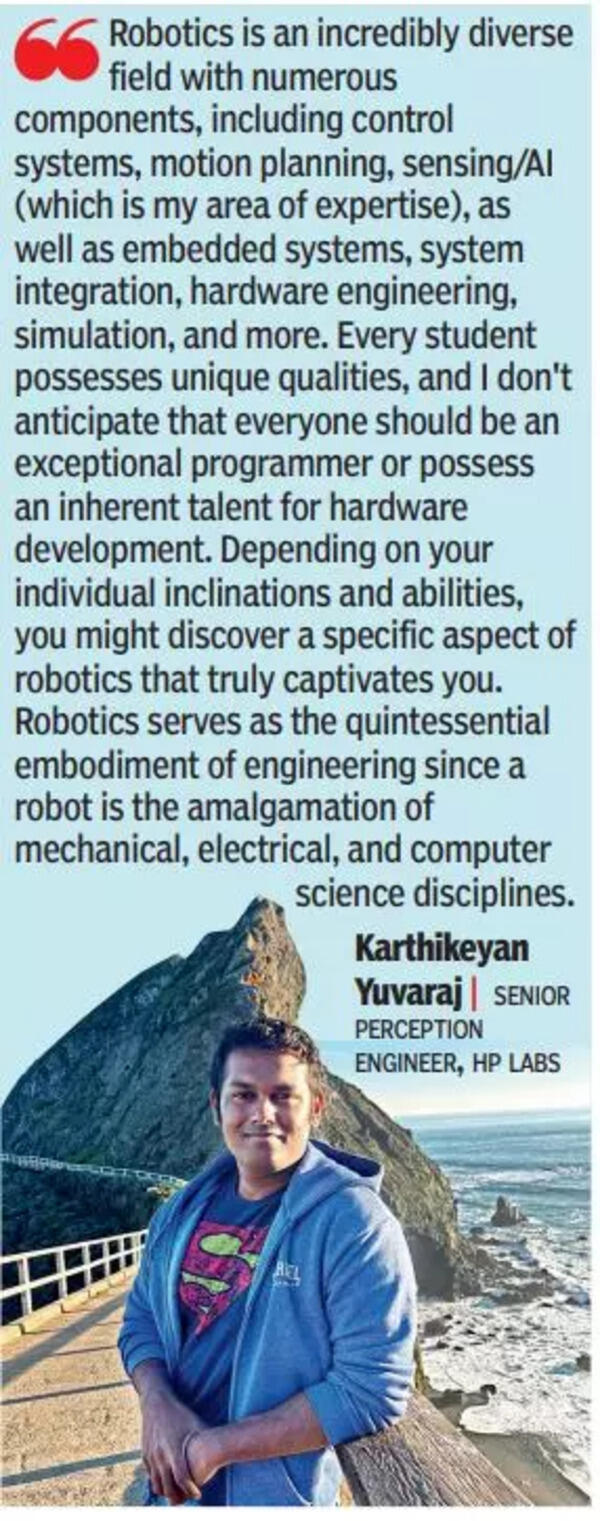
Karthikeyan Yuvaraj decided to build a robot for the finalyear design project during his BTech in computer science in Amrita School of Engineering, Coimbatore. Computer science students would normally do projects in pure software. But Karthikeyan loved programming hardware (like motors, lights, sensors). Growing up in Neyveli, a small mining town in Tamil Nadu, Karthikeyan had developed a fascination for robotics, sparked by sci-fi films like Star Wars and RoboCop, and books by Isaac Asimov.
The robot he built in college created a lot of buzz, but faculty and peers told him there wasn’t much of a career in robotics. But he kept at it. And today, 15 years later, he has 11 granted patents, including five US ones, in areas related to robotics. And many major accomplishments.

Karthikeyan specialises in developing software that helps robots ‘see’ surroundings. That work intensified when he joined Drexel University, US, for a Master’s in electrical engineering, with a focus on control systems and robotics. Around this time, the US Defence Advanced Research Projects Agency (Darpa) launched the Darpa Robotics Challenge (DRC) with the objective of creating robots capable of responding to disasters. Karthikeyan, along with colleagues from Drexel’s Drones and Autonomous Systems Lab, secured funding from Darpa to participate in the DRC. They competed with teams from Nasa, MIT, Boston Dynamics, and Lockheed Martin. The team’s focus was on enhancing the sensing capabilities of the robot, enabling it to adeptly grasp and manipulate objects, including steering wheels and drill machines. Their work led to several peer-reviewed articles in prestigious journals, and had a profound impact on innovation in vision-centric robotic manipulation.
From Honeywell, Karthikeyan moved to Vicarious, a Silicon Valley startup, where he helped develop a robotic system that could teach other robots to perceive and grasp unfamiliar objects. “This resulted in the granting of a patent titled ?Method and system for generating training data’,” he says.
In March 2020, coinciding with the onset of the pandemic, Karthikeyan assumed responsibility for deploying this robot at a Pitney Bowes shipping facility in Cincinnati. “I witnessed first-hand the vital role that robots played in keeping warehouses going, as workers were restricted,” he says.
Vicarious was acquired by Google in 2020. Karthikeyan is now at HP Labs, helping develop advanced robotics and AI/computer vision solutions to create state-of-the-art video conferencing technologies.
Meanwhile, Amrita University has started a programme in robotics and AI. “I was asked to give a welcome speech to their new students,” Karthikeyan says.
The robot he built in college created a lot of buzz, but faculty and peers told him there wasn’t much of a career in robotics. But he kept at it. And today, 15 years later, he has 11 granted patents, including five US ones, in areas related to robotics. And many major accomplishments.
Karthikeyan specialises in developing software that helps robots ‘see’ surroundings. That work intensified when he joined Drexel University, US, for a Master’s in electrical engineering, with a focus on control systems and robotics. Around this time, the US Defence Advanced Research Projects Agency (Darpa) launched the Darpa Robotics Challenge (DRC) with the objective of creating robots capable of responding to disasters. Karthikeyan, along with colleagues from Drexel’s Drones and Autonomous Systems Lab, secured funding from Darpa to participate in the DRC. They competed with teams from Nasa, MIT, Boston Dynamics, and Lockheed Martin. The team’s focus was on enhancing the sensing capabilities of the robot, enabling it to adeptly grasp and manipulate objects, including steering wheels and drill machines. Their work led to several peer-reviewed articles in prestigious journals, and had a profound impact on innovation in vision-centric robotic manipulation.
Karthikeyan went on to join Honeywell, where he helped create an autonomous truck unloader. These are large mobile robots with arms that can drive into delivery trucks and unload cargo. The system combines Lidar (a laser-based sensing technology) and infrared/ RGB cameras. FedEx was one of the early users of these unloaders. And some of Karthikeyan’s patents emerged from this work.
From Honeywell, Karthikeyan moved to Vicarious, a Silicon Valley startup, where he helped develop a robotic system that could teach other robots to perceive and grasp unfamiliar objects. “This resulted in the granting of a patent titled ?Method and system for generating training data’,” he says.
In March 2020, coinciding with the onset of the pandemic, Karthikeyan assumed responsibility for deploying this robot at a Pitney Bowes shipping facility in Cincinnati. “I witnessed first-hand the vital role that robots played in keeping warehouses going, as workers were restricted,” he says.
Vicarious was acquired by Google in 2020. Karthikeyan is now at HP Labs, helping develop advanced robotics and AI/computer vision solutions to create state-of-the-art video conferencing technologies.
Meanwhile, Amrita University has started a programme in robotics and AI. “I was asked to give a welcome speech to their new students,” Karthikeyan says.
End of Article
FOLLOW US ON SOCIAL MEDIA










Hot Picks
TOP TRENDING
Trending Stories
In Business
Entire Website
- Will banks open only for 5 days a week? Here’s what you should know about IBA’s proposal
- India set to be third largest economy, says S&P Global
- Dalal Street bull run continues! BSE Sensex crosses 69,000 for the first time; Nifty above 20,800
- Byju’s reduces notice period for employees as troubles mount
- Sensex surges over 900 points, Nifty above 20,550 as BJP state election wins bolster Modi's Lok Sabha 2024 prospects
- UltraTech to buy building materials business of Kesoram in 7,600 crore deal
- Tata Technologies stock debuts at a bumper 140% premium; share price at Rs 1200 on BSE
- Tata Technologies share allotment: How to check IPO allotment status, listing date, GMP
- BSE m-cap rides rally in Adani stocks, tops $4 trillion
- Charlie Munger, who helped Warren Buffett build Berkshire, dies at 99
- 2 Army officers thrashed, their female friend gang-raped in Madhya Pradesh
- 200 deaths/day, $1.5tn per year: How China is destroying US with fentanyl
- While Kamala focused on substance, Trump's lies had the final word
- Centre seeks review of SC's mineral royalty judgment
- Harris emerges unscathed from debate, dancing around her flip-flops
- 70+ citizens with private cover can also avail PMJAY: Centre
- Why we might not have any men left in just a few million years
- Apple iPhone 16 vs iPhone 15: Which iPhone to buy and why
- 1st T20I: Head, Zampa star as Australia beat England by 28 runs
- IIT-Guwahati academic affairs dean quits amid stir over student suicide'



Popular Categories
Hot on the Web
Top Trends
Trending Topics
Deepika PadukoneMalaika Arora Father DeathArbaaz KhanJayram RaviAishwarya Rai BachchanSlat WaterWeight GainGOAT CollectionVikas Sethi DeathMalayalam ProducersIndia's Best Dancer 4Simi GarewalDilli BabuIndian National ParksLaung BenefitsVikas SethiiPhone 16Dubai Princess Sheikha MahraMG Windsor EvWordle Answer
Living and entertainment
Latest News
The Zodiac Signs Most Naturally Inclined to HealingWhy Banyan trees survive for centuries and spread indefinitely?Telangana government pushes for increased flood relief from CentreWalking dog in Goa? Mouth guard, leash soon to be mustNBA 2K25 locker codes September 2024: Locker codes revealed and know how to reveal themDonald Trump and Kamala Harris shake hands as they meet for first time on debate stage: Watch the 'awkward' momentBRS pushes for disqualification of turncoat MLAs after High Court rulingKamala may have won debate. But election is still too close to callCommunal violence erupts in Karnataka during Ganpati Visarjan, section 144 imposedVarun Dhawan shares unfiltered reaction to Janhvi Kapoor's 'Daavudi' song from 'Devara: Part 1': 'So freaking good...''On basis of fairness and equality': Bangladesh seeks good relations with India, says YunusMpox kills two, six other confirmed cases in Cameroon: GovernmentTrump's claim about sending Taliban leader Abdul his house photo fuels social media frenzyJalen Ramsey demands action against Miami Police following Tyreek Hill's pulled from car49ers RB Christian McCaffrey misses win over JetsWWE Superstar Blames the Company for Failing to Utilize Omos’ PotentialWhy Taylor Swift used Benjamin Button to endorse Kamala HarrisHyundai Alcazar vs Hyundai Creta: Price, variants compared
Copyright © 2024 Bennett, Coleman & Co. Ltd. All rights reserved. For reprint rights: Times Syndication Service