
- News
- Business News
- Startups News
- How Skillveri’s XR simulation boosts blue-collar jobs
Trending
This story is from August 26, 2023
How Skillveri’s XR simulation boosts blue-collar jobs
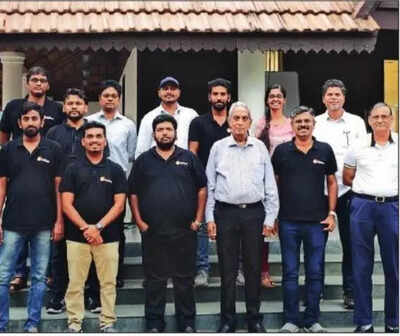
Skillveri team, including founder Sabarinath Nair (front row, second from right), Biji Kurien, former MD of Berger Paints and mentor to Skillveri (front row, third from right), Ravi Iyengar, formerly of Asian Paints and advisor to Skillveri (front row, extreme right), and Rejitha Nair, head of software (back row, second from right)
Lakshminarayan, an engineer and entrepreneur, had already been thinking about utilising technology to scale up vocational training in the country.
This was just before the National Skill Development Corporation was established.
Nair, an engineer who was then working in one of Lakshminarayan’s companies – an ATM software provider called Vortex Engineering – resolved to do something about the blue-collar gap. He researched the realm. He visited factories to understand the problems operators face. And then worked to build simulation products to skill blue-collar workers in areas like welding and painting.
This was a time when the tech startup realm was in its infancy. Most were focused on building mobile apps. Product companies weren’t in fashion, and what Nair had in mind was to build a hardware product company. Fortunately for him, he was in Chennai, and the IIT Madras ecosystem helped. “This ecosystem had a lot of focus on hardware and deep tech,” Nair says.
IIT Madras incubated and mentored the company, which was named Skillveri. The institute also provided the initial investment via soft loans, through schemes of the electronics & IT ministry, and the science & technology ministry.
The Skillveri team worked for “almost no money” initially. “We started with the welding simulator, so we spent a lot of time in factories with real welders. Whatever prototypes we built, we let them use it, and they gave us feedback,” recollects Nair.
It was challenging, considering their small scale, and that several components had to be imported. Immersive technology was then too expensive. “We were doing things in 2D, and were somehow trying to show 3D in 2D. But the moment the VR space became more mainstream – with the launch of the Oculus and XTC VR headsets – a lot of what we were building from scratch became available off the shelf,” says Nair.
Metaverse & XR
As the ecosystem around metaverse and XR (extended reality) grew, Skillveri adapted the technology to enhance their screens. “We brought gaming elements into the mechanics of training because we are dealing with people who are quite young – we had to make it interesting for them,” says Nair.
Before designing a new tool, Nair and team analyse in depth where technology can make a difference in the workflow, and positively impact the quality of the output – by guaranteeing the safety and convenience of the welder or spray painter. “Things like moving the hand during welding – you can’t watch a video and then learn, you have to practise it,” he says.
They realised that the core value they bring is in the hand movement angle. “So, all our tech has been around measuring the dexterity of the hand, comparing it with what is ideal, and then guiding the student to get to that ‘ideal’ in the shortest possible time. And for that we have used different technologies – earlier we had our own sensors, now we lean on the AR and VR devices,” Nair says. In 2015 and 2016, the company also raised funds from the Dell Foundation and Ankur Capital, an early-stage VC firm focused on deep-tech.
End of Article
FOLLOW US ON SOCIAL MEDIA









Photostories

Hot Picks
TOP TRENDING
Trending Stories
In Business
Entire Website
- Will banks open only for 5 days a week? Here’s what you should know about IBA’s proposal
- India set to be third largest economy, says S&P Global
- Dalal Street bull run continues! BSE Sensex crosses 69,000 for the first time; Nifty above 20,800
- Byju’s reduces notice period for employees as troubles mount
- Sensex surges over 900 points, Nifty above 20,550 as BJP state election wins bolster Modi's Lok Sabha 2024 prospects
- UltraTech to buy building materials business of Kesoram in 7,600 crore deal
- Tata Technologies stock debuts at a bumper 140% premium; share price at Rs 1200 on BSE
- Tata Technologies share allotment: How to check IPO allotment status, listing date, GMP
- BSE m-cap rides rally in Adani stocks, tops $4 trillion
- Charlie Munger, who helped Warren Buffett build Berkshire, dies at 99
- From pager blasts to Nasrallah’s killing: How Israel is creating a 'new Middle East'
- Israel informs US of 'limited ground operations' in Lebanon
- Rs 7.8 lakh crore debt – will political instability kill Maharashtra?
- 'Unacceptable,' says Rahul Gandhi as Delhi police detains Sonam Wangchuk
- SA20 Auction: Players, squads, date - everything you need to know
- Pawn or kingmaker? Voters will decide Engineer Rashid fate today
- Why Rahul should stop foreign trips and focus on domestic politics
- Video that may have led to Gaurav Taneja and Ritu Rathee's divorce rumours
- Army expedition recovers 4 more bodies from AN-12 crash near Rohtang Pass in '68
- High stakes in J&K polls phase 3: 415 candidates vie for 40 constituencies


Popular Categories
Hot on the Web
Top Trends
Israel Hezbollah WarMost Runs in International CricketVirat KohliIND vs BAN Live ScoreRohit SharmaIndian Team Fastest Test FiftyMohammed SirajUGC NET Result 2024TS DSC Results 2024Women T20 World Cup Points TableWomen T20 World Cup ScheduleShane McMahon Net WorthHezbollah ChiefTourists Not AllowedDiddyTop Management Colleges of IndiaLive Cricket Score
Trending Topics
Devara CollectionMithun ChakrabortyKangana RanautNavratri WishesGandhi Jayanti WishesAnant AmbaniDevara CollectionGandhi Jayanti 2024Masala OmeletteEmergencyDevaraTaaza Khabar 2 Twitter ReviewDevara Movie ReviewHealthy RaitasSwatantrya Veer SavarkarColdplay India tour 2025Smartphone DealsApple Macbook Air M1Amazon SaleWordle Answer
Living and entertainment
Latest News
iVoomi S1 Lite e-scooter launched at Rs 84,999: 180 km range, three-year warranty!Tata Nexon turbo CNG: Variant-wise features with price explainedPMI in India intensifies efforts against Illicit Tobacco Trade to Safeguard Economic Interests and Consumer ProtectionMumbai vs Rest Of India: Irani Cup tie offers chance for hopefuls and rejects to impress selectorsOlivia Culpo and Christian McCaffrey buy George Clooney's mansion for $14.5 millionKaun Banega Crorepati 16: Amitabh Bachchan believes he is 'Half-Sikh' recalling his maternal roots; reveals his aunts called him 'Amitabh Singh'RG Kar case: Kolkata court extends judicial custody of ex-principal, suspended cop till October 4When Dikembe's shoe size astonished the Mumbai Temple guardHow can Ben Stokes and other overseas players avoid a two-year IPL ban?"Nothing he was doing was believable", Darby Allin picks names wrestler who benefited most from AEW All In 2023 backstage incidentColleagues remember braveheart Delhi Police constable Sandeep: 'Would rush to crime scene alone'5 ways insecurity can ruin a relationshipBengaluru resident exposes fake Flipkart agent attempting to deliver bogus iPhone 15; read online reactionsBihar and Jharkhand among top two states enrolling for contributory pension scheme for farmers"Tyler Huntley’s 'Snoop' Nickname: The Rapper Connection Explained”BTS star V crowned 'Most Handsome Man in the World 2024'Decoding a bowl of Idli Sambhar: From calories to nutrients4 members of notorious robbery gang held in crackdown by Ghaziabad police
Copyright © 2024 Bennett, Coleman & Co. Ltd. All rights reserved. For reprint rights: Times Syndication Service