
- News
- Business News
- India Business News
- Budget decoder: How to choose between old and new tax regime
Trending
This story is from February 2, 2020
Budget decoder: How to choose between old and new tax regime
One tax regime was tricky. Now, you have an optional second one. How do you decide which one to pick? This Times of India–EY Guide helps you decode Union Budget 2020

10 THINGS YOU SHOULD KNOW TO CHANNEL YOUR INNER YODA
1.
A new ‘simplified’ personal income-tax regime has been introduced on income up to 15 lakh but taxpayers can opt for it only if they forego their claim for several exemptions (HRA, LTA), deductions (standard deduction, deduction for investment in PF, PPF, LIC premium) and to set off certain losses (such as loss from house property).
2. Dividend Distribution Tax (DDT) has been abolished and dividends will be taxed in hands of the recipient taxpayers at applicable slab rates. Further, TDS @ 10% will be applicable on dividend paid to an individual exceeding 5,000 during a fiscal. This will benefit small taxpayers who are subject to tax at lower slab rates than the applicable DDT rates.
3. The FM giveth and the FM taketh away. Employer’s contribution to provident fund, National Pension System and superannuation fund exceeding in aggregate 7.5 lakh per year to be taxed as salary in hands of employee. Interest, dividend and other similar incomes arising on such excess contribution (exceeding 7.5 lakh) to be taxed as well. This will lead to additional tax liability, especially for high net worth individuals.
4. Payment of tax on ESOPs received by employees of eligible startups to be deferred. Such tax is now payable on completion of five years from year of allotment of shares or sale of shares or cessation of employment, whichever is earlier. This will improve cash flow for employees. However, such benefits are only available for employees of eligible startups and not of all employers.
5. Homebuyers get some relief. No adjustments to the sale consideration on transfer of immovable property can be made where variation between stamp duty value and sale consideration is not more than 10% of latter (earlier 5%). This will reduce hardship to taxpayers for genuine transactions in real estate.
6. Taxpayers, please open your heart and wallets too. Details of eligible donation under Section 80G will be pre-filled in the incometax returns basis the information submitted by the donee (charitable institution). There is however, a possibility of claims being disallowed if the proper details of donations are not submitted.
7. Lesser disputes better trust. ‘Vivaad se Vishwas’ Scheme to be introduced where taxpayers can pay the amount of disputed tax (no interest or penalty) on or before March 31, 2020 and settle pending disputes. Taxpayers can also pay tax under dispute by June 30, 2020 with some additional amount (expected to be lower than the penalty/interest exposure) under this scheme.
8. More (information with the tax department) is better. Instead of the annual tax statement (Form 26AS) for taxpayers on the online tax portal, a more comprehensive annual financial statement which will capture multiple information such as sale / purchase of immovable property, sharebased transactions, etc in addition to details of taxes deducted at source has been prposed. This will enable taxpayers to reconcile the details reported in their tax returns with the information already available with the tax authorities, thereby reducing litigation.
9. Good news for first-time homebuyers. To promote affordable housing, additional tax deduction of up to 1.5 lakh for interest on housing loan has been extended to loans sanctioned up to March 31, 2021 (earlier, March 31, 2020).
10. Travelling abroad without deducting tax at source from the payment to your tour operator or making a foreign remittance under the Reserve Bank’s Liberalised Remittance Scheme (LRS)? Tour operators/banks (authorised dealers) will collect tax at source of 5% from you. If you don’t furnish your PAN/Aadhaar, the tax to be collected will increase to 10%.
AS YOU FLY YOUR FALCON, WATCH OUT FOR THESE TAX HEADWINDS
Payment of tax on ESOPs by startups will now be after five years from the year of allotment of shares or in the year of termination of employment or of sale, whichever is earlier. However, it will be taxable at rates for the fiscal of allotment. But, there is ambiguity on the mechanism of reporting such income in returns.
DDT on dividends declared by Indian cos and MFs is abolished. However, HNIs will be taxed on dividend income from equity oriented MFs at a higher rate than before
With the withdrawal of DDT, cos will have to deduct TDS @10% on dividends of over 5,000 during a fiscal. So taxpayers like senior citizens, who didn’t have to file returns, will now have to do so or submit Form 15G/Form 15H to each company where they hold shares.
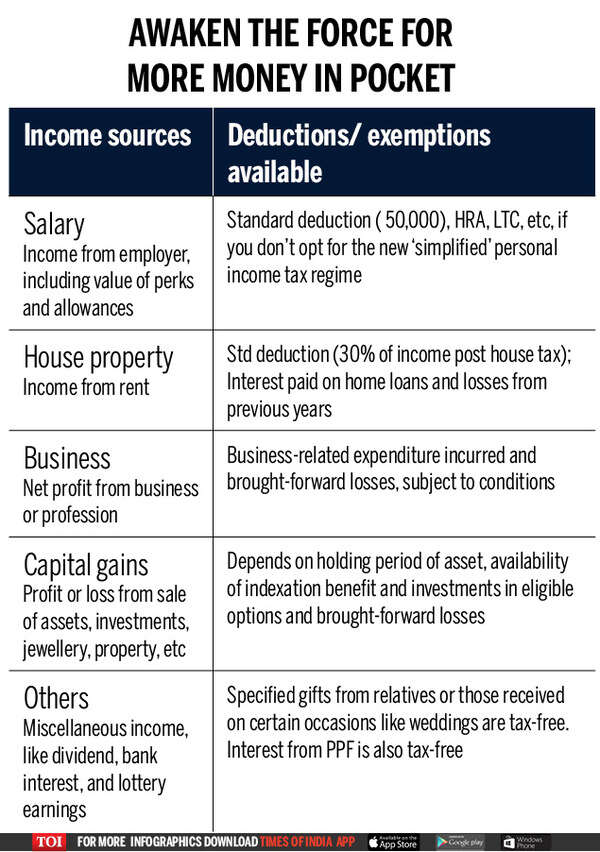
AWAKEN THE FORCE FOR MORE MONEY IN POCKET
Various tax sops, be it for your salary perks or investments that you make, help reduce your tax outgo.
CLUBBING WILL ADD TO YOUR INCOME
In certain cases, the income of the spouse or child is clubbed with that of the taxpayer who has to bear the tax. For instance:
a) Income from investments in the name of a child (below 18 years). In this case, the minor’s income is clubbed with that of the parent who earns more.
b) Income from investments made from the taxpayer’s funds in the spouse’s name.
FACELESS TAX TROOPERS TO KEEP YOU EAR-NEST
Be ready for an all-electronic audit of your tax return, which is a paradigm shift from the current procedure. Here are the key points that you need to know about faceless assessment.
1. All notices will be issued only in electronic mode in your e-filing account on the income-tax department’s portal. You may also receive intimation on your registered email ID. Do keep personal details like email id and mobile number updated on the income tax department’s portal for timely receipt of such notices.
2. Keep login credentials of your account on income tax portal handy to check on such notices and for filing timely responses.
3. The response to notices and all the documents are to be filed electronically on the income tax department’s portal within 15 days of issuance of the notice.
4. You should keep handy Form 16 and Form 12BA (annual withholding tax certificate) issued by the employer; monthly salary slips and proof of all expenses reimbursed by your employer.
5. In addition, do ensure that documents for all deductions and exemptions claimed by you in the tax return form are readily available. These could include evidence of investments, including purchase of immovable property, copy of rent agreement, receipt of municipal tax (if you have let out your house on rent), interest certificate for home loans, details of loans/ gifts taken or received, copy of bank statements and demat account statements.
6. Under the new scheme, there is no face-to-face interaction between the tax officer and the individual. The individual would not know details of the tax officer who would be conducting the audit of his/ her return.
7. There is no requirement to visit the tax office. In rare cases when personal interaction is required, hearing will be conducted only through video-conferencing.
End of Article
FOLLOW US ON SOCIAL MEDIA










Photostories

Hot Picks
TOP TRENDING
Trending Stories
In Business
Entire Website
- Will banks open only for 5 days a week? Here’s what you should know about IBA’s proposal
- India set to be third largest economy, says S&P Global
- Dalal Street bull run continues! BSE Sensex crosses 69,000 for the first time; Nifty above 20,800
- Byju’s reduces notice period for employees as troubles mount
- Sensex surges over 900 points, Nifty above 20,550 as BJP state election wins bolster Modi's Lok Sabha 2024 prospects
- UltraTech to buy building materials business of Kesoram in 7,600 crore deal
- Tata Technologies stock debuts at a bumper 140% premium; share price at Rs 1200 on BSE
- Tata Technologies share allotment: How to check IPO allotment status, listing date, GMP
- BSE m-cap rides rally in Adani stocks, tops $4 trillion
- Charlie Munger, who helped Warren Buffett build Berkshire, dies at 99
- Kolkata rape-murder: Chargesheet reveals disturbing details; accused’s DNA links him to victim
- 'If arrogance had a face': BJP questions Rahul's silence after poll results
- RG Kar rape-murder: Does CBI chargesheet prove Mamata right?
- Hoodannit? Haryana results mystery leaves Congress clueless
- Stunning visuals from space show Hurricane Milton swirling over Earth
- New UPI transaction limits announced! Check here
- How Byju Raveendran could lose every inch of his empire
- Harsh Goenka tags Ola founder Bhavish Aggarwal in this ‘kamra’ post
- 2nd T20I: India face Bangladesh with eye on 2026 T20 World Cup
- Despite Kejriwal’s emotive appeals, AAP fails to open acc in Haryana


Popular Categories
Hot on the Web
Top Trends
Haryana Election ResultNew UPI Transaction LimitHurricane MiltonRBI Monetary Policy MeetingWorld First Top 10 TrillionairesStock Market TodayKerala Lottery ResultElection Results 2024Biblical TreeJammu Kashmir Election ResultIsrael Hezbollah WarHardik SinghManagement Colleges of IndiaTop Medical Colleges of IndiaTop Engineering Colleges of IndiaTop Pharmacy Colleges of IndiaLive Cricket Score
Trending Topics
Tulsi KumarBigg Boss Tamil 8 Contestants ListAjay DevgnNavratri Colours 2024Sanjay Leela BhansaliDurga Puja 2024Bigg Boss 18 House PhotoDevara CollectionBigg Boss 18Deepika PadukoneShailesh LodhaDevaraGovinda NewsNational Film Awards 2024Swatantrya Veer SavarkarColdplay India tour 2025Watch NFL Live StreamDress To ImpressCall Of Duty Black Ops 6Wordle Answer
Living and entertainment
Latest News
After crackdown, Hyderabad’s infamous ‘bride bazaar’ moves onlineA historic victory for "Kallanum Bhagavathiyum" on Amazon Prime7 Potassium-rich foods to eat during Navratri vratHurricane Milton: Why Tampa area is so vulnerable to stormsUP Muslim family creates 80-feet pollution-free Ravan effigy for DussehraBeard Trimmer with Titanium Blades: Style Your Beard to Perfection with Unmatched SharpnessEthel Kennedy, widow of Senator Robert F Kennedy Sr suffers stroke in sleep, hospitalisedMozambique votes in tense election likely to see ruling party winSum 41’s Deryck Whibley accuses former manager of sexual abuse in new memoirHyundai aims to raise up to $3.3 billion in record India IPOLibra, Daily Horoscope Today, October 09, 2024: Today is a test of your resiliencePrabhas starrer 'Kalki 2898 AD' gears up for its release in JapanMan declares income of Rs 9.6k, pays tax on Rs 43.5L after US earnings addedKerala lottery results: Thiruvonam bumper BR-99th winners for 09 October 2024; first prize Rs. 25 crore, second prize Rs 1 crore and third prize Rs. 50 lakhsZodiac Signs Most Likely to SucceedPatanjali Foods gets CCI nod for Rs 1,100-crore buyout of parent's home & personal care businessDocumentary suggests Bitcoin creator Satoshi Nakamoto is developer Peter ToddDry Anjeer vs soaked Anjeer: Which one's better for a glowing skin?
Copyright © 2024 Bennett, Coleman & Co. Ltd. All rights reserved. For reprint rights: Times Syndication Service