
- News
- Business News
- India Business News
- 'Private labels to have better margins & boost growth'
Trending
This story is from February 27, 2020
'Private labels to have better margins & boost growth'
Private label brands are expected to report higher growth rates and yield better margins than the overall growth of e-commerce platforms, says a study by KPMG and Retailers Association of India. Between 2019-2022, private labels are expected to grow 1.3-1.6x faster than e-commerce platforms and continue to generate nearly double the margins of external brands.

(Representative image)
Between 2019 and 2022, private labels are expected to grow 1.3-1.6x faster than ecommerce platforms and continue to generate nearly double the margins of external brands.
“Private labels allow platforms to attract new consumers, improve consumer stickiness, and thereby increase market share,” the report says, adding that major players across product categories attribute more than 50% of their private label sales to repeat purchases.
The share of private labels is category dependent and could range up to 90% for fashion, approximately 15-20% in food, and 8-10% in general merchandise. The number of private labels is dependent on the width of category assortment for offline retailers. In certain categories with low brand presence, private labels have become main-stay brands.
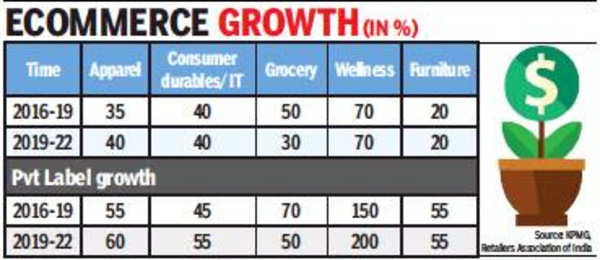
The report also said that leading online multi-category platforms have already developed a presence in private labels. Platforms have between two to five brands in categories such as wellness, electronics and cosmetics, and10-20 brands in larger categories such as apparels and food and grocery. Category focused platforms were early to enter and launch private labels, and currently have 25-40% of sales contribution from such labels, while multi-category platforms have around 5-10% of sales attributed to private labels.
“Private labels could be used as a competitive differentiator for platforms. On the demand side, they can address market gaps through new and differentiated products, leading to higher purchase conversions and better ROI. In relatively unorganised and unbranded categories, private labels could offer greater brand assurance and credibility. On the supply side, private labels can drive higher margins on account of better value chain control, category anchorage on the platform and incremental revenue,” the report said.
End of Article
FOLLOW US ON SOCIAL MEDIA










Photostories

Hot Picks
TOP TRENDING
Trending Stories
In Business
Entire Website
- Will banks open only for 5 days a week? Here’s what you should know about IBA’s proposal
- India set to be third largest economy, says S&P Global
- Dalal Street bull run continues! BSE Sensex crosses 69,000 for the first time; Nifty above 20,800
- Byju’s reduces notice period for employees as troubles mount
- Sensex surges over 900 points, Nifty above 20,550 as BJP state election wins bolster Modi's Lok Sabha 2024 prospects
- UltraTech to buy building materials business of Kesoram in 7,600 crore deal
- Tata Technologies stock debuts at a bumper 140% premium; share price at Rs 1200 on BSE
- Tata Technologies share allotment: How to check IPO allotment status, listing date, GMP
- BSE m-cap rides rally in Adani stocks, tops $4 trillion
- Charlie Munger, who helped Warren Buffett build Berkshire, dies at 99
- Mysuru-Darbhanga Express rams into goods train in TN; 6 coaches derailed, 2 on fire; many feared hurt
- Express train was travelling at 90km/h when it collided with goods train
- When Tata explained why Nano failed and readers offered help
- Train collision: 'Switch to loop line may have caused crash'; rly officials rush to scene
- 'Ties with Canada can't be repaired unless ...': India after PM Modi-Trudeau meet
- Mid-air scare: Air India Express flight suffers hydraulic snag, lands safely
- How a violent Pune battle helped Ratan Tata become Tata group head
- Zerodha co-founder Nikhil Kamath: They can make us shut down ...
- Did Independents play spoilsport for Congress in Haryana?
- T20 World Cup: What Aus win over Pak means for India


Popular Categories
Hot on the Web
Top Trends
Shantanu NaiduRussell WilsonsTom BradyAUS vs PAK Live ScorePakistan Cricket FanSuryakumar YadavNobel Peace PrizeMahadev Betting AppNew UPI Transaction LimitRatan Tata DiesPM ModiUGC NET Result 2024Management Colleges of IndiaTop Medical Colleges of IndiaTop Engineering Colleges of IndiaTop Pharmacy Colleges of IndiaLive Cricket Score
Trending Topics
Diwali WishesJigra ReviewDussehra WishesVettaiyan OTT ReleaseVettaiyan CollectionVettaiyan ReviewBlack Movie ReviewDevara CollectionBigg Boss 18Deepika PadukoneShraddha KapoorRatan Tata Passed AwayJigra Movie ReviewVettaiyan Movie ReviewSwatantrya Veer SavarkarDussehra 2024Elon MuskKing Legacy CodesUltimate Football Codes October 2024Wordle Answer
Living and entertainment
Latest News
Navratri 2024: Jaya Bachchan and Shweta Bachchan join Rani Mukerji at the Durga puja pandalOff Argentina's Patagonian coast, whales and their calves dive deep for foodHappy Dussehra 2024: Images, Quotes, Wishes, Messages, Pictures and GreetingsJaggery vs honey: Which one is better for weight loss?My mother would love to have a swayamwar for me: Raj AnadkatHappy Dussehra 2024: Top 50+ Wishes, Messages, and Quotes to Share with Your Loved OnesBigg Boss 18: Karan Veer Mehra's comment on Arfeen Khan converting his wife's religion sparks anger; Arfeen says, "Agar ye ghar mein nahi hota main iski band baja deta"Happy Dussehra 202: Top 50 Wishes, Messages and Quotes to share with your loved onesAmitabh Bachchan turns 82: Priyanka Chopra, Prabhas, Kajol, and other celebs extend heartfelt birthday wishes to the legendary starPutin won't discuss Ukraine peace with Germany's Scholz, Berlin saysIndia's Steel City (Jamshedpur) mourns loss of iconic steel tycoon Ratan Tata“A fresh approach”: New York Jets' Interim Head Coach Jeff Ulbrich Replaced Nathaniel Hackett as Offensive Play Caller With Todd DowningKarnataka Congress faces backlash over case withdrawals linked to Hubballi riots'Jigra' box office collection day 1 early estimate: The Alia Bhatt starrer faces tough competition with Rajinikanth's starrer 'Vettitan' and Rajkummar Rao's Vicky Vidya Ka Woh Wala Video'Lead with AI and transform challenges into opportunities with GrowFast's AI and Analytics based Business Strategy online courseZodiac signs known for being cold-hearted and emotionally detachedAI is having its Nobel moment. Do scientists need the tech industry to sustain it?Who is judge Arun Subramanian? New Judge assigned to Sean 'Diddy' Combs sex-trafficking case
Copyright © 2024 Bennett, Coleman & Co. Ltd. All rights reserved. For reprint rights: Times Syndication Service