
- News
- Business News
- India Business News
- Lower discounts, payment issues: Why India's Russian oil binge may take a hit
Trending
This story is from July 19, 2023
Lower discounts, payment issues: Why India's Russian oil binge may take a hit

According to people familiar with the matter, the discounts on Russian crude have reduced to just $4 per barrel from the peaks of $25-30.
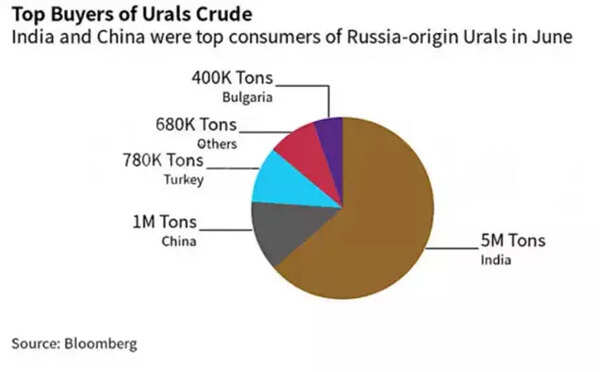
Russia has heavily relied on countries like India, China, Turkey and Bulgaria for oil sales since the imposition of sanctions following its invasion of Ukraine.
Top Picks For You

Russian oil: Trade headaches for India as crude prices hit $60
It emerged as the biggest oil supplier to India with domestic refiners gorging on discounted crude. Due to record purchases, Russian crude accounts for about 40% of India’s total oil imports, up from less than 2% in before the Ukraine conflict.
However, discounts on Russia's flagship Urals grade have now tumbled to $3-$3.5 a barrel for August loading and September delivery, while the availability of Russian oil in spot markets has declined, a source at one Indian refiner said.
Due to falling discounts, Russian oil is often priced above the $60 per barrel ceiling imposed by Western nations, an official told Reuters.
Discounts have been narrowing due to Opec+'s decision to cut output.
The "shift to Russian oil had happened because of discounts. How would you make payment if the price is above the $60/barrel ceiling?" said a government official.
Payment woes
Indian refiners are also facing problems in making payments for Russian cargoes due to western sanctions.
The Indian Oil Corp recently had to make payment in Chinese yuan because of shipping problems as the State Bank of India refused to furnish payment due to western sanctions on the shipping agency, the official said.
Indian refiners buy Russian oil on delivered basis, wherein the seller arranges shipping and insurance, to avoid falling foul of the sanctions.
This aspect became more important after the G7 slapped a price cap of $60 for seaborne Russian energy exports, making shipping or insurance — 60% controlled by European entities — difficult to obtain for oil sold above the ceiling.
“This and splintered procurement by Indian refiners — especially state-run entities that are the biggest buyers — are what the sellers of Russian oil are exploiting. They are charging $11-19 per barrel freight from Baltic or Black Sea ports, or nearly double the normal, while invoicing the crude at $1-2 less than the price cap,” a person involved in the trading told TOI.
He said Indian buyers could lose the discount soon if oil prices decline further and narrow the gap with the G7 price cap.
Looking for alternatives
With Russian discounts narrowing, Indian refiners may be forced to ramp up supplies from other countries.
An official told Reuters that Iraq is willing to supply more oil to India at better discounts and India is also talking to Iraq to extend the credit period to 90 days from 60 days.
Iraq has been pushed to second position since Indian refiners boosted imports of Russian oil last year.
"A longer credit period from a traditional supplier makes more sense than getting embroiled into $1 discount per barrel from a company to which making payment is difficult", the official added.
A separate refining source said his company will not buy Russian oil if it is priced above the $60/barrel cap.
"We know the discounts are receding, we don't know what could be discount for September loading cargoes," he said.
(With inputs from agencies)
End of Article
FOLLOW US ON SOCIAL MEDIA










Photostories

Hot Picks
TOP TRENDING
Trending Stories
In Business
Entire Website
- Will banks open only for 5 days a week? Here’s what you should know about IBA’s proposal
- India set to be third largest economy, says S&P Global
- Dalal Street bull run continues! BSE Sensex crosses 69,000 for the first time; Nifty above 20,800
- Byju’s reduces notice period for employees as troubles mount
- Sensex surges over 900 points, Nifty above 20,550 as BJP state election wins bolster Modi's Lok Sabha 2024 prospects
- UltraTech to buy building materials business of Kesoram in 7,600 crore deal
- Tata Technologies stock debuts at a bumper 140% premium; share price at Rs 1200 on BSE
- Tata Technologies share allotment: How to check IPO allotment status, listing date, GMP
- BSE m-cap rides rally in Adani stocks, tops $4 trillion
- Charlie Munger, who helped Warren Buffett build Berkshire, dies at 99
- Visionary who led Tatas’ renaissance: How Ratan took revenue from $4bn to over $100bn
- RBI governor, Pawars pay last respects to Ratan Tata in Mumbai
- What our netas can learn from former US president Carter’s legacy
- Watch: Leaders, celebrities line up to pay last respects to Ratan Tata
- The way Indians eat is best for Earth: WWF Living Planet Report
- Ratan Tata's ex girlfriend Simi Garewal mourns his loss, pens emotional note
- Arrogance, OBC mistrust: 11 factors that led to Cong’s Haryana debacle
- Why Zomato CEO Deepinder Goyal thanked BJP's Youth Wing chief
- PM Modi interacts with Indian diaspora in Vientiane, Laos
- Who is Noel Tata? Possible successor at Tata Trusts


Popular Categories
Hot on the Web
Top Trends
Hurricane MiltonRatan Tata NewsNew UPI Transaction LimitRatan Tata DiesPM ModiShantanu NaiduTom BradyStock Market TodayNarayana MurthyNitish Kumar ReddyIsrael Hezbollah WarRahat Tata Inspiring QuotesManagement Colleges of IndiaTop Medical Colleges of IndiaTop Engineering Colleges of IndiaTop Pharmacy Colleges of IndiaLive Cricket Score
Trending Topics
Diwali WishesBigg Boss Tamil 8 Contestants ListBhool Bhulaiyaa 3 TrailerVettaiyan Twitter ReviewSanjay Leela BhansaliVettaiyan ReviewSalman KhanDevara CollectionBigg Boss 18Deepika PadukoneShraddha KapoorRatan Tata Passed AwayColdplayVettaiyan Movie ReviewSwatantrya Veer SavarkarDussehra 2024Watch NFL Live StreamDress To ImpressRatan Tata DeathWordle Answer
Living and entertainment
Latest News
Ratan Naval Tata: The inspiring journey of Padma Vibhushan laureate and golden-hearted business tycoonHow Chennai Night Race swerved past challenges to zoom toward a brighter motorsports futureJiiva's 'Black' censored U/A, the thriller drama to release on October 11TCS cancels Q2 earnings press conferenceHurricane Milton: Taylor Swift, Keith Urban, Dolly Parton and other celebrities donate to support relief effortsAll-Star Tower Defense (ASTD) Codes October 2024Samantha Ruth Prabhu shares playtime with Chinmayi Sripaada's daughter, says 'It took her 4.5 seconds to disown her parents'Mohanlal remembers late TP Madhavan: ‘His love and affection were akin to that of a father towards me'Buy only from Sanatanis, says Akhara ParishadWho is Noel Tata? Meet Ratan Tata’s half-brother, who could be successor at Tata TrustsDiljit Dosanjh pays tribute to Ratan Tata during live show: "He lived a flawless life, always helped others"Chiranjeevi, Mahesh Babu, Jr NTR mourn the loss of Ratan Tata, calling him "giant of industry" and "beacon of humanity"How to make Ginger Turmeric Shots for seasonal changePadma Vibhushan industrialist Ratan Tata dies at 86When Amitabh Bachchan slept on Marine Drive with rats as neighbours: I didn’t have a place to stayAtishi bungalow row: AAP says BJP has anti-women mindsetManifesting with the 10/10 Portal: Zodiac-based guide for 2024Why are the CEOs of most luxury brands stepping down?
Copyright © 2024 Bennett, Coleman & Co. Ltd. All rights reserved. For reprint rights: Times Syndication Service