
- News
- Business News
- India Business News
- Green bonds, Rs 19,500 crore PLI booster for solar modules ups India's climate game
Trending
This story is from February 1, 2022
Green bonds, Rs 19,500 crore PLI booster for solar modules ups India's climate game
NEW DELHI: The name’s Bond, green bond! India on Tuesday joined a select group of nations, with the Budget announcing the introduction of sovereign green bonds to have its skin in the global climate financing game for funding public sector infrastructure projects.
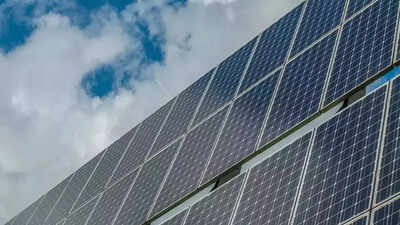
The Budget also signalled India’s intent to make the energy transition largely on its own steam with a booster dose of Rs 19,500 crore for an expanded PLI (performance-linked incentive) scheme to promote domestic manufacturing of high-efficiency solar modules, compulsory biomass burning at coal power plants and making energy audit of commercial buildings mandatory to boost ESCo (energy saving company) business.
“When energy transition and climate action become one of four pillars of the Budget speech, “it sends a strong signal of the government's intent to drive economic growth and employment through sunrise sectors focused on sustainability,” CEEW chief Arunabha Ghosh said.
“India will now join a select group of countries, primarily European, which have issued such bonds. We can also expect this move to catalyse the development of the domestic corporate green bond market,” Hetal Gandhi of CRISIL Research said.
The additional PLI allocation is expected to help set up of 30-35 GW (gigawatts) of solar module capacity and 25-30 GW of cell capacity by 2024 as the country targets a 280 GW solar capacity by 2030.
“This will reduce dependence on imports, which stand at 90% for cells and 75-80% for modules currently. It will make India not only self-reliant for annual module needs but also open up export opportunities for domestic module manufacturers,” Gandhi said.
The Budget proposal of mandatory 5-7% co-firing of biomass pellets in coal power plants will reduce emissions and could curb stubble burning, saving an estimated 38 million tonne of CO2 emission a year. But the availability of pellets can be a hurdle unless states set up infrastructure to turn stubble into pellets.
In addition to announcing India's 'net zero' emission goal by 2070 at COP26, PM Narendra Modi had promised to meet 50% of the country's electricity requirement from renewables by 2030, and reduce the emissions intensity of GDP by 45% by 2030 from 2005 levels. Besides solar, electricity from wind, small hydro and biomass will figure prominently in the country's overall renewable energy target.
The Budget also signalled India’s intent to make the energy transition largely on its own steam with a booster dose of Rs 19,500 crore for an expanded PLI (performance-linked incentive) scheme to promote domestic manufacturing of high-efficiency solar modules, compulsory biomass burning at coal power plants and making energy audit of commercial buildings mandatory to boost ESCo (energy saving company) business.
“When energy transition and climate action become one of four pillars of the Budget speech, “it sends a strong signal of the government's intent to drive economic growth and employment through sunrise sectors focused on sustainability,” CEEW chief Arunabha Ghosh said.
“India will now join a select group of countries, primarily European, which have issued such bonds. We can also expect this move to catalyse the development of the domestic corporate green bond market,” Hetal Gandhi of CRISIL Research said.
Ghosh said using green bonds to fund public sector infrastructure projects would also help private players tap into a deeper green bond market. “Offering climate finance services through GIFT City suggests that India could aspire to become a hub of sustainability financing,” Ghosh said.
The additional PLI allocation is expected to help set up of 30-35 GW (gigawatts) of solar module capacity and 25-30 GW of cell capacity by 2024 as the country targets a 280 GW solar capacity by 2030.
“This will reduce dependence on imports, which stand at 90% for cells and 75-80% for modules currently. It will make India not only self-reliant for annual module needs but also open up export opportunities for domestic module manufacturers,” Gandhi said.
The Budget proposal of mandatory 5-7% co-firing of biomass pellets in coal power plants will reduce emissions and could curb stubble burning, saving an estimated 38 million tonne of CO2 emission a year. But the availability of pellets can be a hurdle unless states set up infrastructure to turn stubble into pellets.
In addition to announcing India's 'net zero' emission goal by 2070 at COP26, PM Narendra Modi had promised to meet 50% of the country's electricity requirement from renewables by 2030, and reduce the emissions intensity of GDP by 45% by 2030 from 2005 levels. Besides solar, electricity from wind, small hydro and biomass will figure prominently in the country's overall renewable energy target.
End of Article
FOLLOW US ON SOCIAL MEDIA










Hot Picks
TOP TRENDING
Trending Stories
In Business
Entire Website
- Will banks open only for 5 days a week? Here’s what you should know about IBA’s proposal
- India set to be third largest economy, says S&P Global
- Dalal Street bull run continues! BSE Sensex crosses 69,000 for the first time; Nifty above 20,800
- Byju’s reduces notice period for employees as troubles mount
- Sensex surges over 900 points, Nifty above 20,550 as BJP state election wins bolster Modi's Lok Sabha 2024 prospects
- UltraTech to buy building materials business of Kesoram in 7,600 crore deal
- Tata Technologies stock debuts at a bumper 140% premium; share price at Rs 1200 on BSE
- Tata Technologies share allotment: How to check IPO allotment status, listing date, GMP
- BSE m-cap rides rally in Adani stocks, tops $4 trillion
- Charlie Munger, who helped Warren Buffett build Berkshire, dies at 99
- 'Be cautious': VP Dhankhar reacts to Supreme Court's 'caged parrot' remark on CBI
- 2 attempts to 'kill' Trump in 2 months: How it may impact US polls
- Will Atishi replace Arvind Kejriwal as Delhi CM?
- Docs sit down for talks with Mamata; minutes of meet to be recorded
- 'I had a birdie putt': Trump's first reaction after 2nd assassination bid
- Kohli's jersey hogs limelight in Pakistan during Babar Azam's match
- Cow vigilantes killing a Brahmin is the wake-up call India needed
- Apple's biggest 'iPhone update' for year 2024 rollout starts today
- Make It Priceless: Gift them a customized TOI Front Page. Know More
- 'No talks with Pak till ...': Amit Shah accuses NC, Cong of 'nurturing' terrorism



Popular Categories
Hot on the Web
Top Trends
Who is Ryan RouthUPI Transaction LimitArvind Kejriwal ResignationNEET UG Admission CriteriaKolkata Doctor Rape CaseBorder Gavaskar TrophyRohit SharmaSports Stars Turned Power CouplesIBPS RRB Clark PO ResultDonald TrumpBianca Belair Net WorthIndia vs Korea LiveBMW Accident Madhya PradeshIndore BMW CrashPrince HarryMiami Dolphins OwnerLive Cricket Score
Trending Topics
Living and entertainment
Latest News
4 types of tea to improve gut health and ease digestive issuesWho was Illia 'Golem' Yefimchyk, the Belarusian bodybuilder who consumed 2.5 kg of meat and 108 sushi pieces daily before his death at 36?Vempalle Shareef's story is now a lesson for degree students in Andhra PradeshWhen Shah Rukh Khan performed 'Kanyadaan' at Farah Khan's wedding- See PICSBike rally held to raise voter awareness in Jammu and Kashmir's Doda ahead of assembly electionsFalcons' Predictable Offense and Cousins' Prime-Time Woes Spell Trouble in PhiladelphiaFather-son duo Eugene and Dan Levy's dazzling entrance at the EmmysLiza Colon becomes 1st Latina to win Best Supporting Emmy Award'Oh no!': Hilarious goof-up leads to missed catch, leaves bowler in smile. WatchJr NTR on shooting under water scene for 35 days in 'Devara Part 1': It is an important sequence!Last Lunar Eclipse of 2024: What it means for your zodiac signTop NFL Superstars Who Are Vegan: Derrick Morgan, David Carter, Theo Riddick and moreKSCA Invitational: Arjun Tendulkar takes match haul of 9 wickets in big Goa CA XI winAbhishek Kumar shares selfies with Alia Bhatt; recalls the time when he worked as a crowd artist in ‘Humpty Sharma Ki Dulhaniya’Jessica Gunning wins her 1st Primetime Emmy for 'Baby Reindeer'Shocking! Man celebrates birthday by lying among massive Pythons‘Stree 2’ star Shraddha Kapoor to reveal her character name! But there’s a catchSathiyan set to partner Sreeja in mixed doubles
Copyright © 2024 Bennett, Coleman & Co. Ltd. All rights reserved. For reprint rights: Times Syndication Service