
- News
- Business News
- India Business News
- Eased Companies Act to help startups take private company route
Trending
This story is from June 24, 2015
Eased Companies Act to help startups take private company route
The recent relaxations in the Companies Act, 2013, notified by the ministry of corporate affairs (MCA) for private companies, such as flexibility in issue of share capital, ease in raising debt from shareholders and reduced compliance burden, has caught the attention of budding entrepreneurs.

As a minimum share capital is no longer required at the time of incorporation, entrepreneurs are increasingly looking at setting up a private company, rather than opting for other legal forms of entities - such as limited liability partnerships.
The notification issued by the MCA in early June has been placed before both houses of Parliament for approval.
Since December 2000, the minimum paid-up share capital for a private company was Rs 1 lakh; now, there is no such requirement. In fact, this particular amendment was notified earlier on May 26. "Requirement of a minimum share capital was demoralizing for startups. Now, even the stamp duty burden attached at the inception stage has been done away with. INC-7, which is the e-application form for company incorporation, no longer requires mention of the quantum of share capital," explains Gopika Shah, partner at Pramod S Shah & Associates, practising company secretaries. "Many young entrepreneurs are showing keen interest in incorporating private companies. We will soon see many companies, largely in the services sector, being incorporated with minuscule capital," adds Shah.
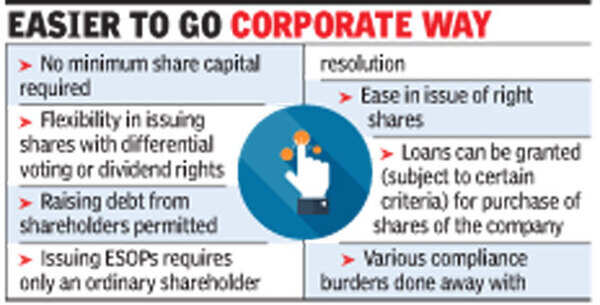
According to MCA's notification dated June 5, private companies are exempt from the provisions of section 43 (relating to types of share capital that can be issued) and section 47 (restriction on voting rights) of the Companies Act, 2013. "Thus, startups incorporated as private companies will have full flexibility in structuring their share capital which is often required to facilitate and accommodate the terms of a Venture Capital investment," says Vishwas Panjiar, Director, Walker Chandiok & Co.
"Exemption from these sections gives freedom to a startup company, to issue any type of instruments, whether it is common shares, preference shares, multi-class shares with special rights and even provide for differential voting and dividend rights to their shareholders. This gives good flexibility for raising funds," adds Vaibhav Parikh, partner, Nishith Desai Associates, international legal counsellors.
According to the notification, a private company can now also obtain deposits from its members to the extent of 100% of its paid-up capital and free reserves. There is no requirement for such a company to issue an offer circular or create a deposit repayment reserve.
"This will be very useful for startup companies. In the absence of a collateral, banks are averse to finance startups. There are a couple of funds that give venture debt (i.e. debt without personal guarantee and hard collaterals) but most of the startups are deprived of debt finance. This relaxation will enable shareholders to lend monies to startups. Permitting debt beyond the stipulated limit would have been more beneficial. However, this is a good start and it also balances risks of highly leveraged companies," says Parikh.
Section 67, which places restrictions on companies for advancing loans for purchase of its own shares, no longer applies to private companies which meet certain criteria - they do not have a corporate shareholder; do not have borrowings from banks, financial institutions or corporates of not more than twice of their paid-up share capital or Rs 50 crore, whichever is lower, and are not in default in repayment of borrowings at the time the loan is being granted. According to experts, these restrictive provisions may hinder startup companies from reaping its full benefits. For instance, most VCs, which invest in startup companies, would be body corporates.
As the startup corporate entity begins to grow, it will now be easier for it to issue right shares. MCA's notification provides that a private company can make a rights issue as soon as 90% of shareholders provide their consent. Issue of ESOPs now requires a simple resolution, as against a special resolution (requiring approval from at least 75% of shareholders).
Operational ease has also been introduced. The board is not required to obtain consent of the shareholders with regard to transactions such as sale of the undertaking, investments or borrowings. Private companies also do not have to file with the Registrar of Companies, the board resolutions, which will reduce compliance cost. "Young entrepreneurs were keen to register a company, but worried about compliance hassles and did not even have enough budgets for meeting the compliance requirements. With operational relaxations and relaxations relating to raising of funds via share capital or debt, private companies may be the preferred mode for entrepreneurship in India," sums up Shah.

About the Author
Lubna KablyEnd of Article
FOLLOW US ON SOCIAL MEDIA










Photostories
Hot Picks
TOP TRENDING
Trending Stories
In Business
Entire Website
- Will banks open only for 5 days a week? Here’s what you should know about IBA’s proposal
- India set to be third largest economy, says S&P Global
- Dalal Street bull run continues! BSE Sensex crosses 69,000 for the first time; Nifty above 20,800
- Byju’s reduces notice period for employees as troubles mount
- Sensex surges over 900 points, Nifty above 20,550 as BJP state election wins bolster Modi's Lok Sabha 2024 prospects
- UltraTech to buy building materials business of Kesoram in 7,600 crore deal
- Tata Technologies stock debuts at a bumper 140% premium; share price at Rs 1200 on BSE
- Tata Technologies share allotment: How to check IPO allotment status, listing date, GMP
- BSE m-cap rides rally in Adani stocks, tops $4 trillion
- Charlie Munger, who helped Warren Buffett build Berkshire, dies at 99
- High stakes in J&K polls phase 3: 415 candidates vie for 40 constituencies
- Israel informs US of 'limited ground operations' in Lebanon
- 7 Hezbollah leaders killed in 7 days. Will Israel stop? What can Iran do?
- From pager blasts to Nasrallah’s killing: How Israel is creating 'new MidEast'
- SA20 Auction: Players, squads, date - everything you need to know
- 'Unacceptable,' says Rahul Gandhi as Delhi police detains Sonam Wangchuk
- Rs 7.8 lakh crore debt – will political instability kill Maharashtra?
- Video that may have led to Gaurav Taneja and Ritu Rathee's divorce rumours
- Pak man, B'deshi wife, her parents living with fake IDs held near B'luru
- Pawn or kingmaker? Voters will decide Engineer Rashid fate today


Popular Categories
Hot on the Web
Top Trends
Israel Hezbollah WarMost Runs in International CricketVirat KohliIND vs BAN Live ScoreRohit SharmaIndian Team Fastest Test FiftyMohammed SirajUGC NET Result 2024TS DSC Results 2024Women T20 World Cup Points TableWomen T20 World Cup ScheduleShane McMahon Net WorthHezbollah ChiefTourists Not AllowedDiddyTop Management Colleges of IndiaLive Cricket Score
Trending Topics
Devara CollectionMithun ChakrabortyKangana RanautNavratri WishesGandhi Jayanti WishesAnant AmbaniDevara CollectionGandhi Jayanti 2024Masala OmeletteEmergencyDevaraTaaza Khabar 2 Twitter ReviewDevara Movie ReviewHealthy RaitasSwatantrya Veer SavarkarColdplay India tour 2025Smartphone DealsApple Macbook Air M1Amazon SaleWordle Answer
Living and entertainment
Latest News
iVoomi S1 Lite e-scooter launched at Rs 84,999: 180 km range, three-year warranty!Tata Nexon turbo CNG: Variant-wise features with price explainedPMI in India intensifies efforts against Illicit Tobacco Trade to Safeguard Economic Interests and Consumer ProtectionMumbai vs Rest Of India: Irani Cup tie offers chance for hopefuls and rejects to impress selectorsOlivia Culpo and Christian McCaffrey buy George Clooney's mansion for $14.5 millionKaun Banega Crorepati 16: Amitabh Bachchan believes he is 'Half-Sikh' recalling his maternal roots; reveals his aunts called him 'Amitabh Singh'RG Kar case: Kolkata court extends judicial custody of ex-principal, suspended cop till October 4When Dikembe's shoe size astonished the Mumbai Temple guardHow can Ben Stokes and other overseas players avoid a two-year IPL ban?"Nothing he was doing was believable", Darby Allin picks names wrestler who benefited most from AEW All In 2023 backstage incident5 ways insecurity can ruin a relationshipBengaluru resident exposes fake Flipkart agent attempting to deliver bogus iPhone 15; read online reactionsBihar and Jharkhand among top two states enrolling for contributory pension scheme for farmers"Tyler Huntley’s 'Snoop' Nickname: The Rapper Connection Explained”BTS star V crowned 'Most Handsome Man in the World 2024'Decoding a bowl of Idli Sambhar: From calories to nutrientsTata to build DRDO-developed armoured vehicles for Morocco armed forcesIndia’s choking beyond Delhi: Byrnihat shows we have a big unnoticed pollution problem
Copyright © 2024 Bennett, Coleman & Co. Ltd. All rights reserved. For reprint rights: Times Syndication Service