
- News
- Business News
- India Business News
- Byju Raveendran’s communist influences help 3.5 million poor children
Trending
This story is from February 11, 2022
Byju Raveendran’s communist influences help 3.5 million poor children

BENGALURU: The communist influences from his early life, combined with his extraordinarily rapid rise to billionaire status, has encouraged Byju Raveendran, together with his wife Divya Gokulnath, to launch a massive online education initiative for India’s underprivileged.
More than 3.5 million children are already part of the free programme that began in a small way 15 months ago.
“The media talks about us being billionaires, we don’t care about that. Nothing has changed for me in the last 10-20 years, except that I’m able to help a lot more people today,” Raveendran told TOI.

Raveendran’s education technology company Byju’s is currently India’s most valued private company, at $18 billion. Raveendran said he would call their effort a success “only when we create the largest for-profit education company, and the largest not-for-profit initiative.” Between the two, he said, the second is easier to do because there’s nobody doing it at scale.
Raveendran grew up in the communist dominated village of Azhikode in Kannur district of Kerala. That, he said, made him realise “there are a lot of good things about it…I’m not a communist, many of those ideas are not practical…but the best thing about that is looking at all as equals.”
Gokulnath said the inequities in the world of physical education are far more difficult to solve, given the need to set up schools and employ good teachers. “Our virtual offering addresses that issue. We are able to provide high quality education content at a massive scale at zero cost. Our products run even without the internet. For many children, our content has become the primary mode of learning,” she said.
Under Byju’s `Education for all’ initiative, the video content offered in paid subscriptions are offered free to children in poor communities, many of who do not go to school, or have appalling school facilities. English voices in the videos have been converted into 11 Indian languages.
The programme is being implemented through NGOs. “At last count, there were 128 NGOs, and that number is rising rapidly,” Mansi Kasliwal, vice president at Byju’s, who leads the programme, said.
Together with the NGOs, Kasliwal’s team figures out the gap students face – whether it is device, content, or teacher – and takes appropriate steps. “We have children now studying even in the remotest parts of India – Uri, Uttarakhand, Sundarbans. We have children with HIV, who can’t go to schools, so we take the school to their hospital beds,” Kasliwal said.
While many children use a device the family already has, the NGOs are also raising funds to supply appropriate devices. Byju’s too donates.
Gokulnath said their artificial intelligence (AI) system is hardcoded into the app, so the app figures out the most appropriate content for a child even without the internet. The internet is needed only occasionally to sync progress, so that Byju’s can monitor learning outcomes.
Consultancy firm KPMG did a study on the initiative that found that 75% of children use the app for an average of 1 hour every day, and 57% attributed improvement in their performance to the app. Girls form 50% of the learners. Girls, Gokulnath noted, had suffered the highest learning losses during the pandemic.
More than 3.5 million children are already part of the free programme that began in a small way 15 months ago.
But so sharp has the pickup been in the past few months that the couple have raised the target for the programme to 10 million children, from the initial 5 million.
“The media talks about us being billionaires, we don’t care about that. Nothing has changed for me in the last 10-20 years, except that I’m able to help a lot more people today,” Raveendran told TOI.
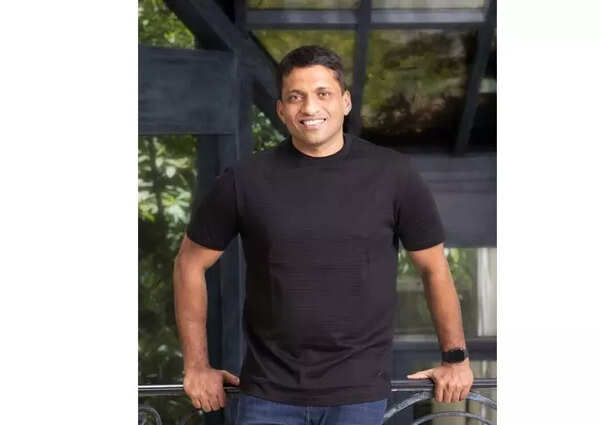
Byju Raveendran
Raveendran’s education technology company Byju’s is currently India’s most valued private company, at $18 billion. Raveendran said he would call their effort a success “only when we create the largest for-profit education company, and the largest not-for-profit initiative.” Between the two, he said, the second is easier to do because there’s nobody doing it at scale.
Raveendran grew up in the communist dominated village of Azhikode in Kannur district of Kerala. That, he said, made him realise “there are a lot of good things about it…I’m not a communist, many of those ideas are not practical…but the best thing about that is looking at all as equals.”
Gokulnath said the inequities in the world of physical education are far more difficult to solve, given the need to set up schools and employ good teachers. “Our virtual offering addresses that issue. We are able to provide high quality education content at a massive scale at zero cost. Our products run even without the internet. For many children, our content has become the primary mode of learning,” she said.

Under Byju’s `Education for all’ initiative, the video content offered in paid subscriptions are offered free to children in poor communities, many of who do not go to school, or have appalling school facilities. English voices in the videos have been converted into 11 Indian languages.
The programme is being implemented through NGOs. “At last count, there were 128 NGOs, and that number is rising rapidly,” Mansi Kasliwal, vice president at Byju’s, who leads the programme, said.
Together with the NGOs, Kasliwal’s team figures out the gap students face – whether it is device, content, or teacher – and takes appropriate steps. “We have children now studying even in the remotest parts of India – Uri, Uttarakhand, Sundarbans. We have children with HIV, who can’t go to schools, so we take the school to their hospital beds,” Kasliwal said.
While many children use a device the family already has, the NGOs are also raising funds to supply appropriate devices. Byju’s too donates.
Gokulnath said their artificial intelligence (AI) system is hardcoded into the app, so the app figures out the most appropriate content for a child even without the internet. The internet is needed only occasionally to sync progress, so that Byju’s can monitor learning outcomes.
Consultancy firm KPMG did a study on the initiative that found that 75% of children use the app for an average of 1 hour every day, and 57% attributed improvement in their performance to the app. Girls form 50% of the learners. Girls, Gokulnath noted, had suffered the highest learning losses during the pandemic.
End of Article
FOLLOW US ON SOCIAL MEDIA










Hot Picks
TOP TRENDING
Trending Stories
In Business
Entire Website
- Will banks open only for 5 days a week? Here’s what you should know about IBA’s proposal
- India set to be third largest economy, says S&P Global
- Dalal Street bull run continues! BSE Sensex crosses 69,000 for the first time; Nifty above 20,800
- Byju’s reduces notice period for employees as troubles mount
- Sensex surges over 900 points, Nifty above 20,550 as BJP state election wins bolster Modi's Lok Sabha 2024 prospects
- UltraTech to buy building materials business of Kesoram in 7,600 crore deal
- Tata Technologies stock debuts at a bumper 140% premium; share price at Rs 1200 on BSE
- Tata Technologies share allotment: How to check IPO allotment status, listing date, GMP
- BSE m-cap rides rally in Adani stocks, tops $4 trillion
- Charlie Munger, who helped Warren Buffett build Berkshire, dies at 99
- 'Deal with it': Oppn vs BJP over PM Modi attending Ganpati Puja at CJI's house
- In the (y)ear of conspiracy theories, Trump hears insults galore
- Actor dies in his sleep. Why sudden heart attacks are killing Indians
- Adani Group rejects Hindenburg claim of $310 mn asset freeze in Swiss banks
- On Mamata's 'ready to resign' offer, protesting docs say 'want justice'
- UK court finds Pakistani guilty of killing Tamil restaurant manager
- Pictures, videos: Why there is no other beach like this in India
- Planning to buy iPhone 16? How much Apple will give for iPhone 12 & others
- IAF wants Tejas jet production to be ramped up as US delays engines supply
- ‘Want peace & dignity, not graveyard for Kashmiris’: Engineer Rashid



Popular Categories
Hot on the Web
Top Trends
Trending Topics
Alia BhattMalaika Arora Father DeathArbaaz KhanNatasa StankovicMr Bachchan OTT ReleaseNational Parks In IndiaSelena GomezGOAT CollectionVikas Sethi DeathMalayalam ProducersIndia's Best Dancer 4Simi GarewalDilli BabuIndian National ParksLaung BenefitsVikas SethiiPhone 16Microsoft 365 OutageCsir Ugc Net 2024Wordle Answer
Living and entertainment
Latest News
India successfully flight tests surface-to-air missileDigest this: Unhealthy gut may be linked to Parkinson’s diseaseCSIR UGC NET 2024 result declared: Steps to download scorecards at csirnet.nta.ac.in'Played a big role in turning the cricket around': Ricky Ponting applauds Virat Kohli’s brilliance as India’s former captainAadhaar card update: Do you have to compulsorily update details on your Aadhaar every 10 years?Single Indians are now choosing slow, meaningful dates over-elaborate outings, reveals an online dating platform’s surveyWho was Illia 'Golem' Yefimchyk, the Belarusian bodybuilder who consumed 2.5 kg of meat and 108 sushi pieces daily before his death at 36?Pakistan: Bilawal cautions Shehbaz govt against political victimisation, points to Imran Khan's caseVijay Varma reveals he was DROPPED from 'Sacred Games' at the last minuteMahindra Thar Roxx with VIN 0001 to be auctiond for charity: How to registerWWE Star Discusses Why Sid Vicious Deserves a Hall of Fame SpotVijay Sathya-starrer 'Dhil Raja' to release in SeptemberHarvard University Sees Drop in Black Freshman Enrollment Post-Supreme Court Ruling on Affirmative ActionCatching up with sports stars in DelhiSalman Khan surrounded by bodyguards as he arrives at Malaika Arora's mother's house to offer his condolences - WATCHCMF Buds Pro 2 by Nothing review: Big delivery on a budgetMallika Sherawat makes big screen comeback in Rajkummar Rao's 'Vicky Vidya Ka Woh Wala Video'; director reveals why he cast herArbaaz Khan spotted outside Malaika Arora's house along with police after the tragic news of her father's demise by alleged suicide - WATCH VIDEO
Copyright © 2024 Bennett, Coleman & Co. Ltd. All rights reserved. For reprint rights: Times Syndication Service