
- News
- Business News
- India Business News
- 6th straight RBI rate hike set to make home loans costlier
Trending
This story is from February 9, 2023
6th straight RBI rate hike set to make home loans costlier
Home loans and other borrowings will get more expensive, with the RBI raising its key policy rate by 25 basis points on Wednesday. The sixth consecutive rise since the RBI started hiking rates in May 2022 has resulted in a 250-basis-point increase in interest rates.
The monetary policy committee voted 4:6 in favour of increasing the repo rate — the rate at which the RBI lends to banks — to 6.5% from 6.25% earlier. The rate hike will immediately impact individual borrowers and small businesses as most retail loans are linked to the repo and get re-priced immediately. Announcing the MPC decision, RBI governor Shaktikanta Das said inflation was moderating, and “the worst is behind us”. “The stickiness of core or underlying inflation is a matter of concern. We need to see a decisive moderation. We have to remain unwavering in our commitment to bring down inflation,” he said.
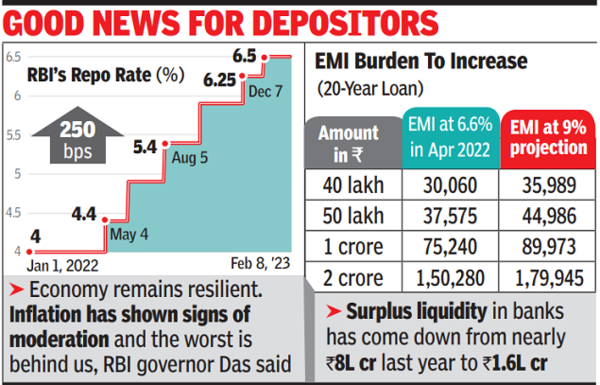
The hike is good news for depositors as the increase in lending rates would mean that the banks will have more headroom to offer higher returns without sacrificing their margins. Das said the rate hike has resulted in the real policy rate (rate adjusted for inflation) moving into positive territory.
While some new borrowers with a high credit score can borrow at 8.5% thanks to the competition for home loans, the older borrowers who took loans at 6.5% earlier this fiscal will see their borrowing cost rise to 9%. Das said that economic activity remains resilient and urban activity is firming up, especially in services — travel, tourism and hospitality with domestic air passenger traffic crossing pre-pandemic level. “Several high-frequency indicators also point toward the strengthening of activity. “Investment activity continues to gain traction. The total flow of resources to the corporate sector increased to over Rs 20.2 lakh crore as against Rs 12.2 lakh crore a year ago,” said Das.
While the governor remained cautious about inflation, he said he was optimistic about the economy. “Available data for Q3 and Q4 2022-23 indicates that economic activity in India remains resilient. Urban consumption demand has been firming up, driven by a sustained recovery in discretionary spending, especially on services such as travel, tourism and hospitality,” said Das.
Real estate experts said that the policy might temper demand for housing. “With the appreciation in real estate prices in the last couple of quarters, any increase in the interest rates, which had already breached the 9.5% mark, would put pressure on sales volumes in the affordable and lower mid-range housing segments, which are more cost-conscious,” said Anuj Puri, chairman of Anarock Group.
Shishir Baijal, chairman & managing director, Knight Frank India, said that so far the impact of the interest rate hike on the housing sector has been limited. The Knight Frank affordability index has deteriorated marginally by an average of 1.4% over the last year. Demand for home loans has remained strong during the last year, as seen in 16% growth in December 2022. “We hope that this rate hike will not adversely impact consumer sentiments towards home purchases in the coming financial year,” Baijal said.
Stay informed with the latest business news, updates on bank holidays and public holidays.
Decode charts & maximise your stock market earnings | Register Today!
End of Article
FOLLOW US ON SOCIAL MEDIA










Hot Picks
TOP TRENDING
Tired of too many ads?go ad free now
Trending Stories
In Business
Entire Website
- RBI takes note! How overseas students are being used by wealthy parents to stash money abroad
- Stock market crash: LIC’s stock portfolio takes a Rs 1.5 lakh crore hit in 2025 as markets bleed
- With IRCTC & IRFC, 7 rail PSUs hold 'navratna' status
- Stock market today: BSE Sensex opens over 350 points down; Nifty50 below 22,000
- Top stocks to buy today: Stock recommendations for March 4, 2025
- ‘You are better off…’: Zerodha's Nithin Kamath shares SIP mantra amidst stock market crash doom and gloom
- How Indian Railways will opt for mix of nuclear, solar, hydropower for 2030 net zero plan
- Stock market crash: Mayhem in smallcap and midcap stocks! What should investors do?
- Stock market today: BSE Sensex opens over 350 points up; Nifty50 above 22,200
- Top stocks to buy: Stock recommendations for the week starting March 3, 2025
- Sambhal’s 2nd coming: How riots changed city’s skyline
- Trump to address Congress for first time since returning to power
- Why new stock market investors may be in for quite a shock
- Minus US' military teeth, Europe vulnerable to Russia
- Kannada actor & DGP's daughter held at airport with 14 kg gold in belt
- India sends request to US seeking crucial info in Rs 64 crore Bofors case
- Why it will take more than a generation to fix mess caused by Trump
- Zepto CEO Aadit Palicha corrects Zomato CEO Goyal: ‘With due respect…’
- Watch: Virat's million-dollar expression looking at Anushka
- Watch: What Virat told Rohit just before India won CT semis


Tired of too many ads?go ad free now
Explore Every Corner
Across The Globe
Houston Rockets vs Indiana PacersMilwaukee Bucks vs Atlanta HawksJoe Burrows OutfitKyiv ReadyAdam SandlerEdmonton OilersTom BradyNew Orleans Pelicans vs Los Angeles LakersElon MuskRhea RipleyCharissa ThompsonTop 5 Bank Fixed DepositsTravis KelceHouston Rockets vs Indiana PacersGolden State Warriors vs Newyork KnicksKyrie Irving ACL InjuryJames Harrison Passes AwayHCL Tech CEOTaylor SwiftPatrick MahomesGiannis AntetokounmpoJoel EmbiidAuston MatthewsTravis ScottSeth JonesBank HolidaysBank Holidays in MarchJames BradberryElon MuskICC Champions Trophy Live Streaming
Hot on the Web
Rubina DilaikYuzvendra ChahalHeart HealthTravis HeadBanarasi SareesIndia vs AustraliaAmitabh BachchanBeer vs WhiskeyAloe Vera For HairTaarak Mehta Ka Ooltah ChashmahKL RahulArthritis DietAnkita LokhandeOptical illusionRegrow HairBhagyashreeNaga ChaitanyaMahira SharmaChhaava Box Office CollectionMorning Brain ExercisesBig Cats IndiaSadhguru Diet HabitsShakti KapoorBeetroot Dosa RecipesUS National ParksUnique AnimalsHomemade Protein MealsFatty Liver Reducing FoodsBaby Girl NamesSeasonal Fruits
Trending Topics
Joe BurrowTaylor SwiftWayne GretzkyTravis KelceTaylor Swift RelationshipJon CooperBrady TkachukRyan WhitneyPatrick MahomesDonald Trump Major SpeechStephen CurryBlake LivelyJuan SotoLuka DoncicJimmy ButlerLebron JamesLamelo BallStephen CurryDonovan MitchellElon MuskNyt ConnectionsKing Legacy CodesJujutsu Infinite CodesWordle HintsNyt StrandsNothing Phone 3aHow to Watch SA vs NZ MatchSA vs NZ Match Weather UpdateChampions Trophy ScheduleICC Champions Trophy 2025 Live Streaming
Popular Categories
HeadlinesSports NewsBusiness NewsIndia NewsWorld NewsBollywood NewsHealth+ TipsIndian TV ShowsTechnologyICC Champions TrophyIPLTravelEtimesHealth & FitnessWWENFLHow to watch IPL 2025How to watch IPL in CanadaHow to watch IPL in USANSE HolidaysBSE HolidaysMCX HolidaysStock Market HolidaysTechnology NewsInternational SportsAstrologyPublic HolidaysBank HolidaysIndia vs AustraliaWeather Today
Latest News
Discover the secret power of Pyrite: Your key to wealth awaits!Donald Trump may announce Canada-Mexico tariff relief on Wednesday: US commerce secretaryBangladesh students-built party calls for new constitutionWATCH: What Virat Kohli told Rohit Sharma just before India won the Champions Trophy semifinal against AustraliaArab leaders endorse plan to rebuild Gaza under Palestinian AuthorityCan you download Palworld from Steam on macOS?Ranveer Allahbadia skips Assam Police summons amid ongoing congroversySuhora Tech wins IN-SPACe seed fund grant for maritime domain awarenessPrime Venture Partners launches $100 million fund to invest in early-stage Indian startups"You have a wife and a child" – Supriya Menon's playful reminder to PrithvirajChhaava box office collection Day 19: Vicky Kaushal starrer slows down; earns Rs 5.5 core as it nears Rs 500 crore milestoneLifestyle tips that can help prevent heart attacks and strokes5 best Hunter Evolution decks in Clash RoyaleThe role of genetics in infant hearing loss: What parents need to knowExclusive- Sehban Azim on Ramadan 2025: I feel fasting helps in getting closer to Allah by practicing self-discipline, patience, and mindfulnessWATCH: Virat Kohli's million-dollar expression looking at Anushka in the stands after India's win in Champions Trophy semisFEFKA rejects blame for violence in society: ‘Cinema reflects reality, doesn’t create it’Israeli army tightens social media rules, bans base photography after probe finds Hamas used soldiers’ posts for Oct 7 attack
Copyright © 2025 Bennett, Coleman & Co. Ltd. All rights reserved. For reprint rights: Times Syndication Service