
- News
- Business News
- Budget News
- Budget 2024 income tax: Why Rs 20 lakh and not Rs 15 lakh should be the new threshold for 30% tax rate
Trending
This story is from January 30, 2024
Budget 2024 income tax: Why Rs 20 lakh and not Rs 15 lakh should be the new threshold for 30% tax rate
Budget 2024 income tax expectations: Income tax rates and tax slabs under the Finance Act 2023 have been reduced to five from six to make the new tax regime more lucrative. The simplified regime allows a standard deduction of Rs 50,000 per annum.
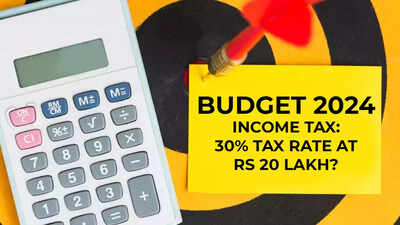
Budget 2024: Enhancing the tax threshold periodically will help maintain the real-income levels of taxpayers.
Budget 2024 income tax expectations: Imagine working for a job that pays you less money every year. Will you continue in such a job? The simple answer for most of us will be a resounding “No”. Welcome to inflation 101 - if you earn the same amount year after year, your real earnings have declined as you cannot buy the same basket of goods anymore.
The same concept applies to the Rs 15 lakh tax threshold, with India’s CPI ranging between the four-eight percent per annum over the past few years; the post-tax income of the common man is not substantial enough. All of us have borne the brunt of the unchanged limit. Enhancing the Rs 15 lakh threshold under the new tax regime to Rs 20 lakh could ease this burden.
The government launched an optional new tax regime under the Finance Act, 2020, enabling individuals and Hindu Undivided Families (HUF) to apply for lower tax rates by giving up certain deductions and exemptions, such as 80C, medical insurance, house rent allowance, and self-occupied property interest. Under this regime, tax rates are distributed per various slab rates starting from five percent and up to 30 percent in cases where annual taxable income exceeds Rs 15 lakh. The new tax regime is a logical choice for taxpayers who do not claim expenditures or investment benefits.
Income tax rates and tax slabs under the Finance Act 2023 have been reduced to five from six to make the new tax regime more lucrative. The simplified regime allows a standard deduction of Rs 50,000 per annum. The new tax regime is considered the default tax regime (unless opted otherwise by the taxpayer). Individual taxpayers and HUFs can still opt for the old tax regime when filing annual income tax returns if claims of eligible deductions and exemptions result in a lesser tax outflow. Wider adoption of the new tax regime is a clear objective for the tax authorities. Increasing the ceiling limit periodically on the basis of inflation will signify a pragmatic and taxpayer-friendly approach and encourage adoption.
This concept of inflation adjustment already exists in the capital gains tax regime. Adjusting the acquisition cost of the asset based on the cost inflation index helps the asset seller offset the impact of inflation while computing capital gains. Carrying forward this concept to the new income tax regime is indeed logical. Recent changes in the income tax rates and the slabs helped to reduce tax outflow for all income levels. However, as income increases, these tax savings get diluted on account of a 30 percent tax cost. Thus, it is time to revisit the said threshold.
Enhancing the tax threshold periodically will help maintain the real-income levels of taxpayers, preventing an unintentional increase in their tax burden as inflation erodes the purchasing power of money over time.
Also Read | Budget 2024: Why standard deduction for salaried taxpayers needs to be hiked
Further, consumer spending is a vital driver of economic activity. If the minimum income tax threshold does not keep pace with inflation, taxpayers may experience a decline in disposable income, leading to reduced spending.
Also, failure to adjust the minimum income tax threshold for inflation can cause economic disparities. Low and middle-income earners may be pushed into higher tax brackets, exacerbating inequality.
Also Read | Budget 2024 Income Tax: How taxpayers can be given relief
To ensure that individuals are not burdened with an increased tax liability, the minimum income tax threshold must be adjusted for inflation. An inflation-adjusted minimum income tax threshold not only safeguards taxpayers from an undue increase in their tax burden but also contributes to a more equitable and dynamic economic environment.
(Deepika Mathur is Executive Director, Deloitte Haskins & Sells LLP. Abhay Chaturvedi, Senior Manager at Deloitte Haskins & Sells LLP contributed to the article.)
Stay informed with the latest Business News on Times of India. Explore the list of Bank Holidays, stay informed about Budget 2025, discover the new Income Tax Slabs, and use the Income Tax Calculator for hassle-free tax planning.
Unlock Investment Potential: Enroll in ET's Stock Valuation Workshop - Batch 3. Secure Your Spot Now!

About the Author
TOI Business ExpertsEnd of Article
FOLLOW US ON SOCIAL MEDIA









Hot Picks
TOP TRENDING
Tired of too many ads?go ad free now
Trending Stories
In Business
Entire Website
- Budget 2025 income tax: Raise 30% income tax slab; provide flat 30% deductions on gross income - here’s why
- Top stock recommendations for January 22, 2025
- Stock market today: BSE Sensex over 300 points up; Nifty50 above 23,100
- TCS, Infosys & other top IT firms boost fresher hiring targets - details here
- 5 big PF changes in 2025: EPFO members take note - from easy PF transfer to EPF member profile updation
- Catch, Australian online retailer owned by Wesfarmers, to shut down; 190 jobs to be axed
- Top stock recommendations for January 21, 2025
- Stock market today: BSE Sensex opens in green; Nifty50 near 23,400
- Gautam Adani-led Adani Group appoints two US law firms, among world's largest, to fight SEC allegations
- MLK Day 2025: Are US stock markets open or closed on January 20, 2025?
- Tea for Rs 6, bhurji pav for Rs 60: How police tracked Saif Ali Khan's attacker
- 'Delhi will remove AAPda': PM Modi addresses BJP workers
- Letters, calls: How serial killer played hide & seek with Delhi Police
- How 'selfie with wife' led security forces to elusive Maoist leader Chalapathi
- 'Can't say' in 56 of 104 queries, 'yes' to CCTV clip: Roy's response in RG Kar probe
- Two Naxals killed in Jharkhand encounter, operations underway
- India’s taxpayers are hopping mad. Will govt provide some relief?
- 'My kid is never gonna grow up being smarter than... ': Sam Altman
- Why have Zomato shares crashed over 30% from all time highs?
- In pics: Jaishankar meets Trump's secretary of state Macro Rubio, other Quad leaders


Tired of too many ads?go ad free now
Popular Categories
Hot on the Web
Top Trends
H1b VisaIND vs ENG Schedule 2025JEE Mains 2025Tax CalculatorPublic Holidays 2025Barron Trump HeightIncome Tax SlabsBirthright CitizenshipChampions Trophy IndianTeam JerseyRachel BushBudget 2025 Income TaxUS Placate TrumpMohammed ShamiStock Recommendation TodayIndia vs England Playing XIWhere to Watch IND vs ENG SeriesBen JohnsonLive Cricket Score
Trending Topics
Emergency Box Office CollectionGame Changer Box Office CollectionSara Ali KhanBaba VangaPumpkin HalwaMost famous 7 WondersSouth Indian DishesDaily DietMagnesium DeficiencyMemory SharpArchana Puran SinghMagnesium DeficiencyBirthright Citizenshipemergency Box Office CollectionShark Tank India 4NYT ConnectionsAmazon SaleSatya NadellaTOI News
Living and entertainment
Latest News
Elderly woman scammed for Rs 66 lakh after being emotionally manipulated by a Chinese influencerTop Hezbollah leader Sheikh Muhammad Ali Hamadi shot dead inside his homeCardio Medithon 3 | Heart Disease in Women: the known and the unknownD Gukesh, Arjun Erigaisi to lead India's charge in Norway Chess 2025CBSE Social Science Class 10 exam 2025: 5 short answer questions students must practise'Boycott is not the way to go about it': Jos Buttler on England's Champions Trophy match against AfghanistanWhy a group of senior lawyers want CJI to instate a CBI inquiry against a sitting HC judgeWinter Special: How to make instant Gajar Mooli ka AcharPQIFL secures a landmark order from Capgemini for IT Park development in VietnamCBI takes over Tamil Nadu's hooch tragedy probeAmber Heard's performance in the Informers resurfaces, igniting online buzzChhattisgarh gangrape-triple murder: Korba court hands death penalty to 5 who killed teen, her father and his nieceKarnataka Bank PO result 2024 declared: Direct link to check hereRohit Sharma and Rishabh Pant set to feature in Ranji Trophy 2025: Match schedule, venue, and how to watch onlineWatch: Tata Curvv 1.2-litre turbo-petrol tows three trucks weighing 42,000 KG!Anusha Dandekar reunites with her 'First father-in-law, Amitabh Bachchan at Javed Akhtar’s 80th birthday celebration'So-called Bishop's service boring and uninspiring': Donald Trump reacts after Mariann Edgar Budde's mercy appeal for queersMP pre-board question papers for classes 10 and 12 leaked: Here is what has happened
Copyright © 2025 Bennett, Coleman & Co. Ltd. All rights reserved. For reprint rights: Times Syndication Service