




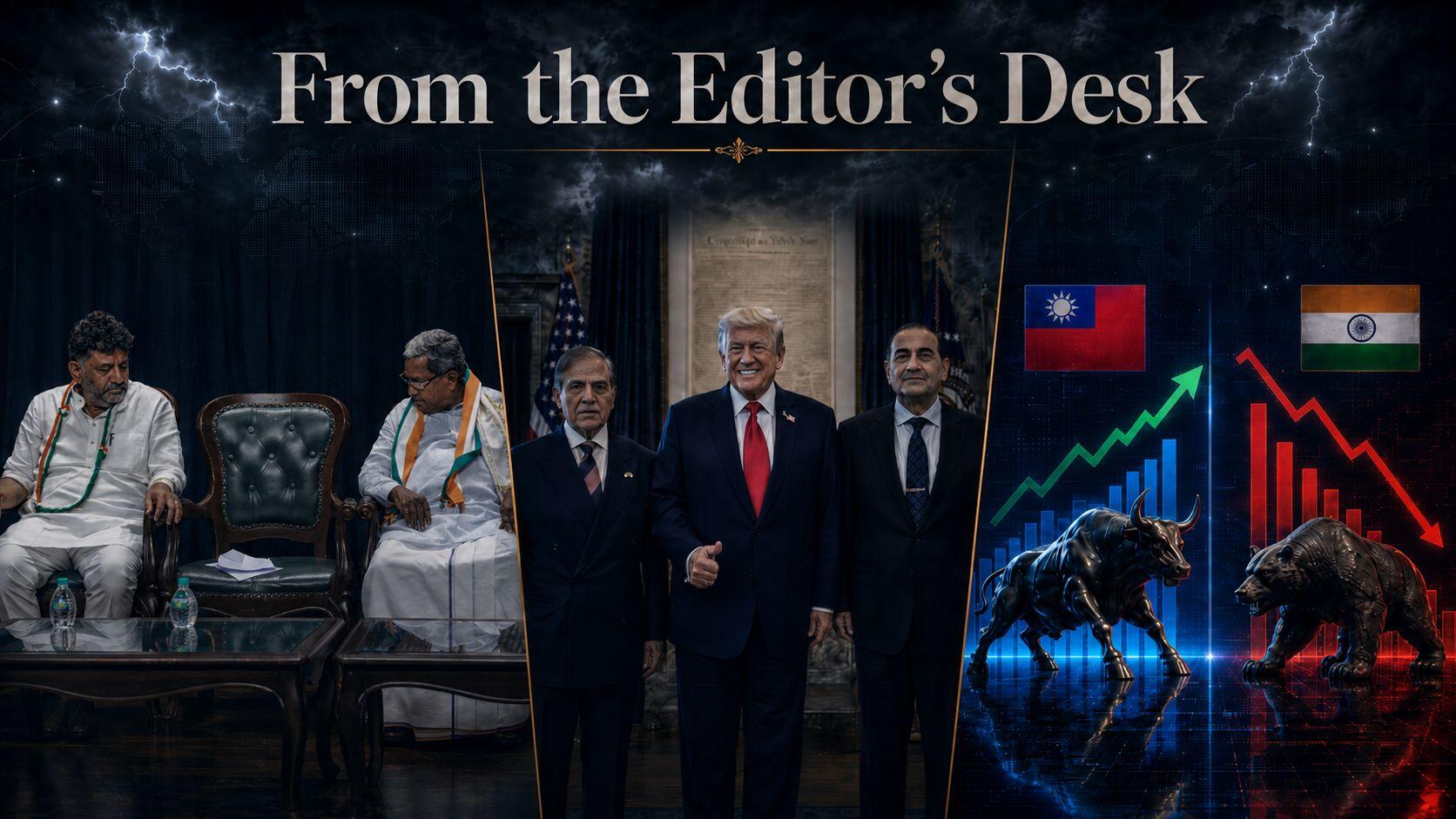

What happens when power is distributed or diluted in ways no one fully controls: The Congress party’s “CM‑in‑waiting” model has created a culture of endlessly jockeying for the kursi. In Rawalpindi, Pakistan’s Asim Munir risks an Icarus moment over the Abraham Accords. India’s richly valued stock market is becoming a victim of its own success. Cockroach Janta Party memes show Gen Z turning insults into viral avatars that rarely cross into real‑world power, even as a new study on dog brains underscores the long‑term costs of domestication.
‘CM-in-wating’: Why nobody – and everybody – seems in charge of Congress
If you’ve watched Congress politics over the past decade, you’ll know this script by heart.
First, a big victory or a hard-fought coalition. Then the suspense: Who’ll get the kursi? Names float in Delhi drawing rooms, “sources” whisper about informal deals, and one leader is sworn in while another is promised “their turn” halfway through the term. Fast-forward a couple of years and the real governance debate in the state isn’t about jobs, infrastructure or schools. It’s about whether that private power-sharing deal will actually be honoured.
Call it the Congress Model: One CM, one officially designated CM-in-waiting and five years of shadow-boxing.
Karnataka is only the latest episode. Siddaramaiah led the party back to power and became the face of the government. DK Shivakumar, the organisational workhorse and self-styled troubleshooter for the Gandhis, settled for deputy CM on the understanding that he’d get the top job midway. Ever since, the real story out of Bengaluru has been less about policy and more about palace intrigue: Breakfast summits, emotional cabinet farewells, and flights to Delhi to read the mind of the “high command”.
On paper, this is the OG “high command” party. In practice, no one seems fully in command.
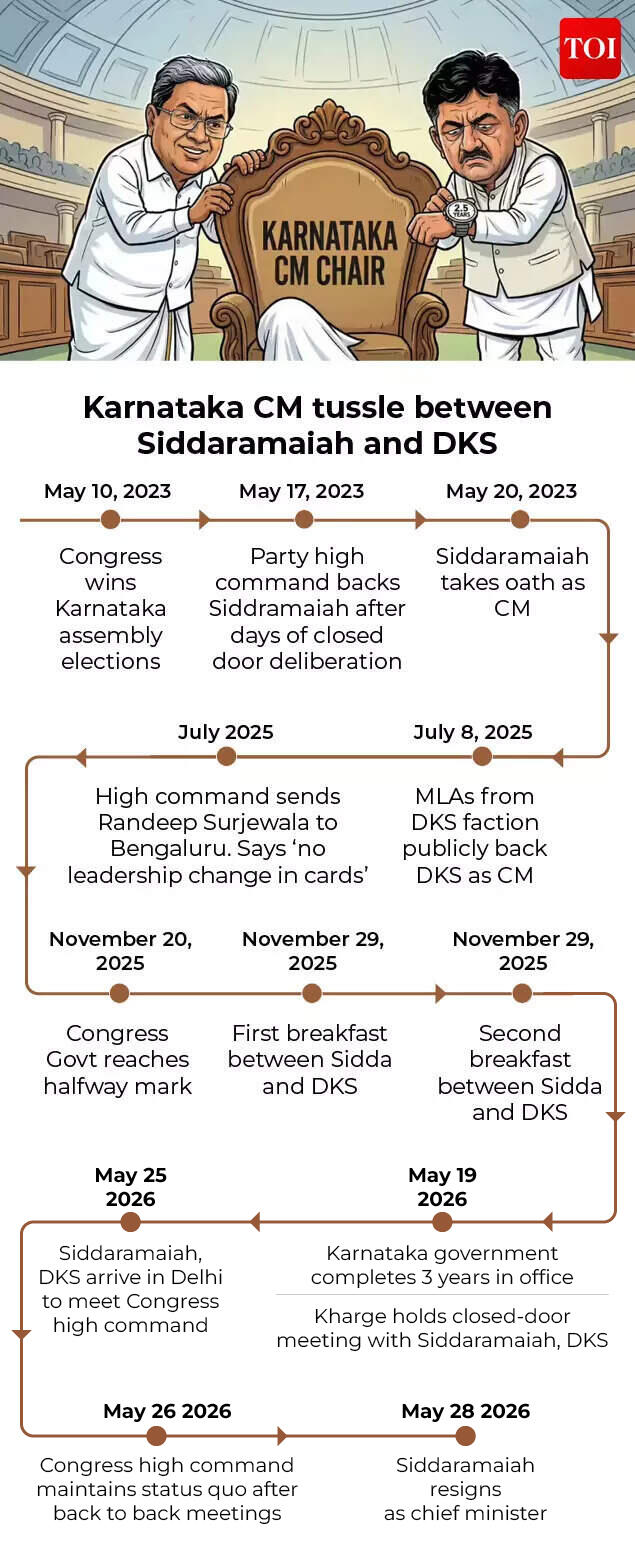

The pattern goes well beyond Karnataka. Jyotiraditya Scindia was billed as the future of Congress in Madhya Pradesh; the kursi went to Kamal Nath. Sachin Pilot was projected as the young face of Rajasthan; the job stayed with Ashok Gehlot. In Kerala, Rahul Gandhi’s supposed favourite “KC” lost out to VD Satheeshan. In each case, the party ended up with a chief minister and a powerful rival under the same roof, competing for attention, loyalties and, ultimately, credit.
The result is a kind of permanent coalition within a single party. The CM knows Delhi can change its mind. The aspirant knows sulking openly could help get the chair. So both spend precious political energy negotiating with each other and lobbying the Gandhis, instead of building a governance model. Voters watch this and conclude, not unreasonably, that the kursi matters more than governance.
Flying too close to Trump: Asim Munir’s Icarus moment
In Greek mythology, Icarus soars on wax wings, ignores warnings, flies too close to the sun and crashes. Pakistan’s Field Marshal Asim Munir now finds himself in a similar danger zone: Basking in the glow of Donald Trump’s attention while underestimating the heat from him.
Donald Trump’s latest push to expand the Abraham Accords may be Munir’s Icarus moment. In his pitch, Trump named Munir personally as one of the leaders he’d spoken to about bringing new Muslim-majority countries, including Pakistan, into the framework with Israel. That instantly elevated Munir as Washington’s preferred interlocutor on one of the most radioactive issues in Pakistan’s domestic politics.
As analyst Michael Kugelman warned, “the more you work with Trump, the greater the risk you’ll be asked to do something you don’t want to do—like join the Abraham Accords. An occupational hazard of being in his good graces.” That is the Icarus problem in one tweet.
For Munir, the structural constraints are brutal. Pakistan has never recognised Israel and has repeatedly tied any shift to the creation of a Palestinian state. Defence minister Khawaja Asif reiterated that line, saying “Personally, I don’t think we should join any such accord that clashes with our fundamental ideologies,” and, more categorically, “We have a very clear stance that this is not acceptable to us.”
Enter Lashkar-e-Taiba. Saifullah Kasuri, the group’s deputy chief, has now publicly threatened Pakistan’s “frontline leadership and top military officials” with “elimination” if they “even thought of recognising Israel,” promising that whoever accepts Israel “will be destroyed. God willing.”
So Munir is pulled in three directions at once: A transactional US president dangling prestige and diplomatic leverage; a domestic political elite that publicly rules out any accommodation with Israel; and a jihadist ecosystem that thrives on precisely this fault line. The more he appears in Trump’s sunbeam-as the man who could “deliver” Pakistan for the Accords-the more he risks overestimating his room for manoeuvre and underestimating the melting point of Pakistan’s internal consensus.
The Icarus parable is a warning about calibration. Can Munir engage Trump without letting himself be cast as the general who tested Pakistan’s ideological red lines on Israel at the behest of a foreign leader, with militants openly threatening bloodshed in response?
In other words, the question is not whether Munir can fly; it is whether he understands how waxed his wings really are.
How Indian stock market became a victim of its own success
For a while, it felt like Indian markets could do no wrong. Demat accounts were exploding, IPOs were getting snapped up in hours, and SIP flows were hitting fresh records every month. But that very strength is now showing up in an unexpected place: A weakening rupee and increasingly impatient foreign investors.
Look at the currency first. The rupee was around 85-86 to US dollar at the start of 2025, slipped past 90 by early 2026, and has recently flirted with 97. In just over a year, it has lost more than 10% against the dollar, making it one of Asia’s weakest performers. That isn’t happening in isolation – it’s tied directly to how rich Indian equities have become and how foreign capital is reacting.
Foreign portfolio investors have noticed the premium valuation of Indian stocks. As Swaminathan S Anklesaria Aiyar (“Swamy”) points out, an “astonishing $53 billion has exited Indian stock markets in the last 18 months.” In the past, that kind of selling would have hammered the indices. This time, it hasn’t – because domestic investors are stepping in. Monthly SIP inflows have climbed from roughly ₹20,000 crore at the start of 2025 to over ₹32,000 crore by March 2026, effectively buying what foreign money is selling and keeping the Sensex only modestly off its highs.
That creates a strange balance. Prices stay high, foreigners keep cashing out, and instead of a market correction, the strain shows up in the rupee.
Meanwhile, the global equity spotlight has shifted. Taiwan has just overtaken India to become the world’s fifth-largest stock market, with about $4.95 trillion in market cap versus India’s $4.92 trillion. The star is Taiwan Semiconductor Manufacturing Co, which now makes up roughly 42% of the benchmark index after a blistering AI-driven rally in its chips business.


Put it all together and India’s stock market looks like a victim of its own success: Too expensive to ignore on the way in, and now too tempting to resist on the way out. The indices are largely holding up, but the rupee is quietly footing the bill.
Ghibli, Cockroach Party and Gen Z: A short story of a long trend
Remember the Ghibli-fication fad, when your feed was full of people turning themselves into soft-edged anime protagonists? It felt harmless, but it also marked something bigger: the cartoonification of public life, where the goal is not persuasion or power, just the dopamine hit of going viral.
Fast-forward to 2026 and the Cockroach Janta Party (CJP). A misconstrued CJI remark about youngsters “like cockroaches” lit the fuse; Gen Z flipped the insult into a badge of honour. Suddenly, AI-generated cockroach mascots and “Cockroach Janta Party” posters were all over reels and X.
It is tempting to over-interpret this as a new kind of politics. In reality, it looks more like the latest chapter in the long story of online fads. There was a time when the Right seemed to dominate social media in India. Now, a more liberal, younger cohort appears louder. The faces and hashtags change, but the underlying logic stays the same: Go viral first, figure out what it means later.
Meanwhile, the distance between reel life and real politics remains a bridge too far. India, that is Bharat, is simply too large and too layered to be moved by one meme wave. The entry barriers to actual power – parties, money, ground organisation – have not shrunk just because our feeds are busier. For every rare outlier who breaks through, there are thousands of online “movements” that never leave the screen.
Cockroaches do have a reputation for surviving anything. Online, the Cockroach Janta Party may even have an afterlife, resurfacing in jokes, callbacks and nostalgia posts. But like the Ghibli avatars before it, it will eventually be nudged aside by the next filter, the next meme, the next clever way of turning frustration into something you can post in 10-15 seconds.
In that sense, the story is less about one fad and more about the rhythm of the platforms themselves. Toons and memes take over reel life, hold our attention briefly, and then make room for whatever comes after.
Dogs got cozier with humans – and their brains ‘paid the price’
For most of history, dogs have had one job: Solve human problems. Guard the camp. Trail a herd. Warm a bed. Now a new study in Royal Society Open Science suggests that long resume came with a hidden cost: Over thousands of years, our partnership quite literally took a bite out of the dog brain.
Researchers scanned the skulls of 22 prehistoric wolves and dogs, from 35,000 to 5,000 years ago, and compared them with 185 modern wolves and dogs. Because brains don’t fossilise, they used the hollow inside the skull – the endocranial volume – as a stand-in for brain size. The result, echoed in coverage from outlets like The Guardian and Popular Mechanics, is stark: by the Late Neolithic, dogs’ brains were dramatically smaller than those of wolves.
Here’s the twist. The first “protodogs,” living alongside Ice Age hunters 35,000 and 15,000 years ago, did not have shrunken brains. The real cliff-edge comes much later. Around 5,000 to 4,500 years ago, as humans settled into dense farming villages, dogs show about a 46% brain-size reduction compared with contemporary wolves – with volumes comparable to today’s toy breeds. That is not a rounding error. That is a redesign.
So did we “dumb down” dogs? If you equate bigger brains with raw problem-solving power in the wild, then yes, village life removed a lot of the cognitive heavy lifting wolves face. Humans took over the hardest tasks: planning hunts, defending territory, distributing food. Dogs no longer had to be general-purpose survivors. They had to be specialists in us.
Editor’s picks: Some of our most and must-read articles
Hundreds try to flee to Bangladesh as West Bengal CM Suvendu Adhikari says quit India
Trump lookalike buffalo spared in Bangladesh after last-minute government intervention
Beyond combat capability, how AMCA will help India beat China in the long race
Vaibhav Sooryavanshi scripts history, breaks Chris Gayle’s 14-year-old IPL record
Chandrayaan-2 finds strong evidence for ice in ‘doubly-shadowed’ lunar craters
Disclaimer
Views expressed above are the author's own.






Top Comment
{{A_D_N}}
{{C_D}}
{{{short}}} {{#more}} {{{long}}}... Read More {{/more}}
{{/totalcount}} {{^totalcount}}Start a Conversation