




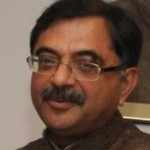
Suvendu Adhikari is a rare politician who has demonstrated humility, ideological commitment, an unapologetic stance on Hindu assertion and a vision for moving forward. Although I have never met him, I feel he is the rightful inheritor of Syama Prasad Mookerjee’s legacy.
Many may not remember that the first-ever government with a saffron coalition, known as the “Syama-Huq Ministry,” was formed in 1941. Dr Syama Prasad’s Hindu Mahasabha partnered with the Krishak Praja Party (KPP) of A K Fazlul Huq. That administration saw four members of the Hindu Mahasabha and five from the KPP taking ministerial berths, with Mookerjee serving as finance minister and Huq as chief minister.
Eighty-five years after that coalition, this is the first time a Hindutva nationalist party has formed a government in Bengal on its own, without a coalition partner, placing the followers of Syama Prasad in complete control of governance. During these eight decades, Bengal has journeyed through extreme upheavals: the Calcutta Direct Action Day, the Partition of Bengal, the formation of East Pakistan (which re-emerged as Bangladesh), Naxal violence, the Marichjhapi massacre and a massive influx of illegal infiltrators.
Throughout this time, the political leadership, from the Congress to the CPM and TMC regimes, remained at loggerheads with and fiercely opposed to Hindutva ideology.
The significance of an absolute majority for a Hindutva-led regime in Bengal must not be lost on anyone. For seventy-nine years after independence, the administrative setup, the ruling elite, the Bhadralok and the law enforcement agencies have been fed a single line of power: keep Hindutva at a distance. They were taught that it was “poison” and must not be facilitated.
When the British ruled Bengal and made Calcutta their first capital, they sought to convert the Hindu elite into servile “Babus” (a term essentially ‘made in Bengal’).
They divided society into Hindu-Muslim extremes, loathed the Hindu Bhadralok’s yearning for freedom and corrupted the name of Shri Ram Pur into “Serampore,” making it a hub for proselytisation.
Bengal witnessed an era where British Christian missionaries propagated falsehoods against Hindus, calling them “heathens,” “pagans,” and “rope-trick magicians.” This infuriated Swami Vivekananda, who chided them, saying: “You are not Christians; go back to Christ.” They hated our Dharma and our language, forcibly imposing English through Macaulay’s conspiratorial orders. Their disdain was so profound that they brazenly oversaw a famine that took the lives of three million Bengalis.
But Bengal never yielded.
The most rebellious voices rose from this land: revolutionaries, spiritual rejuvenators, and uncompromising Sanatan Dharma thought leaders. From Bankim’s Anandmath and Vande Mataram to Vivekananda’s “Cyclonic Hindu” clarion calls; from Sister Nivedita, Tagore, and Subhash Chandra Bose to Syama Prasad Mookerjee and Kazi Nazrul Islam—thousands of revolutionaries kissed the gallows chanting Vande Mataram. Bengal never compromised with alien ideologies. Despite British imperial power, Islamic severities, and Marxist vagaries, not a single soul could snatch Durga Puja from a Bengali Hindu home. Today, Durga has taken her place of honour with renewed grandeur. There was a time when assertive Hindus felt they were living under an Arab regime, so much so that the greatest Hindu organisation, Ramakrishna Mission, had to submit an affidavit in court declaring they are not Hindus just to have the Bengal government educational grant continued.
Long before the decline of the Hindu Mahasabha, RSS pracharaks began their work in the 1940s. RSS founder Dr Hedgewar had his medical college training in Calcutta, and there he joined Anusheelan Samiti. Keshav Rao Dixit and Shrikrishna Motlag were the early RSS “monks,” followed by stalwarts like K S Sudarshan and Mohan Bhagwat, who worked for Hindu solidarity in the unassuming style characteristic of the Sangh. They inspired thousands of Swayamsevaks and initiated the work of the Vishwa Hindu Parishad, Kalyan Ashram, and the Jana Sangh.
Dr Syama Prasad Mookerjee was chosen by the RSS architect and second Sarsanghchalak, Shri M S Golwalkar, to be the founder-president of India’s first Hindutva party, the Bharatiya Jana Sangh. In 1952, Mookerjee and Durga Charan Banerjee became the first two Jana Sangh MPs elected from Bengal.
An illustrious son of the soil, Mookerjee fought for India’s unity and the absolute merger of Kashmir with the rest of the country, eventually sacrificing his life in 1953, an event many believe was a premeditated murder.
The BJP ruling Bengal today is the avatar of Mookerjee’s Bharatiya Jana Sangh. The new Chief Minister, Suvendu Adhikari, defeated Mamata Banerjee in Mookerjee’s home area, Bhowanipur.
After taking his oath, he religiously visited Mookerjee’s home at 77 Sir Asutosh Mookerjee Road.
A word must also be said for the industrious Marwari community of Bengal, which has virtually nourished the state’s socio-political and cultural life. Though often much maligned, their homes and coffers have been open to Hindu causes for ages.
Stalwarts like Bhaurao Deoras, Nanaji Deshmukh, Atal Ji, and L K Advani all had designated Marwari homes in Kolkata where they stayed before the era of hotels. Hindu life in Bengal was consistently enriched by the unassuming, low-profile Marwari Bhaiji.
PM Narendra Modi and Amit Shah have achieved what was, until recently, deemed impossible.
They demolished an eighty-five-year-old wall of hate and isolation against Hindus. This victory has rattled anti-India elements both at home and abroad. Post-1947, two primary milestones define the march of Hindutva forces: first, the Ram Mandir at Ayodhya and second, this victory in Bengal.
Suvendu Adhikari now faces the task of freeing Bengal from fossilised anti-Hindu elements and detoxifying the state apparatus. He carries the burden of purging seventy-nine years of “secular” toxic influence – post 1947- that has permeated the state machinery. It is no easy task, but the detox war has to begin.
Disclaimer
Views expressed above are the author's own.




Top Comment
{{A_D_N}}
{{C_D}}
{{{short}}} {{#more}} {{{long}}}... Read More {{/more}}
{{/totalcount}} {{^totalcount}}Start a Conversation