- News
- entertainment
- hindi
- bollywood
- Rajasthan was a must for my film: Imtiaz Ali
Trending
This story is from May 8, 2013
Rajasthan was a must for my film: Imtiaz Ali
The director tells us why shooting in Rajasthan was a must for this movie…
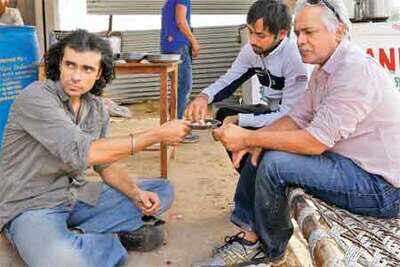
Filmmaker Imtiaz Ali was quite sure he was going to make another big-budget film with actor Ranbir Kapoor post Rockstar. But a chance encounter with an old script of his, which had been eating dust for quite sometime, made him take up the challenge of shooting on the highways of not one, but six states.

Hitting on the roads of Delhi, Haryana, Rajasthan, Punjab, Himachal Pradesh and Kashmir, Imtiaz and his crew comprising Randeep Hooda and Alia Bhatt, Anil Mehta (director of photography) would on to the highways of India to capture real location.
The filmmaker who has extensively shot for the film for 15 days non-stop at locations like Sambhar Lake, Bikaner, Pupan, Ajmer and outskirts of Jaipur. “My story is about highways of north India. So, Rajasthan was a must for us. Over the years, it has evolved as a state. It no longer is as arid as it used to be, it is greener than before, now mustard is cultivated here. I wanted to project the new emerging state in my film. Coupling highway and some scenic locations, we have done some attractive shoots,” says Imtiaz. He adds that the idea of shooting here was to get good visuals, and creating a lively atmosphere that depicted a layered culture. “And this was possible only in Rajasthan,” he adds.
Well, it’s not just Imtiaz who has come to Rajasthan for his road trip film. Rajasthan has always held a fascination for filmmakers down the years. In 1974, Satyajit Ray made a detective movie for children titled Sonar Kella (The Golden Fortress) and shot many scenes on the roads of Rajasthan. Earlier filmmakers like Dev Benegal (Road, Movie), Ram Gopal Verma (Road), Lara Dutta (Chalo Dilli) and many others have been to Rajasthan to shoot for their road movies. So, what is it that entices them to shoot in Rajasthan?
“The desert has a soul of its own. The light is clear, the mountain ranges, the sand dunes, and picturesque landscapes, makes shooting in Rajasthan as must when it comes to this genre of films,” says actor Tanistha Chatterjee, who has shot for Road, Movie and Dekh Indian Circus here in Rajasthan. Chatterjee, who shot for Road, Movie in the peak of summer feels that the association of highways of desert areas to a film’s script adds a certain flavour to the film. “There is a certain type of romanticism associated with such shoots. And that is reflected in the films. We started from Jodhpur and travelled via Jaisalmer to Bhuj, during the peak summer. It was challenging, but when you see the film, you will realize that it was worth it,” she says.
Perhaps its the magic world of desert coupled with the prospect of some mind-blowing cinematography that brings the filmmakers to Rajasthan. “The silence of the desert adds on to the mystique of Rajasthan. The fact that the traditions that we have lost as a country are still alive over here, make it more interesting for those wanting to capture the landscape of this state,” says filmmaker Pooja Bhatt, who has shot some portion or the other of almost all her films, even Jism, here.
“One of my upcoming films will capture not only the roads but the spirituality of Rajasthan too. It’s the story of two young women who meet with a catastrophe, while travelling to Ajmer Sharif, and then how they take on to the roads of Rajasthan. It’s a bit non-conventional, but is exciting me a lot,” says Bhatt. “It’s the aesthetics and logistics that bring them here,” says film historian Gayatri Chatterjee. According to her, Rajasthan’s flat terrain with scant vegetation provides a vast horizon that can take on the most romantic or desolate or even a mysterious look, depending on what the filmmaker wants to show. “It’s a big state with lesser population, so the vast back drop, lesser cars in a vast space creates a sense of freedom, upbeat mood and even prepares people for an adventure trip,” she says.
(With inputs from Aditya Mukherjee)
End of Article
FOLLOW US ON SOCIAL MEDIA







Photostories
entertainment videos
Featured In Movies

Popular Categories
Entertainment NewsBollywood NewsTollywood NewsKollywood NewsMollywood NewsMovie ReviewsLatest Hindi MoviesLatest Tamil MoviesMX PlayerParenting TipsHome RemediesWeight LossBeauty TipsParenting TipsHindi VideosHindi Video SongsBhojpuri Music VideosLatest Telugu MoviesBhojpuri Music VideoHindi TV News
Trending in Entertainment
Latest MoviesBollywood MoviesHollywood MoviesTamil Movies 2024Telugu Movies 2024Malayalam Movies 2024Kannada Movies 2024Marathi Movies 2024Bengali Movies 2024Top Rated Movies 2024Best Hindi MoviesBest English MoviesBest Telugu MoviesBest Tamil MoviesBest Malayalam MoviesBest Kannada MoviesBest Bengali MoviesUpcoming Hindi MoviesBest Movies Of All TimeBest Hindi Movies of All Time
Trending in Etimes
Horoscope TodayNumerology Predictions TodayWalz Vs VanceJD VanceKamala HarrisPopulated Indian CitiesAlcohol Cancer RiskNational Boyfriend Day 2024Sunita WilliamsDepression RiskNepal FloodBarbra StreisandSnoring Prevention TipsDonald TrumpMagnesium DeficiencyRelationship TipsLake Michigan DiscoveryRelationship TipsEkadashi in October 2024
Trending in TV
Trending in Lifestyle
Trending in Regional
Movie Reviews
Binny And Family ReviewLove, Sitara ReviewWill & Harper ReviewWolfs ReviewYudhra ReviewJo Tera Hai Woh Mera Hai ReviewKahan Shuru Kahan Khatam ReviewHis Three Daughters ReviewNever Let Go ReviewDancing Village: The Curse Begins ReviewTransformers One ReviewFirst Love ReviewBerlin ReviewThe Buckingham Murders Review
Upcoming Hindi Movies
Upcoming Regional Movies
Latest News
Long farewell: Yellow alert for today and tomorrowBigg Boss Marathi 5: Riteish Deshmukh condemns Nikki Tamboli and Aarya Jadhao's remarks on Varsha Usgaonkar and Jahnavi KillekarRevealed: The real reason Taylor Swift was missing from Travis Kelce's birthday celebrationDelhi ki festive vibe hi alag hai: Mannara ChopraPunjab AAP leader shot at during argument with Akali Dal leaderNavratri 2024 Day 5: Maa Skandamata, Puja Vidhi, Mantra and SignificanceBhumi Pednekar’s Badhaai Do co-star Chum Darang to be a part of Bigg Boss 18? Here’s what we knowBigg Boss Tamil 8: Actress Sachana Namidass to participate in the upcoming season?Amul ready to enter European market after US: MDBigg Boss Marathi 5: Akshay Kumar reunites with Varsha Usgaonkar after 20 years on the reality show; says 'You Haven’t Changed a Bit'Flash flooding kills three in northern Thailand'We just walked the talk': Suryakumar Yadav elated after team executes plans to perfectionOptical Illusion: Can you find who's the boss in this picture?Fans Fume Over Whistle Mania: How the New York Jets' Early Penalty Struggles and Aaron Rodgers' Milestone Ignite Outrage and Calls for Accountability from NFL OfficiatingBigg Boss Tamil 8: Who will be the next host?Ducking Below The WavesBigg Boss Tamil 8: Arun Prasath, the dazzling young actor set to shine in the houseIdentifying PCOS and when to seek help from professionals
Other Group Sites -
ETimes is an Entertainment, TV & Lifestyle industrys promotional website and carries advertorials and native advertising.