
- News
- Business News
- India Business News
- Double delight: Industrial output up, price rise slows
Trending
This story is from November 13, 2014
Double delight: Industrial output up, price rise slows
Industrial output growth gathered strength in September and retail inflation cooled to a fresh record low in October providing some signs of an economic revival.

NEW DELHI: Industrial output growth gathered strength in September and retail inflation cooled to a fresh record low in October providing some signs of an economic revival and bolstering the case for an interest rate cut.
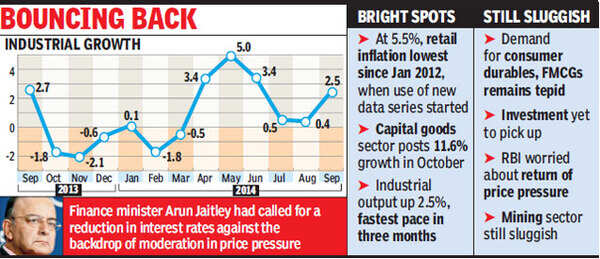
Data released by the Central Statistics Office (CSO) on Wednesday showed industrial output grew a better-than-expected 2.5% year-on-year in September, the fastest in the past three months led by a spurt in the capital goods segment.
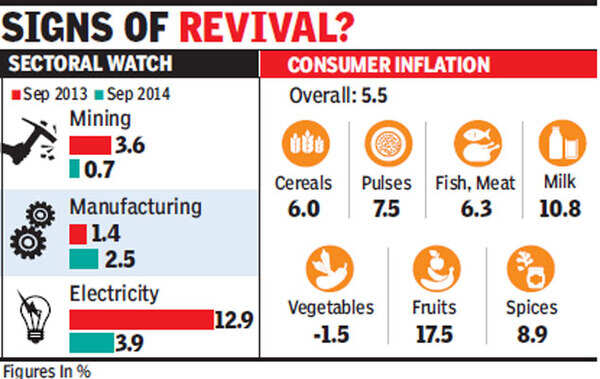
Separate data released by the CSO showed retail inflation, as measured by the consumer price index, slowed to a 5.5% in October compared with the previous month's 6.5%. The October figure is the lowest since the government started computing the new series of data in January 2012. Cooling food and fuel prices helped moderate the overall numbers.
The latest retail inflation data puts pressure on the Reserve Bank of India to cut rates when it reviews monetary policy on December 2.
The RBI has so far resisted calls for reducing interest rates citing stubborn inflationary pressures but some economists said they expect some easing in the months ahead.
"Both sets of data released this evening were better than expected with CPI easing to 5.5% from 6.5% last month and industrial output rising 2.5% from 0.5%. Given that the pace of normalization in inflation has been relatively faster than that of growth, we maintain our view of cumulative 100 basis poins easing in policy rates by FY16," said Rohini Malkani, economist at Citigroup, India.
India Inc stepped up the pressure for an interest rate cut and said the industrial output data signalled early signs of revival based on what it called "feel good factors and positive investor sentiment."
"We welcome the drop in inflation based on consumer price index and hope this would propel the RBI to reduce policy rates in its forthcoming monetary policy especially as consumer demand continues to be tepid," said Chandrajit Banerjee, director-general at the Confederation of Indian Industry.

The industrial output data showed the capital goods sector, a key gauge of economic activity, rose 11.6% year-on-year in September compared with a decline of 6.6% in the year earlier period and a fall of 9.8% in the previous month.
The consumer segment continued to remain sluggish. Consumer durables contracted an annual 11.3% in September compared to a decline of 10.6% in September 2013 while consumer goods fell an annual 4% compared to an expansion of 1% in the previous year ago period.
Some economists, however, cautioned against reading too much into the sharp moderation in retail inflation.
The inflation data showed the moderation was led largely by softening food prices. Prices of vegetables declined 1.5% year-on-year in October while overall food and beverages prices rose 5.7% year-on-year slower than the double digit levels in the past. However, prices of milk, milk products, fruits and spices continued to witness pressure.
"These numbers should be viewed with caution. First, the base effect is pronounced and will be so in November too when the CPI index peaked. These numbers could turn around in December and January when the index had come down last year. Second, the ministry of agriculture has forecaste lower kharif output for cereals, pulses and oilseeds. This being the case, there could be some upward bias on inflation in the coming months," said Madan Sabnavis, chief economist at Care Ratings.
"There is a strong case for the RBI to consider a rate cut given the continuous decline in CPI inflation numbers in the last few months. However, it has been pointed out that it is not yet time to celebrate lower inflation due to the factors mentioned above. Therefore, while a rate cut would help to assuage sentiment, the RBI may choose to defer the decision for the next review," said Sabnavis.
Data released by the Central Statistics Office (CSO) on Wednesday showed industrial output grew a better-than-expected 2.5% year-on-year in September, the fastest in the past three months led by a spurt in the capital goods segment.
In August, industrial output rose an annual 0.5%.
Separate data released by the CSO showed retail inflation, as measured by the consumer price index, slowed to a 5.5% in October compared with the previous month's 6.5%. The October figure is the lowest since the government started computing the new series of data in January 2012. Cooling food and fuel prices helped moderate the overall numbers.
The latest retail inflation data puts pressure on the Reserve Bank of India to cut rates when it reviews monetary policy on December 2.
Finance minister Arun Jaitley, in an interview to TOI, had called for a reduction in interest rates against the backdrop of moderation in price pressure. He had said reducing rates would help trigger demand for homes and revive the economy.
The RBI has so far resisted calls for reducing interest rates citing stubborn inflationary pressures but some economists said they expect some easing in the months ahead.
"Both sets of data released this evening were better than expected with CPI easing to 5.5% from 6.5% last month and industrial output rising 2.5% from 0.5%. Given that the pace of normalization in inflation has been relatively faster than that of growth, we maintain our view of cumulative 100 basis poins easing in policy rates by FY16," said Rohini Malkani, economist at Citigroup, India.
India Inc stepped up the pressure for an interest rate cut and said the industrial output data signalled early signs of revival based on what it called "feel good factors and positive investor sentiment."
"We welcome the drop in inflation based on consumer price index and hope this would propel the RBI to reduce policy rates in its forthcoming monetary policy especially as consumer demand continues to be tepid," said Chandrajit Banerjee, director-general at the Confederation of Indian Industry.
The industrial output data showed the capital goods sector, a key gauge of economic activity, rose 11.6% year-on-year in September compared with a decline of 6.6% in the year earlier period and a fall of 9.8% in the previous month.
The consumer segment continued to remain sluggish. Consumer durables contracted an annual 11.3% in September compared to a decline of 10.6% in September 2013 while consumer goods fell an annual 4% compared to an expansion of 1% in the previous year ago period.
Some economists, however, cautioned against reading too much into the sharp moderation in retail inflation.
The inflation data showed the moderation was led largely by softening food prices. Prices of vegetables declined 1.5% year-on-year in October while overall food and beverages prices rose 5.7% year-on-year slower than the double digit levels in the past. However, prices of milk, milk products, fruits and spices continued to witness pressure.
"These numbers should be viewed with caution. First, the base effect is pronounced and will be so in November too when the CPI index peaked. These numbers could turn around in December and January when the index had come down last year. Second, the ministry of agriculture has forecaste lower kharif output for cereals, pulses and oilseeds. This being the case, there could be some upward bias on inflation in the coming months," said Madan Sabnavis, chief economist at Care Ratings.
"There is a strong case for the RBI to consider a rate cut given the continuous decline in CPI inflation numbers in the last few months. However, it has been pointed out that it is not yet time to celebrate lower inflation due to the factors mentioned above. Therefore, while a rate cut would help to assuage sentiment, the RBI may choose to defer the decision for the next review," said Sabnavis.
End of Article
FOLLOW US ON SOCIAL MEDIA










Hot Picks
TOP TRENDING
Trending Stories
In Business
Entire Website
- Will banks open only for 5 days a week? Here’s what you should know about IBA’s proposal
- India set to be third largest economy, says S&P Global
- Dalal Street bull run continues! BSE Sensex crosses 69,000 for the first time; Nifty above 20,800
- Byju’s reduces notice period for employees as troubles mount
- Sensex surges over 900 points, Nifty above 20,550 as BJP state election wins bolster Modi's Lok Sabha 2024 prospects
- UltraTech to buy building materials business of Kesoram in 7,600 crore deal
- Tata Technologies stock debuts at a bumper 140% premium; share price at Rs 1200 on BSE
- Tata Technologies share allotment: How to check IPO allotment status, listing date, GMP
- BSE m-cap rides rally in Adani stocks, tops $4 trillion
- Charlie Munger, who helped Warren Buffett build Berkshire, dies at 99
- India needs to know why China disturbed peace: EAM Jaishankar
- SC: Bulldozer justice like bulldozing laws of land
- Why India is now insisting on an immediate ceasefire in Gaza
- Patient, 11, raped in Agra medical college, doctor held
- UK court finds Pakistani guilty of killing Tamil restaurant manager
- India, China to work urgently for disengagement in Ladakh
- How life froze near Delhi as a tiger walked and decided to stay
- Planning to buy iPhone 16? How much Apple will give for iPhone 12 & others
- 'Deal with it': Oppn vs BJP over PM Modi attending Ganpati Puja at CJI's house
- Leading light of Left, effective parliamentarian: PM Modi on Yechury



Popular Categories
Hot on the Web
Top Trends
Trending Topics
Alia BhattMalaika Arora Father DeathArbaaz KhanNatasa StankovicMr Bachchan OTT ReleaseNational Parks In IndiaSelena GomezGOAT CollectionVikas Sethi DeathMalayalam ProducersIndia's Best Dancer 4Simi GarewalDilli BabuIndian National ParksLaung BenefitsVikas SethiiPhone 16Microsoft 365 OutageCsir Ugc Net 2024Wordle Answer
Living and entertainment
Latest News
India successfully flight tests surface-to-air missileFintech Moneyview turns unicorn, 6th one this yearDigest this: Unhealthy gut may be linked to Parkinson’s diseaseCSIR UGC NET 2024 result declared: Steps to download scorecards at csirnet.nta.ac.inWho was Illia 'Golem' Yefimchyk, the Belarusian bodybuilder who consumed 2.5 kg of meat and 108 sushi pieces daily before his death at 36?Vijay Varma reveals he was DROPPED from 'Sacred Games' at the last minuteWWE Star Discusses Why Sid Vicious Deserves a Hall of Fame SpotCatching up with sports stars in DelhiSalman Khan surrounded by bodyguards as he arrives at Malaika Arora's mother's house to offer his condolences - WATCHCMF Buds Pro 2 by Nothing review: Big delivery on a budgetMallika Sherawat makes big screen comeback in Rajkummar Rao's 'Vicky Vidya Ka Woh Wala Video'; director reveals why he cast herArbaaz Khan spotted outside Malaika Arora's house along with police after the tragic news of her father's demise by alleged suicide - WATCH VIDEOHarvey Weinstein charged with additional crimes during hearing on rape chargesMitchell Schwartz's Cryptic Tweet Stirs Debate About Mahomes' ContractSiddhant Chaturvedi reveals he rejected Ranbir Kapoor, Alia Bhatt and Amitabh Bachchan starrer Brahmastra after father’s advice: 'He asked me, ‘Tujhe kaun dekhega?''EcoR unloads 100 million tons of goods in just 160 daysBritain’s one of the largest mobile services providers BT Group raises cybersecurity alarm: “...every 90 seconds hackers are checking…”Youth shows interest in liquor business
Copyright © 2024 Bennett, Coleman & Co. Ltd. All rights reserved. For reprint rights: Times Syndication Service